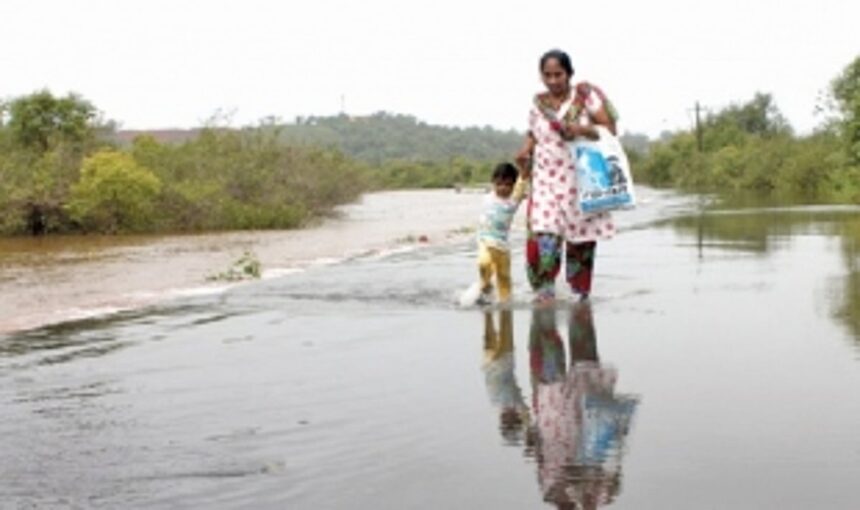
The intricate khazan land ecosystems of the island of Divar are under threat from constant inundation. The bunds, built with soft mud have been breached and will not withstand the pressure of the waves that jet skis and fast transportation vessels will bring if the River Mandovi is brought under the national waterways project. Breaching of bunds, deepening of the rivers, unplanned dredging and desilting will destroy the river ecology.
The islands in River Mandovi – Divar, Capao, Juvem, Accado, Tolto, Cumbarjuvem, Chorao, Caraim etc – are extremely fragile. Divar, like many other estuarine islands, is made of reclaimed land, basically created out of nine small islets. What we see today is a reclaimed island made out of deposited silt, a beautiful island on the River Mandovi that is now sinking, perhaps even returning to its natural formation.
The residents of Divar have silently watched the rape of their island. And the forces enjoying this scenario behind the political curtain are waiting to descend on the island and build massive aquaculture estates and luxury eco-tourism resorts.
But Divar cannot be allowed to be lost. Its biodiversity is rich and irreplaceable. Divar and Chorao and their surrounding marine areas constitute unique eco-systems, comprising animal plant species that are endemic and unique. The island can boast of a unique assemblage of life, as it is often said that islands contribute to global biodiversity, containing some of the richest treasures of plants, animals and birds on earth. (Inventory recorded by Goa State Biodiversity Board in 2014).
The water level of the River Mandovi is rising, and Divar is getting inundated through breaches in the bunds. The water has almost reached the island’s habitation area, polluting the ground water. A large number of people living on the island are dependent on the rivers and paddy fields for fishing and agriculture. Vast “varvhem” (kitchen gardens) once encircling the core of the island had abundant crops of local vegetables like onions, chilies, radish, which were sufficient for consumption at home with a little left over for sale.
But today, Divar’s farmers from silently suffer losses due to flooding of the agricultural land and helplessly watch their land recede. It may not be long, before many Divarkars may be forced to leave their ancestral agricultural land, orchards and homes and find homes elsewhere fend for themselves. Birds are already disappearing from the island, as migratory species, especially wild ducks, are hardly seen. The Salim Ali Bird Sanctuary on the other side of the river, has also seen a drop in the bird population.
The outer mangroves of Divar act as a fortification and are a defence, along with the bund, which were destroyed for deepening, making way for jetties, pontoons, cottages, platforms in the river and bunds. The Goa government had passed a resolution in the Assembly to conserve such estuarine islands in the Mandovi.
In late 1990s, then MLA, Krishna Kuttikar had taken the initiative to repair some of the major bunds but the repairs were not effective. In 2017, Agriculture Department took the initiative to strengthen the bunds and tender the work. Work started from the ferry wharf (Divar-Navelim side) and heading towards north via champion Yatch Club’s eastern boundary towards Vhodli Mannos and after a stretch of a quarter kilometer was halted at regular intervals due to which the previous mud/materials was washed away.
The outer retaining wall along the bund on the river side, if its base foundation is not put to required depth. And if not professionally planed is of no use, the mud / material on the soft mud will not retain.
Dr Nandakumar Kamat, in an article years ago, had mentioned that the administration has absolutely no knowledge of the ecological history and eco-system characteristics of this island. Almost 80 per cent of the cultivable land has emerged with saline water and mangroves. Kamat’s article in 1999 regarding the negligence on the Island of Divar was converted into a suomotu petition by the High Court of Bombay at Goa (Writ Petition no 89 of 1999). The matter was also raised in the Goa Assembly (Monsoon Session 1989) and the authorities had then repaired the breaches in the bunds.
Only a comprehensive, integrated ecological security plan for the estuarine islands of River Mandovi, which will be scientifically implemented, may be with the help of NIO scientists or other experts, and the local communities and subjected to a realistic time frame, will save the roughly 17.56 km. sq. island from being erased from the physical map of Goa in the next century.
A special tag is in the offing for the islanders in the name of eco-friendly tourism. Added to the breaches of the bunds is the loud sound systems, lightings, fireworks at night that have been robbing the Divarkars of their peace of mind. Why should the villagers suffer? There are elderly people in the village who cannot bear this loud sound system of a club on the island.
Tons of garbage scattered in the river and fields, heaps of broken glass bottles thrown in the river and in the surrounding can be seen at low tide. Video footage and photographs filmed by volunteers who had accompanied at the time of inspection are evidence of it. In recent reports, NIO and Goa State Control Pollution Board confirmed that River Mandovi is highly polluted.
Divar residents learnt of rave and EDM parties, being organised by a certain group involved in commercial activities, via advertisement and announcements on social media and other networking websites. The dates for the events were 14th to 16th August 2015 and were held on the bunds of Navelim-Divar which is Eco Sensitive Zone, the area falling in the No Development Zone.
Under the garb of eco tourism, such pernicious events have taken place and blocked access to this part of the island by breaking the bunds and they had made that part of land accessible only by boat thereby restricting any supervision from any authority to this site.