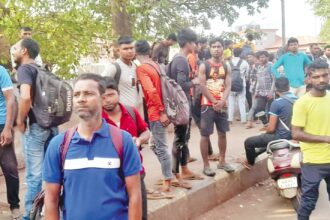
Drug addiction is a bigger challenge than militancy in Jammu & Kashmir today, the state’s director general of police, Shesh Paul Vaid, told a news agency on November 16.
Drug seizures have increased and the number of cases being registered under the Narcotic Drugs and Psychotropic Substances (NDPS) Act, 1985, for peddling and smuggling of banned substances are rising, said Vaid.
Over the last “five to six years,” 968 quintals, or 96.8 tonnes, equivalent to 12 truckloads (at 8 tonnes per truck), of narcotic drugs have been seized, the state’s home department revealed–in an order issued on September 25, asking police officers to follow standard operating procedure while dealing with cases registered under the NDPS Act.
Despite the seizure, “the problem has not received due attention of investigators and the prosecutors,” the order said. “As a result the number of acquittals in such cases greatly outnumbered the convictions, as for every conviction there are about nine acquittals.”
Between 2014 and August 2017, 118 kg of heroin was seized, according to Vaid. In the same period, as many as 18,435 drug addicts reported for treatment at the two hospitals associated with the Government Medical College (GMC) in Srinagar and a Drug De-addiction Centre (DDC) run by the Jammu & Kashmir police in the city, official data at the two hospitals and DDC revealed.
The numbers may not seem alarming for a region with a population of 7 million but only a small percentage of those who are addicted land up for treatment, Muzaffar Khan, director of the DDC, pointed out.
“In the early 1980s, when doctors at a Srinagar Hospital found that a patient was a heroin addict, it was such an unusual experience that the matter was brought to the notice of the then chief minister,” said Arshad Hussain, a leading psychiatrist in Kashmir who treats mental health patients at the two GMC hospitals in Srinagar.
The subcontinent was dealing with an opioids boom in the 1980s, but Kashmir stayed trouble-free, Hussain pointed out. Now, he and his colleagues are witnessing a very different situation, he added.
Vaid’s statement did not elicit any response from political parties, civil society groups or citizens. This could imply widespread knowledge of the problem. It could be also because of the general cynicism with which citizens here greet statements made by security agencies, often accused of twisting Kashmir’s political narrative.
But the state’s judiciary and civil administration have expressed concern over the growing drug menace. On August 20, 2017, the Jammu & Kashmir high court directed the state government to “revisit the issue relating to control of drugs as per the experience gathered from other states and various international forums dealing with the control of drug addiction”.
In September 2017, chief minister Mehbooba Mufti directed senior police officials to use the most draconian laws, including the Public Safety Act (PSA)–a law under which a person can be detained without trial for up to two years–against those involved in the cultivation and smuggling of drugs.
Drugs easily available, poppy cultivation spreads across Kashmir
The most important reason for growing drug addiction is the easy availability of drugs, said Hussain.
“There are some rural areas where buses do not go but opioids do. And cannabis is available more easily than cigarettes,” he said. “We need purposeful policing if we have to stop the circulation of drugs.”
That poppy and cannabis cultivation is spreading is confirmed by official agencies as well. “Some years ago, poppy cultivation was restricted to Kashmir’s southern parts. But, poppy cultivation has now spread to the northern and central parts of the region as well,” said Shamim Ahmad, an officer with the state’s excise department. He leads a team that is tasked with destroying poppy and cannabis crops.
Many farmers in southern Kashmir have been growing poppy to supplement their incomes since at least the late 1980s, finding a ready market in nearby states such as Punjab, Haryana and Rajasthan. Law enforcement agencies have been taking action, even destroying crops, but they haven’t been able to prevent the spread of poppy cultivation in the state.
Farmers manage to conceal poppy or cannabis among other crops and in tree plantations.
In 2016, 180 kg of charas (a product from the resin of cannabis plant), 546 kg of fuki (a powdery substance made from poppy seed) and 4,161 kg of poppy straw (the husk left after opium is extracted from poppy pods) was seized, police claim. This is in addition to seizures of synthetic drugs such as heroin and brown sugar. In 2016, more than 550 cases involving synthetic drugs were registered.
Political unrest, growing unemployment and drug use
Relentless conflict, stress and collapsing governance can often lead to rising levels of drug addiction in a population, as IndiaSpend had reported in this November 12, 2016, article on Manipuri women. Even in an otherwise prosperous and orderly state such as Sikkim, high unemployment levels could cause rampant drug addiction, as IndiaSpend reported on March 18, 2017.
All these problems, from conflict to unemployment, are prevalent in Jammu & Kashmir. Political and armed conflict has had an adverse impact on the state’s economic growth and infrastructure development, according to the 2016 Economic Survey of Jammu & Kashmir.
The unemployment rate in Jammu & Kashmir is 24.6% (in the age group of 18 to 29), nearly twice as much as the all India average of 13.2% for this age group, the survey said.
The survey showed that nearly 1.8 million adults (45 per cent of the adult population) in Kashmir are experiencing symptoms of mental distress, with 41 per cent exhibiting signs of probable depression, 26 per cent probable anxiety and 19 per cent probable post-traumatic stress disorder (PTSD).
‘I want to get over drug use, I want to study’
Three years ago, Waleem (name changed to protect identity), a university law student in Jammu & Kashmir, took to drugs to deal with a broken relationship. Today, Waleem, who once aspired to become a top lawyer, has not completed his degree, and his family is in distress. His expensive drug habit, which includes heroin and brown sugar, have eaten into his mother’s savings.
Waleem is being treated by psychologists, and his mother said that she is hoping that her son will soon recover.
At the DDC in Srinagar, we met Rustum (name changed to protect identity), a 15-year-old lean boy with sunken and bloodshot eyes. He started using drugs when he was in grade V, he said.
Rustum’s descent began when a classmate took him home when the family was out. “He took out some charas and put it into a cigarette,” Rustum said. “He smoked half and passed the rest to me. I was already a smoker, so I took it with great curiosity.”
Rustum’s father, a class-four government employee, said that his wife is depressed by her son’s addiction. “She often doesn’t sleep at night and has almost stopped talking to others,” he said. She has started showing signs of recovery after the boy was admitted at DDC, he added.
But the drug habit is hard to shake off, said doctors.
Police, administration preoccupied with law and order
A police officer, who spoke with IndiaSpend on the condition of anonymity, acknowledged police failure to address the drug problem and attributed it to the force’s preoccupation with law and order.
“Why the police are not able to restrict the circulation of drugs has a lot to do with their constant involvement in the law and order problems that Kashmir has no dearth of,” he said.
Umar Trumboo, general secretary of Civil Society Forum of Kashmir (CSFK), an NGO, agreed. “It is a fact that the political and security situation keeps changing here frequently,” said Trumboo. “The police often get busy dealing with law and order issues and that allows drug use and peddling to remain unnoticed.”
The NDPS Act provides stringent provisions for offences related to drug abuse and trafficking.
What can be done: More officers, fewer acquittals
A police official who did not wish to be named told IndiaSpend that the police force needed an exclusive anti-drug cell active in every district. “Any progress in curbing this menace will be possible only when some police officials are specifically asked to deal with drug addiction and peddling,” he said.
Speedy acquittals of drug peddlers is another issue. “In other north Indian states, a person arrested under NDPS Act doesn’t get bail for months,” said the officer. “But here in Kashmir, such arrestees secure release within 10 days.”
The CSFK’s Trumboo suggested coordination between various government agencies. “We need proper education, rehabilitation and corrective measures,” said Trumboo. “It isn’t rocket science.”
(Parvaiz is a Srinagar-based journalist.)