he tiny State of Goa is all set to lose a huge chunk of forest cover. Imagine this, of the 1424.46 sq km of forest land in Goa, approximately 200 sq km is privately owned. As per the initial estimates at least 50,000 trees will be cut as the State government chooses to go ahead with three proposed infrastructure projects.
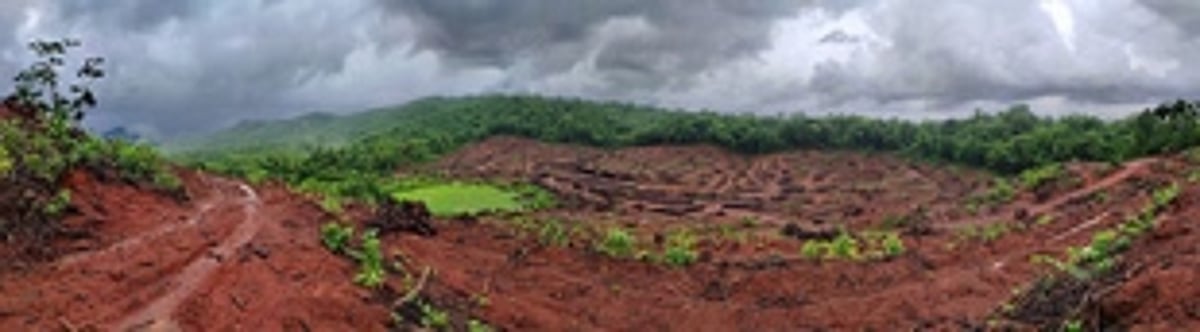
A visit to the Sangodd locality in Mollem village, a few kilometres walk from National Highway 4A, reveals how thousands of trees have been mercilessly killed for a power project. The scene was devastating, as the Herald team walked through it. Huge logs of trees can be seen placed together, while the roots still remain to reveal the sordid tale.
Locals, say they had no knowledge of any large-scale tree felling that took place only a few kilometres away; as most of the people there have continued to remain indoors due to the COVID-19 scare.
“How could these people have the heart to kill so many trees? Are they humans?” asks Madhu Gauns. He points out that the tree logs are yet to be transported and hence the people had no clue of tree felling during the lockdown.
Information reveals that the trees have been cut for a new power project of laying of transmission line at Xeldem through the Bhagwan Mahaveer Wildlife Sanctuary in Mollem.
Information further reveals that while the Goa Biodiversity Board granted its approval on December 2, 2019, the three projects – including doubling of South Western Railway track on Castlerock-Collem-Margao stretch in South Goa; four-laning of national highways over a distance of 13 km in Anmod-Mollem border area – were cleared by the Union Ministry of Environment, Forest and Climate Change only on April 6, 2020.
So it is clear that taking shelter of the lockdown, the authorities have cut around 20,000 trees in the area. Not only this, inquiries reveal that at least 21,000 trees will need to be cut and 135 acres of forest land will need to be acquired for doubling of the South-Western Railway track; and for the four-laning of the national highway, another 12,097 trees from protected areas will have to be chopped. Investigations also reveal that 33 hectares of forest and non-forest area will be diverted for the above project.
While the locals have their own reservations about the project, acting Mollem Sarpanch Sushant Bhagat says the trees have been cut at Sukhtallem Mollem for the power project and that there is no opposition. “People have not opposed the project as it would provide employment opportunities to locals,” the acting Sarpanch tells Herald.
While the Mollem sarpanch has said this, the Collem Panchayat Village Biodiversity Board have expressed their fear that the proposed double tracking of the South Western Railway (SWR), if realised would destroy the natural beauty of Dudhsagar Waterfalls at Collem.
Collem Sarpanch Manish Lambore tells the Herald team that locals are not against development projects but don’t want the village beauty and Dudhsagar to be destroyed due to the additional constructions.
“We must protect this waterfall and the village bio-diversity. A year ago, the panchayat and Biodiversity Board had written to SWR opposing any sort of construction on Dudhsagar Waterfall that will destroy its beauty,” he adds.
Lambore, who is also the chairman of the Village Biodiversity Board, feels the additional construction and felling of forests would lead to a natural disaster.
DISASTROUS, say experts
Interestingly, at a time when several green activists, conservationists and people are fighting to stop the diversion of Mhadei River and also protect the tiger species, which are already under threat, the Central government’s approval for felling of around 55,000 trees to facilitate three projects in the Bhagwan Mahaveer Wildlife and the Mollem National Park in Goa, is going to cause a further dent to the people’s fight.
Goa is set to lose around 55,000 trees and 185 hectares of pristine Western Ghats forest cover for the three projects – a highway, railway line double-tracking and a new power line. The projects, which were approved by State Wildlife Board headed by Chief Minister Pramod Sawant in December 2019, has finally got the consent from the Union Ministry of Environment, Forest and Climate Change (MoEF&CC).
Green experts warn that the projects, if they become a reality, will have a drastic impact on the Mhadei River tributaries – Rabado and Khandepar – the main feeder for the Opa Water treatment plant, which provides water supply to Panjim and Ponda.
Also, the Bhagwan Mahaveer Wildlife Sanctuary, closely linked to the Bheemgad Wildlife Sanctuary in Karnataka, is a corridor for tigers and felling of trees will cause a major habitat loss to this wild cats.
Habitat loss and ecological destructions are also something that will harm several species of birds, butterflies, mammals, reptiles, etc.
Over 150 scientists, academicians, conservationists and concerned citizens from across the country, have made an open appeal and urged Union MoEF&CC Minister, Prakash Javadekar, to reconsider the approvals that have been granted.
Renowned environmentalist and a former member of national wildlife board Rajendra Kerkar explains that the felling of trees will have two major serious implications – it will disturb the flow of Mhadei water and habitats of tigers.
“Mhadei water is the source to the Khandepar River, which supplies water to the Opa Treatment Plant. The felling of trees will dry out Khandepar River, thereby affecting the water supply to Panjim and Ponda areas,” he said. “We are fighting to protect the diversion of Mhadei River flow to Karnataka but our government seems to be out to destroy its flow within the State,” says Kerkar.
The expert adds that the felling of trees will cause disturbance and destruction to the legally protected natural habitats for tigers and other animal and bird species. “The move is a great loss to biodiversity and ecology,” he says, while advising the government that it should purchase other private land, which is within the periphery of the protected area and substitute it to the loss.
Former Chief Minister Pratapsingh Rane and former Environment Minister Alina Saldanha, who were part of the State Wildlife Board; had raised strong objections to the projects, while pointing out that it will have a castigating impact on ecology and the environment, as a whole.
Ecology expert Parag Rangnekar has pointed out serious flaws in the Environment Impact Assessment (EIA) study that was conducted for all the three projects. He claimed that while the EIA undertaken for the railway project speaks about the existence of species like birds, mammal and butterflies, it has not thrown any light on the impact the project will have on these species.
“However, the EIA done for roads has no mention about birds and butterflies. According to them, only mammal species will be affected with the project,” says Rangnekar.
The expert further adds that all the three projects, which are going through one protected area, cannot be looked at in isolation and hence there is a need to have a cumulative environment impact assessment study.
The conservationists are also alleging that the projects have been facilitated to promote transportation of coal. “All this has been done to help coal transportation,” says environmentalist Ramesh Gawas, while adding that by allowing the felling of trees, the Central government has opened the doors for 500 mining leases in biodiversity hotspot Western Ghat.