‘Go’ in Sankrit means cow and Goa derived its name from ‘Govapuri’ meaning ‘The Sacred Land of the Cows’. Welfare for Animals in Goa also called WAG is a charitable trust based in Siolim that rescues stray animals and saves their lives.
Started in 2005, the trustee/founder of the NGO Atul Sarin is a Barrister by profession and was a successful businessman in the UK before he settled in Goa in 2005.
Sarin says he came to Goa in 2000 for a holiday and while he was a beach in Pernem saw stray animals suffering. Touched by their plight, he then started feeding the stray animals but soon understood that feeding them was just not enough, so in 2005 he permanently settled in Goa and started this organization called Welfare for Animals in Goa.
Asked why he chose Siolim and not any other location, he said he and his partner were supposed to open a guest house in Siolim and so had chosen this location but then instead of a guest house he turned up opening a welfare house.
Sarin has a team consisting of Stephnie Panayiotou, Dr Upendra Kumar, Crysel Garg, Sunita Kripalani and volunteers Claira, Roshini and Kiran Salgoankar, Di Cooper, Romy Moodley, Michaela Kelemen, Rose Raymond, Susan Singh, Megha Mehta, Duncan and Linda Wick, Katrina Haris, Jenna Rpberts, Sue Taylor, Luise Crossland, Rabia Krishanan and Gita Sahn.
This NGO has a cow shelter where they rescue stay cattle and treat them with proper medication. Currently they have around 25 cattle along with other stray animals such as dogs, goats, cats and many others who were rescued from the road side. The animals are mostly without shelter and roam around on the road resulting in injuries from accidents which can be fatal.
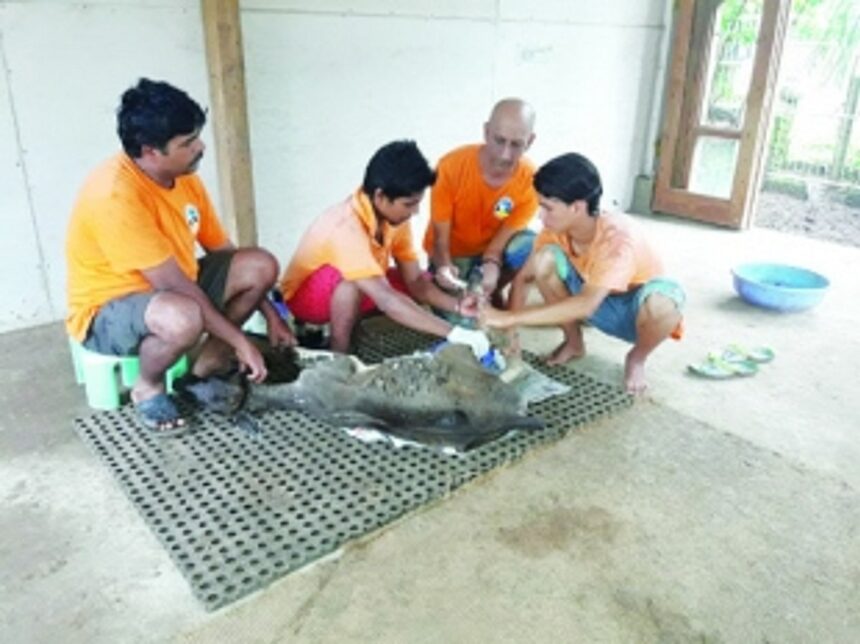
The NGO also has its own veterinary clinic where they sterilise dogs and cats and also provide homes for abandoned ones and if needed they provide medicines and ongoing support. The NGO also vaccinates and de-worms stray dogs who are not dependent on them for food.
WAG also has a Bio-gas plant, the only such plant in Goa which produces almost two cylinders per month. Along with this, the NGO also encourages people to use sustainable methods to produce product from the waste of cattle. Products such as dhoop, phenyl, and hand wash liquids, liquid cleaners are some of the products which the NGO produces to earn an income.
Their mission is to encourage local farmers to manufacture products from cow waste, which is a low investment process and can add to their income. This NGO also carries different kinds of activities for stray animals. Programs as diverse as stray cattle program, cattle sterilization program, re-homing program, semi care program, and beach feeding programs are conducted.
Even after working in Siolim for so many years and after rescuing many animals, the NGO gets little support from the local people. Sarin says that from his team of volunteers, only one is a Goan. “It’s difficult to feed and take care of so many animals when there is no proper financial help and support. Different people and organizations give us funds but that’s not enough because the expense is more and help is less,” he said.
Sarin says that now the only source through which the NGO can get help is the government. He said in the Panchayat Raj Act under section 112-A, every panchayat should establish cattle pounds and may appoint pound keepers with the approval of the director. Under section 112-b there is a penalty for allowing cattle’s to stay in the street 7 this penalty is to the person who owns that cattle and under section 112-C it is the duty of every police officer and a panchayat or BDO to seize the cattle pound if any illegalities are happening.
Sarin further said that in foreign countries the government takes the core responsibility of taking care of the stray animals who are then supported by the NGOs and other organizations, but in India the basic core itself is not functioning properly due to which one witnesses animals suffering.
“There are so many genius minds like Martin Luther King, Mahatma Gandhi, Einstein who have spoken up for animals. Not only for animals rescue but their rights and they all said the same thing that it doesn’t matter if you eat animals or you do whatever else but you must respect their life. If we don’t respect them we will not respect each other. If we can’t have the basic core than nothing can improve,” Sarin said.