Imagine a meal with only fish but no rice! Unimaginable isn’t it? Just like how a typical Goan goes crazy without the fish so does s/he without the rice! Both form staple food for Goans. A complete ‘fish-rice thali’ defines Goan culture and is an integral part of existence of every Goan.
But the pace at which Goa is losing its khazan lands, the day is not far when the staple food will vanish from the plates.
The concept of khazan land in Goa is becoming irresolute inchmeal. Farmers are crying over the issue of intentional flooding of cultivable land complaining about how the court of justice is turning a deaf ear to their complaints against ‘fishing mafias’, intolerable level of corruption, farmers struggling with issues like land transfer. These teething problems have raised multiple questions. Is it really not possible to untangle this intentionally tangled matter? Will the new government take necessary efforts to resolve the grievances of farmers before these precious lands become extinct? It is important for the government to take strict action for protecting Goa’s biggest community asset.
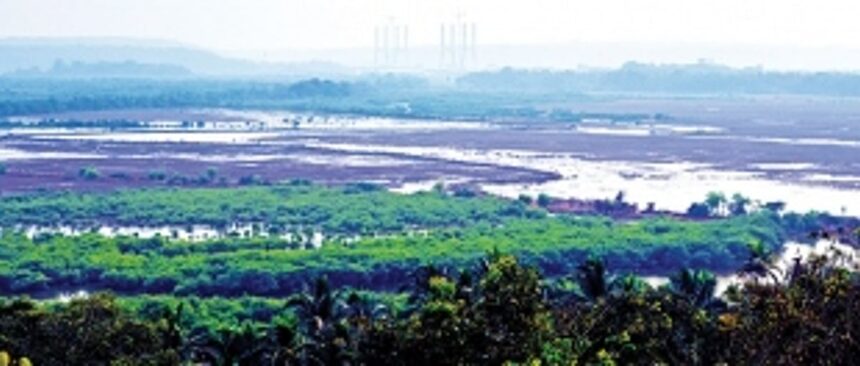
Khazan land, the estuarine agro-system occupies nearly 18,000 hectares land, of which 3,500 hectares is marshy and fallow. Khazans are the coastal wetlands located close to a mangrove-fringed estuary and are reclaimed lands recovered from marshes which are protected by dykes (bunds), sluice gates and canals. These mainly are the paddy and fish farms which are nature’s shield against tidal waves and flooding.
The crops grown on these highly cultivable lands are self-sustainable and don’t need fertiliser. Since they are sustained on compost produced from dead and decomposed leaves, the yield has ample amount of health benefits.
Explaining the concept of khazan in detail, Gaurish Naik, talathi, Oxel-Siolim said, “Khazans are vital to maintain the ecological balance. These are defined as the low lands situated at the side of creek or the river.”
The system of khazan farmlands that came into existence centuries ago is used for multiple purposes; of which agriculture, pisciculture, aquaculture and salt farming forms the major parts. These low lying lands are majorly used for growing winter (rabi) crops and monsoon (kharif) crops.
“A structured system was designed by the early settlers of Goa for smooth functioning of this fragile land. Protective barriers known as dykes/bunds were constructed between the inland riverine body and khazan area to avoid ingress of saline water into the cultivable area. The amount of saline water required to maintain the salinity was taken inside the fields using sluice gates (sluice gate refers to a wooden/metal barrier sliding in grooves that are fitted in the sides of the waterway).
Explaining further Naik said, “The excess of saline water that enters the paddy fields due to tidal influx is drained back into the backwaters (backwater is the part of river where there little or no current). This area was used for fishing. Income generated by selling fish was utilized to repair breached dykes and for maintenance of sluice gates.
“Fishing was permitted only in the backwaters, strictly at the time of low tide and was prohibited at the period of high tide. In early days, even before the Portuguese ruled Goa, this was the standard procedure followed by the committee of farmers called Gaunkaris (community farmers/communidade) in order to conserve this fragile land,” Naik said.
“Times have changed and so has the priorities. Now-a-days, fish farming is gaining more importance compared to that of paddy farming. Pisciculture is seen as fastest mode of income generation. In contrast, considerable efforts and time is needed for cultivation of paddy crops.
“Growing disinterest in growing paddy because of the manual effort required and urge of earning more money, that too faster, has adversely impacted the need for preserving the traditional culture,” added Naik.
“Intentional breaching of bund is a criminal offence and the guilty deserved to be punished. But most of times the offenders go unpunished due to lack of concrete evidence, which emboldens the violators,” the Odxel-Siolim talathi said.
Amilcar Alvares, farmer from Neura village, who was a squire during Portuguese rule, said, “Government is not taking strict action to punish those who infringe the law. Pleas of farmers are falling on deaf ears. Those who are appointed to serve justice are serving exactly opposite to what they are duty-bound for.”
“Vast area of khazan remains submerged under water due to intentional breaching of bunds making it impossible for the agriculturists to cultivate. Stringent rules must be enforced and existing Acts must be amended for effective functioning of khazan. Those involved deliberate breaching of bunds must be punished,” Alvares said.
“This was not the case in the era of Portuguese rule,” he added.
An Agriculture department official on conditions of anonymity said, “As a governing authority, we had come forward to fight against the injustice that was done to the farmers of Tiswadi. We decided to go out of the way and help those in need.
“We had decided to give our 100 per cent and resolve this issue by taking action against the guilty. The Collector had supported us whole-heartedly. But those officials who try to solve the issue honestly are transferred and thrown at the farthest possible location,” he lamented.
He alleged that the tenant associations do not conduct regular meetings. “Even if they do, they conduct it in such a way that they maintain their stranglehold on the association. Those who intentionally breach the bunds are protected by the administration. The fence itself is eating the crop,” the official added.
Corroborating the official’s allegations, one of the affected farmers, Ratnakar Naik said, “Everyone including the Panchayat body, committee members, talathi as well as Mamlatdar is hand-in-glove in this scam. Neither the general body meetings are held on time nor does the authority bother to act upon our complaints. Neither do they investigate nor do they inspect the site.”
He informed that Neura is the second largest khazan in Goa admeasuring 57 lakh square metres. “The 8 km long bund has been recently constructed by spending crores of rupees to avoid flooding of khazans,” Naik said.
Another farmer, Jitendra Sawant said, “I have been trying to get my succession right since last three years but in vain. Mamlatdar is indulging in delaying tactics by continuously giving the next date of hearing since last three years. More than 150 farmers of our village are struggling to become the part of this association in order to get the voting right. The entire administrative system is corrupt. All are venal.”
“The lobby of ‘fish mafias’ in conjunction with the administrative officials are leaving no stone unturned to delay the process of giving succession right to the farmers. Many farmers of our village have given up on transferring the land rights due to dereliction of administration.
“People with vested interests are involved behind operating the khazan in unlawful manner. The sluice gates are purposely opened at odd times leaving the fields flooded for fish ripening,” claimed Sawant.
“Another problem that arises when land is left inundated for substantial period is land infestation by mangroves. Since felling of mangroves is banned, it becomes much difficult for the farmer to cultivate the section of land due to flooding,” he added.
Adding further Ratnakar said, “Out of 750 tenants, only 34-35 are part of Neura Tenants Association, which doesn’t even come up to 10 per cent of the total. The association has created an illegal vote bank by adding eight names of non-agriculturists to the tenants list.
“We have lodged a complaint against this illegality but we haven’t received any reply till now,” he added.
Throwing light on the concept and responsibilities of the tenants association formed by the government for management of khazan, Sanjeev Singnapurkar, a designated Awwal Karkun, said, “Tenants association is a local body of farmers formed to ensure the proper functioning of khazan area. This local body of agriculturists is responsible for the maintenance of khazan land and is accountable to carry out all the formalities such as approaching the concerned government authority for sanctioning of schemes, availing financial assistance for maintenance of sluice gates, bunds etc.”
Adding he said, “The major portion of Goa’s khazan being in the custody of government, the tenants associations are registered with the government and are administered by the Mamlatdar, office of district Collectorate.”
Khazan farming is practised at multiple Talukas in Goa including Canacona, Pernem, Salcete, Bicholim, Ponda, Bardez, Tiswadi, Mormugao, Dharbandora, Sattari and Sanguem of which Tiswadi, Pernem, Bardez forms the major ones.
“A portion of khazan in Goa is privately owned while a part of it is owned by the comunidade in joint ownership of private individuals and religious institutions. The major portion of which is under the control of State government (comunidade land),” Naik said.
“The traditional farmers are losing the right over leased land either due to the ownership issues or due to delay in the transfer of leased land,” informed Singnapurkar.
Explaining the procedure of transfer of leased land (lease refers to transfer of a right to enjoy the land for a specified or unspecified period of time and in consideration of rent) Singnapurkar said, “As per the Agriculture Tenancy Act – 1964, (tenancy refers to the relationship of landlord and tenant) the agricultural activity must be given the highest priority.
“To include the name of successor in the tenants list, it is essential that one provides the ‘succession deed’ that is to be placed before the committee members which in turn is forwarded to office of Mamlatdar for further process”.
According to the Agriculture Tenancy Act, only one member of the family who is succeeding heir of the departed farmer can get the right to cast a vote in the elections of Tenants Association.
“The process of transferring the lease right can take half-year or more depending upon the time taken to receive the clearance from concerned authority,” informed Singnapurkar.
“Now-a-days, delay tactics are played to obstruct the process of this land transfer to the successor by those who don’t want to see farmers in the Tenant Association,” he claimed.
Generally, farmer should be given full right of every component pertaining to khazan; be it related to the bunds, formation of local association, operation or auctioning of sluice gate and other.
“Ethically, all the rights must be reserved with the farmers but alike,” the Agriculture department official added.
He further claimed that the Mamlatdar connives with those indulging in illegalities and manipulates the election process of Tenants Association.
Viresh Borkar, a farmer of Neura and newly elected Revolutionary Goans Party MLA from St. Andre constituency said, “We had approached the authorities a several times complaining about the deliberate flooding of khazans. They have always turned a blind eye to our grievances.”
“As an elected representative, my first priority will be to solve the issue related to khazan. Our research to promote traditional techniques of farming for protection of khazan is already on, the implementation of which was not fully in our hands since the authorities were not in support of local farmers,” Borkar said.
“Being an elected representative, I can now put in all the efforts by taking suggestions from the elders about the traditional methods they used to practice to cultivate the khazan land. Revival of khazan will now be my first priority,” the newly elected MLA said.
Mamlatdar of Tiswadi Taluka Dashrath Gaus however rejected the allegations by farmers by saying, “We deny all the allegations.”
At the Department of agriculture, Herald learnt that any repair work of bunds is undertaken by the soil conservation division (SCD).
Dattanand Kamat, Assistant Engineer, SCD informed, “Bunds are notified by the Revenue Department (RD) and maintained by the SCD. The technical guidance and financial assistance is provided by the SCD to the farmers who approach the government for repair of breached bunds, subject to the conditions.”
“Not everything that is related to khazan falls under our jurisdiction of SCD,” he added.
“Mamlatdar deals with auctioning of sluice gates and handles the accounts related to khazans. Department of Fisheries hardly deals with the matters related to khazan,” an official of Directorate of fisheries replied on conditions of anonymity.
In the year 2020, the Directorate of Fisheries had written to the government recommending that the State government should put aside some section of fertile khazan land for aquaculture and some for agricultural activities. The Directorate of Fisheries had suggested this at the time of drafting the Khazan Management Plan.
“The suggestion given by us was struck down by the government in a prompt reply they had sent to us. We have re-drafted and re-sent it hoping to receive a positive reply,” added Shamila Monteiro, Director of Fisheries.
The concerned authority at the Revenue Department informed that it whenever grievances of farmers are received regarding breaching of bunds, the same are forwarded to the Water Resource Department (WRD) for appropriate action. The respective taluka Mamlatdar or talathi or any other officer authorised by the mamlatdar conducts inspection of these bunds and submits the report to higher-ups.
However, the farmers expressed their resentment over the lackadaisical approach of the government. They rued that every department just passes the buck to each other while issue of damage to khazan lands remains unresolved.
Unless the khazan land issue is brought under one authority, struggle of farmers will continue. Strict enforcement of law is required and need to continue motivate farmers to cultivate their fields. It is responsibility of the authorities to look into the problems and provide a concrete solution. Unfortunately, what Herald noticed was exact opposite to what was expected.
Small steps like conducting awareness drives on available schemes should be undertaken. The government must form a committee that deals exclusively with the issues related to the farmers, provide compensation as fast as possible to farmers who have lost their crops due to natural calamity.