In a tweet, RG leader Manoj Parab recently congratulated Chief Minister of Jharkhand Hemant Soren for the passing of Jharkhand’s domicile bill, known as Jharkhand Definition of Local Persons and for Extending the Consequential Social, Cultural and Other Benefits to such Local Persons Bill, 2022.
Parab called it a “historic day for native people of Jharkhand”. “We @RGOfficial_Goa have introduced a similar domicile bill for native Goans named as Person of Goan Origin Bill (POGO Bill). But @BJP4Goa @goacm called it unconstitutional,” the RG leader had tweeted.
The RG has been demanding that all Goans who were born or whose family members were born in Goa before 1961, when the state was liberated from Portuguese rule, should be declared as “People of Goan Origin” and should be given priority in the government sector for employment and other purposes.
The domicile bill, known as Jharkhand Definition of Local Persons and for Extending the Consequential Social, Cultural and Other Benefits to such Local Persons Bill, 2022, was passed in a special session following a demand by tribal bodies who had urged that the last land survey conducted by the British in 1932 be used as the basis for defining ‘locals’. The earlier cut-off date was 1985.
Under the new domicile law, people whose ancestors were living in a particular area in Jharkhand before 1932, and whose names were included in that year’s land records, will be considered local residents of Jharkhand.
But is it justifiable to correlate POGO with the Jharkhand domicile Bill considering that there are a lot of technical differences between the two? Does one need a Bill like POGO which seeks to find whether a person is of Goan origin?
“There are 27 states and union territories in India. As one country, anyone is allowed to go, stay and work or conduct business wherever they wish to. In the spirit of federalism and considering the expansion today at world level, I feel this Bill has no relevance,” Siddharth Kuncalienker, former BJP Panjim MLA said.
“We have identified domiciles very clearly. Those who are domiciles have spent a certain number of years here in Goa and we have to consider them as Goans. People who have come here, who consider Goa as their home, who have served this State are eligible to be called as Goenkars,” Kuncalienker said.
There are various dates with historical importance attached to Goa and its Liberation, which happened on December 19, 1961. Then in September of 1962 we got the Citizenship Order which granted us Indian citizenship status. February 19, 1968 is crucial if one wishes to obtain a caste certificate as the person is required to have moved here before that date.
May 19, 1974 is another significant date which is not really discussed often. Portugal and India with UN’s involvement signed a treaty on this date with Portugal recognising India’s sovereignty over Goa, which helped both the countries to re-establish diplomatic ties which were strained post-Liberation. Goa was Liberated in 1961 but there was military rule here until the first democratic government was elected in 1963.
There is no record of the documents being destroyed during the annexation. First land survey in Goa was held in 1975. In this backdrop, how does one look at the POGO Bill?
“There are two important aspects of this Bill. They are trying to define all over again who qualifies as a Goan. That is very much debatable and so are all the dates you have mentioned. Little bit of variation in the dates would qualify some and disqualify others. If we consider 1961, more people will be qualified as Goans as compared to the year 1975. The real issue with the Bill for me lies at what do you want to give to the POGO?” Advocate Pundalik Raiker said.
The POGO Bill has been compared to the other laws by RG such as Notaries Succession Act which came in 2013 but that Bill is applicable only to a certain section of the society. They pointed out another Bill in Uttarakhand where 75% reservation is given to the domiciles of the State. So now what is the difference between POGO, Notaries Act, Bill passed in Uttarakhand and the bill passed in Jharkhand Assembly?
Notaries Act neither gives nor takes away any rights from anybody. It only lays out the procedure of how the devolution of succession will take place. It is a procedural law so that law is not applicable to the POGO Bill.
The Act passed in Uttarakhand uses domicile as the basis. It does not discriminate between people. Whoever qualifies as domicile gets the benefits. More importantly, it is time bound and is valid only for 10 years. It will automatically lapse after 10 years.
What is happening with POGO is that it will grant benefits to only a certain section of the population born on or before a particular date while depriving others. That depriving part does not fit into the constitutional and federal structure. There is a tendency to break India apart in various pieces, this Bill has that exact same tendency.
People who have not read the Bill are supporting it. But the Bill is not about domicile, which means they have not read the Bill. This Bill has not been drafted by a lawyer. There are various mistakes and it is clear that it is not vetted by constitutional experts.
Even if this Bill is passed in the Assembly, they will have to call upon the Central government to issue it in the 9th Schedule, which is impossible. The Article 370 has been removed by the Indian government to integrate Jammu and Kashmir in India with regards to all aspects. So, there is no way this Bill could have been passed now. The content of this Bill is unconstitutional and even if the Bill is presented in the Assembly, nobody would want to lay their hands on something so unconstitutional.
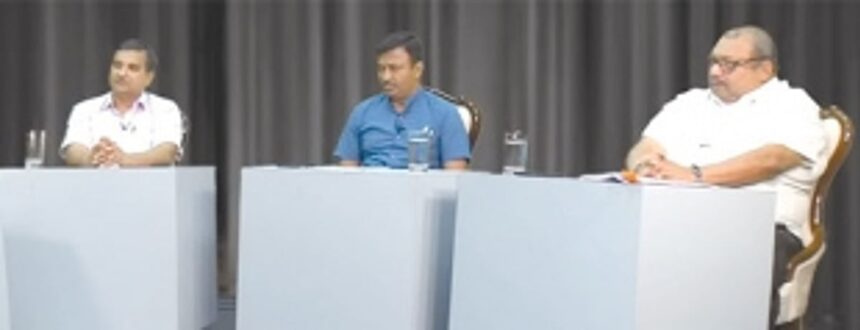
When asked about his thoughts on the ongoing dispute between Bangladeshi nationals and locals of West Bengal and a possibility of a similar dispute in Goa where people are the natives are considered as insiders and migrants as outsiders, Trajan D’Mello, who represents Trinamool Congress (TMC) in Goa, which is in power the eastern State, said, “The fact that RG was unable to send its representatives to participate in this debate, they are not in a position to defend the POGO Bill. That is a simple reading of the situation. This is because there is nothing to defend.”
“We must also understand that the idea of the Bill was not to give anyone any rights, but whip up emotions for getting votes. They played on the sentiments of certain sections of the people. That is why the Bill became such a hot topic and for some reason, people started believing that they would be benefited,” he said.
“Today this balloon has burst because they can’t even defend it. It can’t stand the sanctity of law. In Maharashtra there was a proposal for 50% reservation for Marathas, which was struck down by the Supreme Court. Just passing a Bill does not give you any right. It is all politics and they have succeeded in it to some extent. But they are unable to take it any further. The Goans are known to be emotional and trustworthy and RG took advantage of this by hyping the matter,” D’Mello said.
Those with Portuguese citizenship can also be defined as Goans. The issue of citizenship is not a State subject. It is under the purview of the Ministry of External Affairs. Issue of citizenship can never be taken up in a State Assembly. The Home Ministry and Foreign Ministry are supposed to take the decision in this regard. Citizenship is a Central government’s subject just like defence.
Trajan D’Mello said that emotions have taken over reasoning. That is why RG has benefited from it to a certain extent.
Siddharth Kuncalienker said that there is a certain section of the people who will always fall for sentiments.
“Those who leave their hometown in search of better opportunities always feel connected with their native place. Despite all this achievements, he would want his village to remain as it is. He probably doesn’t want to understand that his village also has its own aspirations and needs development. This section is the target for such bills,” Kuncalienker said.
He said that insistence for POGO Bill is pure appeasement by RG. That is why they did not participate in this debate.
“Actually they should have been keener on participating than the others as they are the ones to come up with it. It means even they have realised that they have been exposed,” the BJP spokesperson said.
Advocate Raikar said that the bill was not tabled in the Assembly and an issue was made out of that. “What if the Bill was actually presented in the Assembly and was legally defeated? They would have protested saying that the Bill was intentionally thrown out and according to me, if we see from a political point of view, they would have gotten more mileage. There is no point debating on something on the floor of the Assembly, which is unconstitutional,” Adv Raikar said.
The BJP spokesperson said that the Assembly is a platform to deliberate on only constitutional matters as it is the supreme platform of the State. It can’t afford to debate anything unconstitutional.
When asked how POGO issue germinated, Trajan D’Mello referred to the issue of Special Status for Goa.
“All the parties were united for it and a delegation went to Delhi under late Manohar Parrikar. BJP rule at the Centre would have made it more accommodative. But since the Centre already had plans of removing the special status of Kashmir, how would they have granted the same to Goa? If that is never granted, how can POGO ever be accepted? You can’t be giving special status to one State and withdrawing for another and that is why BJP brought everything at a par, let us accept that. Now whether that was right or wrong is an entirely different topic,” he said.
Adv Raikar said that the special status for Kashmir is an entirely different thing. Otherwise, there is special status granted to Nagaland, Mizoram under 371. That is done constitutionally. However the POGO Bill is blatantly unconstitutional. We are at least discussing it, if you show it to a constitutional expert he would just lift it and throw it in the garbage bin.
Trajan D’Mello responded by saying, “We are not saying that Article 371 is unconstitutional. When the government by the act of Parliament decides to withdraw it constitutionally, that is not unconstitutional. When you decide to remove the special status of one state, you can’t grant the same for another, which is why we could not understand why Goa was not being given a special status. Of Course we understood it later.”
Adv Raikar added, “If you bring irrelevant business to the House, you are disrespecting the legislature.” Trajan said it was a political gimmick.
The question now is, for how long will RG be able to take mileage from the POGO Bill issue?
Adv Raikar said, “Let us keep the constitutional part aside. Will they be able to give things which are mentioned in the Bill? There too, the bill falls apart.”
Trajan said that certain sections got carried away with this Bill, certain people got carried away with other promises. In all this confusion, POGO Bill is being portrayed as a saviour for that particular section. It was a farce.
Advocate Raikar said that whether this bill is there or not, “Goa has only 3700 sq km of area. It is smaller than Sindhudurg, which is just a district of Maharashtra. It has a unique blend of various cultures such as Portuguese, Konkani, various other Indian cultures and many want to preserve them, including me, as that is what sets us apart from the rest of the Indian states. How do we preserve it? Certainly not the way suggested in the POGO Bill.”
Goa was liberated in 1961 and the government elected by people came to power in 1963, which was led by Bhausaheb Bandodkar. In between these two years, a lot of Goan people left Goa to settle elsewhere in the world, while a lot of people from India came here which eventually led to forming a mixed culture.
So the process of identifying Goan will be troublesome to those who have left Goa and also to the people who have settled here from the rest of the country. How does one look at this scenario?
Kuncalienker said, “I would like to go back by 200 years. When inquisition took place, a lot of families were forced to leave Goa to retain their identity. There are so many Konkani-speaking Goans today who have settled in Fort Kochi and their culture has slightly changed over the period of time. But they are still Goans.”
There are some families where one sibling is still in Goa, while other siblings have settled elsewhere. “When we discuss domicile certificates, I think the issue of ‘Goenkar’ is laid to rest. There are innumerable Goa who are scatered not just across the country, but all over the world and are doing incredible work,” he said.
“It’s not like Goans did not get good opportunities. When Goa was liberated we did not even have teachers to teach. We did not have engineers to run the departments because Portuguese never developed that culture. Bhausaheb that time brought teachers, engineers from outside who shaped Goa. Everyone’s contribution has to be recognised,” the BJP spokesperson said.
So does it mean that whoever is currently in Goa, are all Goans and should be benefited equally instead of creating a divide amongst them?
“Definitely yes. Whoever has served this place, deserve to get their dues,” Kuncalienker said
Trajan said that this issue of who is Goan and who is not is going around only in political circles.
“It is the politicians who bring up this issue. It is nothing but vote bank politics. We must accept that today we have become a global village. Many of us have migrated to Mumbai. Every building in Dhobi Talao has Goan clubs. Caste, creed, culture, definition of State – all these are raked up to only divide, not to unite. Let us not fall prey to politicians like me who will try to incite people of certain sections to vote banks. And I believe that people from Goa are realising and they will think. Later on we will see that the voting pattern will be based on reasons rather than emotions,” D’Mello said.
While a lot of Goans migrated outside Goa, many migrated to Goa and
eventually settled down. What does this signify?
Advocate Raikar said that cross migration will always happen. That is part of history and it does not take place only in Goa.
“Why we notice it more in Goa is because it’s very small in size. If one rupee is taken out of thousand rupees, then it seems miniscule, whereas if you take one rupee out of ten rupees it looks like a big deal. Since Goa is so small, any change that is happening is noticed immediately,” Adv Rakikar said.
He added that now instead of harping on the issue of “insiders and outsiders”, it is important that the Bill should discuss one major issue of Goa and define the carrying capacity of Goa.
“I had told the RG’s so-called chief that instead of playing divisive politics, we all should sit together and discuss the carrying capacity of both, urban and rural Goa. Because it’s not about protecting people per se but it’s also about protecting the environment, biodiversity, topography etc. The Bill in its outlook, in its perception is very narrow,” he said.
Using divisive methods in politics to garner votes is an old tried and tested method. Often an issue is raised during election meetings to polarise the votes. What could be the political answer to such attempts to polarise the voters?
Siddharth Kuncalienker said, “I think the social development and overall development of the state is the answer to this. If the ruling government, of whichever party it might be, ensures that the money paid as taxes is going back to the tax payers through various development schemes, I think it will resolve most of the issues.”
So you the social reforms have to be fast-racked?
“Definitely. Now Adv Raikar gave a different dimension such as a carrying capacity. People like we politicians, legal experts, social thinkers have to come together. In the end Goa is really very small. Although the area is 3700 sq kms, 67% of it is green, consisting of orchards, forests, private forests etc. 7-8% are water bodies. So we are left with a narrow band of 20-22% land which we will have to utilise wisely. We have to also think of the future generations,” he said.
So instead of deciding who qualifies as Goans, we should define the carrying capacity of the State first?
Trajan D’Mello said that when you say define a carrying capacity in another way, you are saying give us a special status.
“How do you stop the carrying capacity? Are you going to block the borders? Are you going to have passports and visas? Are you going to stop people coming inside once the fixed limit of carrying capacity is crossed? You are giving a temporary solution. Instead of doing an operation, you want to put a band-aid. Point is issues like carrying capacity are just different names for special status,” he said.
Advocate Raikar said, “Let me just add something since I had raised it. Let’s say, we are defining carrying capacity for the next 10 years which is even there in the ODP. Planning is dynamic issue, it’s not static.”
Let us shed light again on what is happening in Jharkhand. If one wants to obtain a caste certificate in Goa, then the cut-off date for the same is February 19, 1968. Similarly, for Jharkhand that cut-off year was 1985 which now they have decided to make 1932, based on a survey conducted by the British during those days. In Goa, the land survey took place in 1975. Suppose the Bill proposed in Jharkhand is amended in the 9th schedule, would it be appropriate for Goa to do it on the similar lines?
D’Mello asked, “What would be the benefit of doing it and what does one get? Let’s not forget that the majority of population in Jharkhand is tribal. Whole demographic of that State is different. Instead of doing all the juggleries, there should be concrete plans like focusing on development and infrastructure. Jobs and everything will fall into place. We are diverting the issue because we cannot satisfy the other side.”
But if Jharkhand succeeds in amending, then should Goa too go for it?
“That would be a different situation and for your information, Jharkhand won’t succeed,” D’Mello said.
Adv Raikar said that the very fact that Jharkhand has passed the Bill with a rider saying they want this Bill to be added to the 9th Schedule raises doubts whether this bill is constitutional or not. Probably, some degree of politics is going on there also. In POGO, there are two major problems. One is identification and another is what rights it intends to take or give.
“As far as the Jharkhand Bill is concerned that same rule will apply. Jharkhand is just a context in which we want to discuss POGO. Section 3 of the Bill says that 100% government jobs should be for the Goans. Let us for argument’s sake say that 3 to 4 lakh people are identified as POGO as per the year 1961. Rest of the people kept outside of the purview of the Bill which is almost 70 to 80% of the population,” Adv Raikar said.
So the bill is in direct violation of the Constitution, which says a person of this country can go, stay, work anywhere as per his desire. Law always has two sides. It gives something and takes something. And this bill takes away the rights of a major chunk of the population.
“They will pay the taxes but what benefits will they get? None. It means in effect you are leaving a substantial amount of the population with only 25% of government or labour work. It’s a double whammy, which will destroy Goa’s economy, social fabric and everything there is. The one who drafted the Bill is clever, he knows that they were intending for the short term benefits,” he said.