For decades, a confessional in a church in Lithuania’s capital Vilnius kept a precious secret: a trove of documents offering an unprecedented glimpse into Jewish life in Eastern Europe before and during the Holocaust.
The cache, with documents dating back to the mid-18th century, includes religious texts, Yiddish literature and poetry, testimonies about pogroms as well as autobiographies and photographs.
“The diversity of material is breathtaking,” David Fishman, professor of Jewish History at New York’s Jewish Theological Seminary, told AFP via telephone, describing the discovery as a “total surprise”.
“It’s almost like you could reconstruct Jewish life before the Holocaust based on these materials because there is no aspect and no region and no period that is missing,” he added.
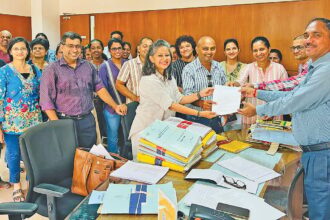
The trove was discovered earlier this year during a cleanout of the church that was used as a book repository during Soviet times.
The documents, together with a larger cache found in Vilnius nearly three decades ago, are “the most significant discovery for Jewish history since the discovery of the Dead Sea Scrolls in the 1950s”, Fishman said.
‘Jerusalem of the North’
Among the most treasured finds are several original manuscripts of poems written in the Vilnius ghetto by celebrated Yiddish poet Avrom Sutzkever, including the haunting “To My Brother”.
“We had the versions that he reconstructed from memory and published right after the war,” Fishman said of Sutzkever, who survived the Holocaust.
“Now we have the manuscripts that he actually wrote in the ghetto and there are differences — that was a very powerful find.”
An 1857 agreement between the Jewish water carriers in Vilnius and the city’s famous Ramailes rabbinic Talmudic academy, or yeshiva, offers a telling insight into everyday life 160 years ago.
In exchange for copies of the Bible and Talmud, the yeshiva agreed to let the water carriers use a room for prayers on the Sabbath and holidays free of charge.
A ledger of the patients of Zemach Shabad, a famous Jewish doctor and social and political activist whose monument stands in central Vilnius, was also among the documents seen by AFP.
‘Book Smugglers’
Established in 1925, the YIVO Yiddish Scientific Institute was among the most important. Co-founded by Shabad, it documented and studied Jewish life in Eastern Europe.
Its New York branch was founded in 1926, and became the institute’s headquarters in 1940 as Nazi Germany invaded Eastern Europe.
After occupying Vilnius in 1941, the Nazis destroyed the Jewish community and plundered its cultural wealth.
Their story has been chronicled in a book written by Professor Fishman entitled “The Book Smugglers”.
The Germans sent a portion of the plundered texts to Frankfurt, but the Jewish archivists risked their lives to hide a vast array of precious documents from their tormentors.
Then, the Soviets
But that was not the end of the threat.
After the war, a Lithuanian librarian, Antanas Ulpis, intervened to save those documents that had survived the Nazis from the country’s new Soviet occupiers, who were bent on destroying them as part of dictator Joseph Stalin’s anti-Jewish purges.
Ulpis deftly hid some of the manuscripts “under a pile of Soviet journals — that’s why no one bothered to look, that’s why they weren’t discovered sooner,” Renaldas Gudauskas, director of Lithuania’s National Library told AFP.
There they remained untouched for decades in the confessional in St. George’s Church that the Soviets used as a book repository after the war.
It was only earlier this year when any remaining papers were being cleared out in order to hand the building back to the Catholic Church that the pile of Jewish documents was stumbled upon.
History online
Library archivists, who read Yiddish and Hebrew, pore over the newly-found documents that Fishman estimates will take five years to catalogue.
They are also preparing them to be accessible on the internet.
Launched two years ago, the cyberspace history project aims to put the overall total of more than one million documents online in a digital archive highlighting Jewish life in Eastern Europe before and during the Holocaust.
© Agence France-Presse