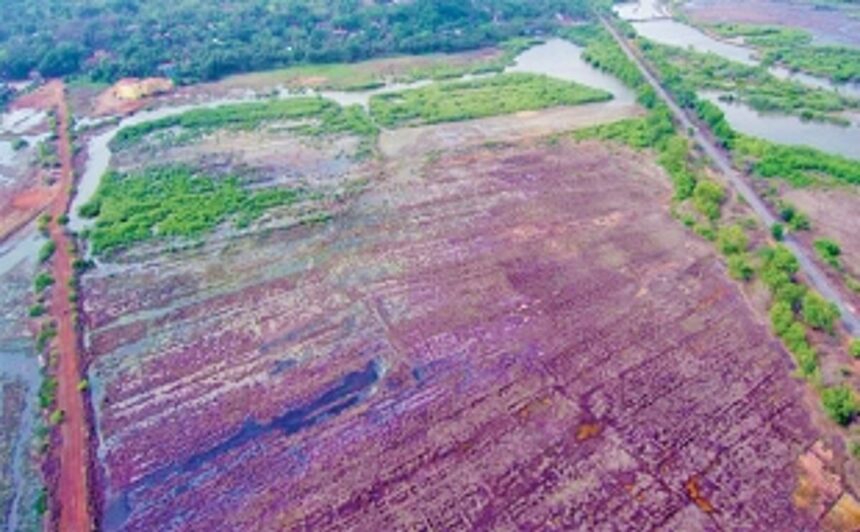
Several residents, who have been involved with agricultural activities in their village khazan land, are facing problems in cultivating their crops as saline river water has found its way to their fields, leaving it damaged.
In Nuera, a group of unhappy farmers listed out their grievances, while lamenting that farming in the khazan land of the village has been what their families have been doing for generations.
They further claimed that Neura houses the largest Khazan land from Goa and that it needs to be protected. They added that in the present times, this can ensure that the 750-odd farmers can stay self-sufficient.
What’s the problem?
When asked to summarize these difficulties, the farmers took a team of Herald reporters for a walk around the Khazan land. Here, they pointed out that a long bandh was constructed recently for a significantly large amount. However, the bandh, which was meant to regulate the flow of water and essentially block the entry of river water into the fields, has failed to serve its purpose. To explain why this is occurring, the locals showed several places where there were large visible cracks on the bandh. Water has been passing through at many places and locals allege that it was built with poor quality as it appears to be on the verge of collapsing at some spots. For instance, at such spots, it can be seen tilting while at other places it appears too weak to sustain the pressure. They lament that if the problem is occurring now itself, what will happen when it starts raining heavily or there are strong currents and that when it is high tide water could even flow above the bandh.
Further, it was revealed that the entry of saline water has discouraged locals, including several youngsters, who were into farming activities and had already begun work in that regard.
Francis Correia, local resident added that the khazan land was utilized for agriculture purposes for years and not sluice gate fishing activities! He added that farmers were cultivating the crops and that part of the produce was being used for self consumption as well. He also alleged that saline water was released into the fields since the last 15 days, at a time when the farmers were supposed to undertake the tilling of the land. “Due to this, the tilling machinery cannot be used, keeping the farmers deprived of our regular activity. I urge the government authorities to take action on this matter and give us justice,” he added.
Rising mangrove menace
Another local farmer, Jitendra Sawant, spoke about how he has been deprived of undertaking farming in his land for the last 12 years as mangroves have grown in his field. He alleged that people who are involved in sluice gate fishing tend to release the saline river water into the fields.

He also called on the government authorities to inspect the khazan land and to inspect the alleged malpractices that have occurred and are occurring in the area.
“There is a need to inspect the recently built bandh as it can be seen how it is in a poor condition and is on the verge of collapse,” Jitendra added, while criticizing the quality of the bandh.
He also touched on the topic about how many youngsters are interested in taking up agricultural activities and why the government’s timely intervention can help push such a trend.
Another resident named Silvia, said she feels deeply pained to see saline water being released into their kahzan lands.
“Our forefathers were doing farming in these fields. We were getting rice and other crops grown in our fields but now we are deprived of carrying out farming activities,” she said, while adding that they wanted to grow paddy at this stage.
Activist Viresh Borkar further added that recently had had uploaded some videos about the saline water issue following which, they decided to take a closer look. After a personal inspection, they discovered that almost 90% of the land has been submerged under the saline river water. He feared that this could damage farming activity for a long period of time.
Quality of bandh questioned
Reiterating about why the problem has been occurring, Borkar placed the fault on the quality of the bandh. He pointed out that it was supposed to get completed on April 4, 2020 but that deadline was crossed and the work is still in progress.
Questioning if it will be able to stand the test of time, he reasoned that he footing and base work was not done properly which is why the bandh had developed cracks. “During heavy monsoon and high tide, there is absolutely no guarantee that this newly-built bandh will stand tall” Borkar added.
He also highlighted the fact that the work of building the bandh is above Rs 9 crores.
“It is the duty of the government agencies concerned to keep a check and inspect the progress of the project work. It is sad to see that this project seemed to be neglected. Local people are in fear looking at the poor condition of the bandh. In some places this newly built bandh has already collapsed and in some places it is on the verge of collapse,” he added.
He further demanded that the Agriculture department, Water Resources Department should inquire and rectify the issue at the earliest.
The authorities’ version
When efforts were made to contact the sarpanch of Neura, her husband Anand Naik said that he used to cultivate the Khazan land too few years ago but due to some people being involved in sluice gate fishing, saline water was being released into the fields, which discouraged the farmers from carrying out their traditional activities.
He gave the example of how rabi crops were grown in the field, which has stopped now due to the prevailing problem.
Speaking about the measures the Sarpanch plans to take, Anand Naik said that due to the lockdown, they had not yet approached anyone but that the issue would soon be raised with the government.
Later, when the Chairman of Neura Khazan Tenant Association, Bhikaro Lumo Madkaikar was contacted, he said he had raised the issue with the contractor when he got to know that saline water was entering the khazan fields during the high tide. He said that the contractor, who is in the process of building the bandh, was told to take necessary measures. “As demanded, steps were taken to stop water from entering the fields” Madkaikar said.
When asked if he felt that saline water is purposely being released in the fields, Madkaikar refuted such possibilities and allegations and added that the bandh construction is underway and that ‘therefore may be the water enters the fields during high tide’. He also added that he along with his association members visited the bandh. He further informed that due to the statewide lockdown, they weren’t able to complain about this issue but in the near future they might refer this issue to the Mamlatdar and Agriculture department officials.
Repeated efforts were made to contact the Tiswadi Mamlatdar, Franklin Ferrao, to find out if he was aware about the matter and whether he has inspected the site, but he was unavailable for comments.