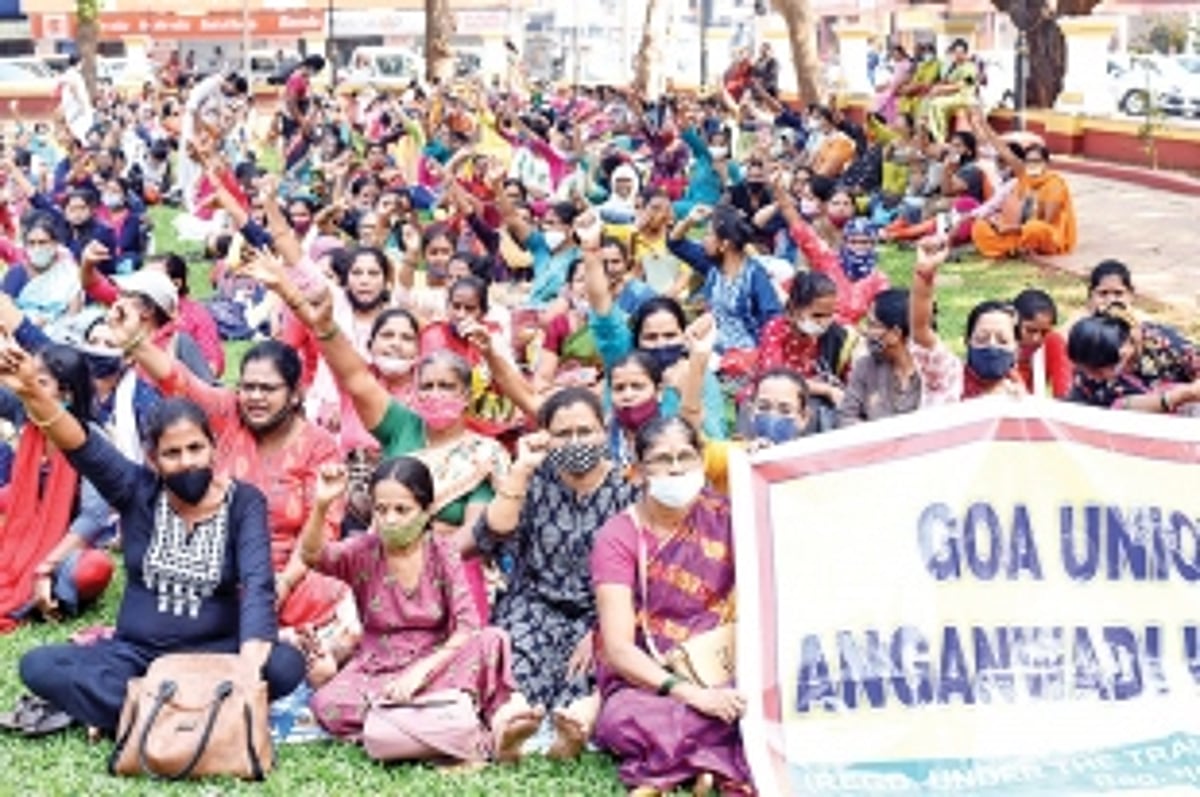
Inadequate minimum wages is a lingering issue for close to 4.5 lakh workers in the state, along with better facilities by way of medical treatment, Provident Fund, Variable Dearness Allowance, overtime, transport to the place of work, hygienic working condition, etc.
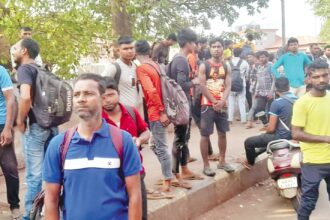
There are close to 2.5 lakh contract workers employed across various industrial estates while another 1.5 lakh are categorised as construction workers. In addition the population of migrant workers is estimated at three lakh people.
There are over 10,000 salaried workers working on contract basis in government sector, while over three lakh people where directly or indirectly employed in the mining sector, who are today struggling for survival.
Like in rest part of India, in Goa too, the workers are characterised as either organised or unorganised. Those in the former category work in larger businesses and have some formal rights – just for name sake. Then there are labourers, provided by contractors from the unorganised sector, rather than permanent workers. The owners pay the contractors who then pay workers a part of the payment they receive.
It was last in 2016 that the daily wages of the labour class was revised and fixed at Rs 307 per day. The minimum rates of wages also include Special Allowance i.e. Variable Dearness Allowance (VDA) linked to Consumer Price Index Number. Goa is one state which has not implemented it.
Alongside several other States, Goa too, had amended the Factories Act, 1948 to increase the maximum number of working hours per day from eight to 12, while exempting the women workforce.
President of Goa Convention of Workers Suhas Naik said that the present basic minimum wages ranging between Rs 307 per day to Rs 423 per day for highly-skilled worker has not been revised in the state since 2016 despite several requests from the trade unions and workers.
“Unions have asked for minimum wages of Rs 600-Rs 650 per day. Government and industries are one of the biggest exploiters of the working class. It is very important that the minimum wages are enhanced to cope up with the high cost of living,” Naik said.
Naik said that the organised workers are in a better position as they are represented by trade unions and can negotiate with employers or even government in that matter, for better services and higher wages.
“But that is not the case when it comes to workers from unorganised sector, most of whom are migrants. They struggle even to meet their daily needs. We have seen how the contractors fool these workers, who are not paid even the minimum wages as fixed,” he explained demanding that a proper system has to be followed wherein daily wages goes into their bank account maintaining the details.
According to the Center for Monitoring Indian Economy (CMIE), Goa’s unemployment rate is around 13 per cent as against the national average of 8 per cent. In such situation, the trade union leaders feel that unemployed people are at risk of exploitation.
“The increasing unemployment has enabled the employers to recruit workers at the terms and wages dictated by them,” All India Trade Union Congress (AITUC) Goa general secretary Christopher Fonseca said.
Fonseca said that Goa’s minimum wages are the lowest in the country and for the last six years it has not been revised. “The highest authority in the state is responsible for keeping the wages unrevised. The wages paid are nothing but an insult to the workers, who deserve equal pay for equal work,” he said.
In the absence of Employment Policy, Labour Policy and Industry Policy, the working class has no social or economic security.
The COVID-19 pandemic has thrown more challenges before this community. Over 25,000 workers lost their jobs with closer of industries or halting of construction and development works, etc. “The pandemic is being used as a nice cover-up to silence the rights of the workers as well as exploit them. The employer is squeezing the maximum output from the worker to fill up his company losses but workers are at same misery. There lacks humane working conditions,” Fonseca said.
The pandemic has led to mass unemployment and the government has not lifted a finger to help the people. As many as 14 central trade unions, including AITUC have said that all those people who are not in tax bracket should be paid Rs 7500 per month as long as the pandemic blooms but the government has not taken cognizance of it.
A trade union member said that Union government has plans to replace 29 labour laws with four labour codes – Code on Wages, Industrial Relations Code, Code on Social Security and Occupational Safety, Health and Working Conditions Code.
“Trade unions have opposed the labour codes as they will have castigating impact on the workers. The code favours the industries and has nothing to do to improve the working condition or economic condition of the workers,” the member said.
The villagers cum mining workers across seven iron ore rich taluka’s are looking at very bleak, very uncertain future. An estimated 2 lakh direct dependents are without wages or salaries since 2012. Another one lakh people involved in ancillary business have been severely impacted.
“They have been very, very patient. But how long one can remain without work…without pay…without livelihood…Government has failed to protect them,” Goa Mining People’s Front (GMPF) convenor Puti Gaonkar said adding ‘the living condition of these workers is very depressing and it needs urgent attention’.
Goankar has warned that government might face the hit if people turn violent and hit the street. He said that the workers under umbrella organized GMPF has done everything that was needed but nothing happened.
“Hundreds have lost their jobs, hundreds have seen their salaries halved, and many are just living on one meal a day. We are in a horrible, horrible condition,” he explained.