Manuel Francisco Xavier Fernandes, popularly known as Manuel de Santa Cruz hails from St Agostinho ward in Santa Cruz. Born to late Diogo Alfredo do Rosario Fernandes and Maria Zoriada Elvira Germack de Souza, he studied Portuguese primeiro and segundo grau in the village school and later at Liceu Nacional Afonso de Albuquerque at Panjim, where he studied upto terceiro ano.
After the Liberation of Goa in December 1961, ‘Liceu Nacional Afonso de Albuquerque’ was affiliated to Delhi Board of Higher Secondary Examination where Manuel completed his class XI. Manual took an interest in acting and singing from an early age and in 1959, he had the opportunity of performing as a child artiste in late Florence Fernandes’s tiatr ‘Atam Sampoddlo’.
Following that, his passion for the Konkani stage grew in leaps and bounds. “Every ward in the village would organise at least one tiatr practically all year-round,” he informs, adding,”St Agostinho ward did not have a tiatr to present and so I approached other wards to cast me in their tiatrs. But nobody was interested in taking me in as I did not belong to their ward. It was this rejection that prompted me to take it up as a challenge and present a tiatr all by myself.”
On January 1, 1967, with the assistance of fellow artiste Hilario de Rego, Manuel jointly penned and directed his first tiatr, ‘Axek Lagon’, and the audience heaped praises on him when it was presented in Maddir. The success of his first venture prompted him to direct another tiatr, ‘Pisuddlelem Kalliz’, on May 28, followed by ‘Maim-Sun’ on December 10. “I made a hat-trick with those three tiatrs,” he says.
At this juncture, Manuel garnered the attention of other writers and directors, who had once refused to cast him in their tiatrs. Those directors started offering him pivotal roles in many tiatrs staged in the village and neighbouring places.
Manuel’s interest in social work at the village level as well as his keenness to support social causes took him towards politics. He canvassed extensively for separate identity of Goa and toured north Goa during the Opinion Poll, addressing public meetings along with United Goans stalwarts like Dr Jack Sequeira, Ananta Narcinva Naik, Erasmo Sequeira, Orlando Lobo and Jagdish Rao, who helped him to come in the limelight.
A new genre of tiatr in the form of khell-tiatr were presented and it was in the late ‘70s that those presentations started receiving attention. Alexander Noronha chose Manuel for a powerful role, which revolved around the story theme ‘Ekvottan Somplo’. In 1980, Manuel penned and directed another tiatr, ‘Bhav Bhav ani Zau Zau’, which was rated as one of his best and it received a great response from the audience. He also acted in several tiatrs written and directed by Peter Barbosa, Frank de Santa Cruz, Candido Araujo and others.
To showcase his talent before a larger audience, Manuel decided to take part in tiatrs staged for Kala Academy’s annual tiatr competition. He made his entry in Caetano Pereira’s tiatr ‘Tukaim Tench’ in May 1980, where he was adjudged as the best actor. In 1981, he acted as a ‘bhatkar’ in Ping-Pong (Lawrence Rod’s) tiatr at Aldona-Carona and played the role to perfectionwithout any rehearsals.
In 1982, Manuel went to Kuwait in search of greener pastures. During his time there, till 1990, he was never recognised as a tiatrist and never attempted to script or stage tiatrs. Instead, he served as a commercial assistant in a private firm, Rezayat Trading Company.
In May 1990, when Manuel suffered facial paralysis, he returned to Goa for treatment. After he recovered, he was set to return to Kuwaitin August, but at that juncture, Kuwait was invaded by Iraq and he was forced to stay back. “All Goans returned home,” he reveals, “and while in Goa, the Goa-Kuwait Solidarity Centre was formed with Anthony Veronica Fernandes as the Convenor; meetings and morchas were carried out in favour of Kuwait.”
“The Liberation of Kuwait happened on February 26, 1991,” Manuel relates, “and my old company in Kuwait refused to take me back due to my involvement in the movement. But Caetano Rebello, who was also involved in the movement and was serving as personal manager at Doodai Trading Company, assisted in arranging a visiting visa for me.”
Manuel returned to Kuwait in 1992 andgot a job as a secretary in the same company. He served as a secretary to the general manager till 2010. In December, due to a family tragedy, he resigned and returned to Goa.
During his stay in Kuwait, Manuel came to be known as a tiatrist thanks to the efforts of his fellow villager Dominic Araujo, as well as Brazinho Soares, who wrote a piece on him and his contribution to tiatr in Konkani monthly ‘Gulab’. When Kuwait Konknni Kendr organised a musical show-cum-opera with the assistance of Rosary Ferns in October, 2003, he was a part of the show.
When Kala Mogui Kuwait organised a competition of Konkani songs with a play ‘Mafi Magtam’ by Dominic Araujo, Manuel was invited to play the role of an uncle. In tiatr ‘Tukai Tench Ravta’ by Rafael de Majorda, he enacted the role of a doctor.
In September 2003, Manuel featured in Laurente Pereira’s tiatr ‘Lokanchim Tonddam Bond’, followed by tiatrs ‘Almachea Disa’ by Marcus Vaz and ‘Ghor Bandlem Ghorabo Moddlo’ by Rosary Ferns, where he enacted the role of a priest. He also acted in Laurente Pereira’s tiatr ‘Hea Ghorachim Daram Bond’.
In 2006, when Kuwait-Goa Tiatristanchi Sonvstha was formed, Manuel was appointed as the VicePresident; the organisation annually organised a musical show in Kuwait.
In September 2012, Manuel acted in Menino Araujo’s tiatr ‘Karanna Viret’, which was presented at Kala Academy’s tiatr competition. In February 2013, he participated in the Lenten show ‘Bhavartachi Poinn’, presented by the parishioners of Santa Cruz, and in May 2015, he was last seen in Peter Barbosa’s tiatr ‘Mhozo Tiatr Somplo’.
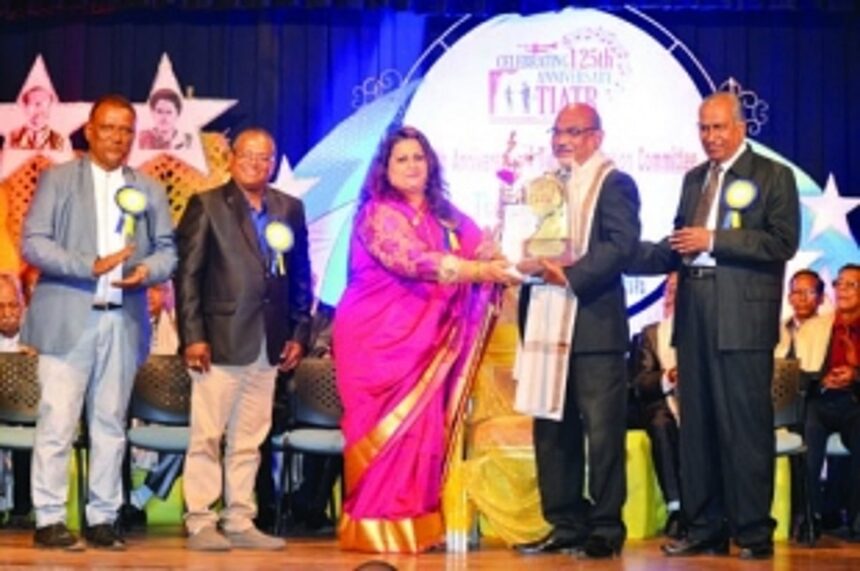
Manuel received the prestigious Kala Gaurav Puraskar 2015-16 for excellence in the field of tiatr. As part of the 125th anniversary of tiatr, he was also felicitated by the Tiatr Academy of Goa and Department of Art and Culture.
“Tiatr today has evolved into a powerful medium for mass communication,” Manuel states, adding, “We should continue to demand support from the state government as well as central government. Why shouldn’t the language of the Goans and the Konknni Roman script be supported at par with Devanagri script?”