The excited voices of school children reverberating from the classrooms inside the Pragati Vidyalaya at Borim almost led one to believe that a fun fair was taking place in the school. Who would have thought that the children were actually participating in the Sci-Fun activity being conducted by the young B.Ed. trainees of the Dada Vaidya College of Education instead.
In one of the classrooms, Harsh Gaude, a class VIII student excitedly explains the theory of centrifugal force to me. Shaking a plastic bottle containing two plastic balls vigorously, Harsh explains how the balls move away from each other. A few minutes later, he also explains how the balls attach themselves to each other when the plastic bottle comes to a standstill.
Likewise, Sanghavi Naik from the same class proceeded to explain how air exerted pressure on water. For this, she demonstrated how water flowed out of the holes created in a plastic bottle every time she inserted and pressed a syringe.
Both Harsh and Sanghavi had broad smiles on their faces and it was evident that they were having fun learning these scientific principles. “This beats learning science from boring text books anytime,” said Harsh, while Sanghavi said, “Science was never more fun, than this.”
A brainchild of Professor Anna Neena George, this Sci-Fun activity is being conducted across Goa and some parts of southern Maharashtra for the last five years. The programme launched in 2011 to popularize science among school children of middle and secondary schools is funded by the Department of Science, Technology and Environment, Government of Goa.
In just five years, the Sci-fun programme has been to 25 schools across Goa and catered to over 2,500 school children and presented 25 science concepts in each school.
Speaking to The Herald, Neena said that she had been inspired by the Pune based science popularisation ace, Arvind Gupta. “Arvindji taught me to use dry waste matter to make scientific toys which we could better explain scientific principles to school children,” Neena said.
According to Neena, the main purpose of Sci-Fun was to rejuvenate the dying scientific attitude, curiosity and dormant scientific temper in school children. “Scifun programme focuses on learning science by enquiry, observation and experimentation. This approach satiates the innate curiosity and desire to learn, present in every human being. It introduces science as an endeavour, beyond books and classroom,” Neena said.
The other big benefit was that the B.Ed. trainees, all science post graduates found a new perspective to teaching and learning. “They discovered their own skills, understood the concepts in the real sense, realized the working of scientific principles in daily life and most of all the fact that ‘children love to learn’,” Neena said.
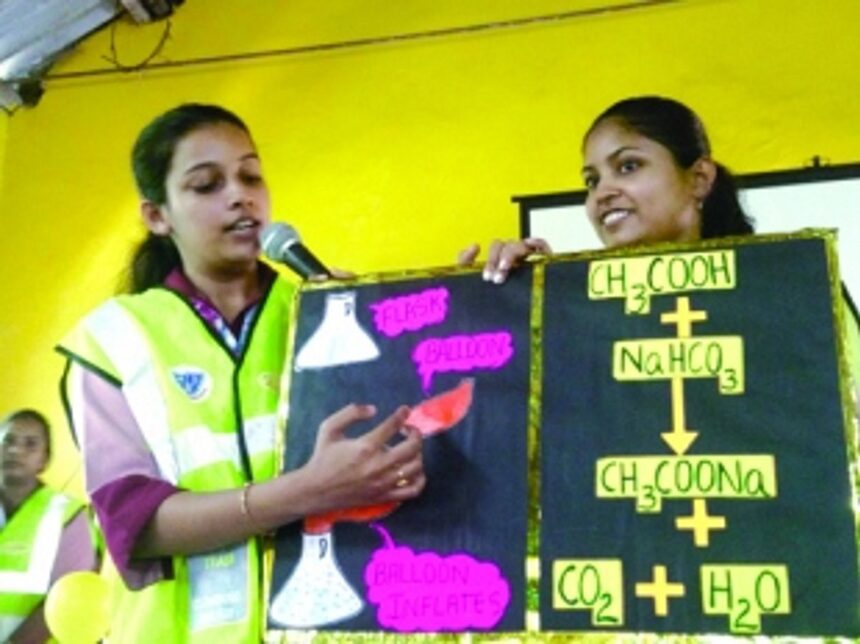
The B.Ed. trainees later demonstrated several live scientific experiments to the school children in the school hall. One of the experiments showed how paper when mixed with potassium permanganate and glycerin could produce a fire. While another experiment demonstrated the density quotient of various liquids like a strawberry crush mixed with dishwasher soap, coloured water and coconut oil etc. There was genuine awe and astonishment writ large on the faces of the school children. Komal Phadte, a school student said, “This is such a good way to understand and learn scientific principles.”
The B.Ed. trainees then put up a small dance accompanied by foot tapping music to explain the human skeletal system. Jitendra Shinkre, the headmaster of the school was so enthused by the dance performance, that he did not hesitate in shaking a leg himself! He said, “This is such a great way to learn science. So happy to see the children understand the principles of science by conducting practical experiments themselves.”
Not just the school children, but the trainee teachers also seemed energised by the experience. Siddhi Naik, one of the trainee teachers said, “Science is considered a difficult subject, but when taught this way it becomes fun.” While her colleague, Sanyogita Phadte said, “Our job is to show them how the scientific principles are used by us in daily life.”