Since the inception of humanity, we have seen conflict and combat for land and territory, but in recent times it appears that the Third World War may unequivocally be wrangled over this ‘Elixir of Life’ called Water. Water has been at the forefront of opulent and titanic confrontations since the dawn of the second millennium. The Helsinki Declaration, The Berlin Conference and UN Water Conservation Observer, are all examples of the given impetus to modulate and compose such disputes. Even though my current statement may seem awfully hyperbolic, it is in reality based on well-founded facts.
Leaving aside the global front, let’s just focus on our very own nation. In the 21st Century, every state in peninsular India, has controverted over the ‘War for Water’, the Kaveri, Krishna, Godavari, Narmada and Mhadei have turned into battlefields of political vendetta and human prerequisite, Northern India too being in a perpetual dispute amongst its international neighbours over the aversion and superintendence of the water system. One of the most austere of the domestic disputes predominant in peninsular India, is between Goa and its arch rival Karnataka. This is the Battle for the Mahadayi.
One river, two names and a battleground of two states, Mahadayi or Mandovi as it is known has for centuries blessed its dependants, proffering them, water for irrigation and consumption. It has been the corpus of the littoral flora and fauna in the state of Goa. This placid and picturesque river is born at Bhimgad in Karnataka on the channelizing of 30 or so springs, eventually ending its course into the Arabian Sea near Dona Paula in Goa. She moves through Mountains, forest and civilization covering a strenuous journey of 87 kilometres on its path. Out of which 11 km lie in Karnataka and 76 km lie in Goa and 46 km out of the 76 km in Goa fall into the saline zone. In total the Mhadei river basin drains an area of 2032 km2, out of which 375 km2 lies in Karnataka, 77km2 lies in Maharashtra and 1580 km2 lies in Goa. The total water harnessed by the entire basin amounts to 188.06 thousand million cubic feet (TMC). Out of this the water availability in the catchment area of Karnataka is 32.11 TMC, in Maharashtra it is 7.21 TMC and in 148.74 TMC in Goa, where it ultimately drains into the sea.
Now let us fathom and comprehend the rudiments of this dispute. This dispute has its premise, three decades ago, in 1973. The Mysore Province had newly been partitioned and the State of Karnataka was nascent. The Indian National Congress under D. Devraj Urs was drawn to the prospect hydropower generation from the Mhadei. The proposal persisted and limited action was observed. The dispute began to escalate and became a major political factor in the 1980s, when Karnataka’s decision to build a number of dams, canals and barrages on the Mhadei River to channelize water to the Malaprabha basin in order to meet the requirements of water-scarce districts of Bagalkot, Gadag, Dharwad and Belagavi. Again this issue was dormant, until 2002, when the then Chief Minister of Karnataka, S. M Krishna had without consulting the then Chief Minister of Goa, (late) Manohar Parrikar, approached the Ministry of Water Resources under the Vajpayee led-NDA Government at the centre and received permission to divert 7.56 TMC of water from the Mhadei basin to the Malaprabha basin.This project received fervent and vehement opposition from Chief Minister Manohar Parrikar and was eventually stalled by the NDA. Goa objected to Karnataka’s decision and appealed to the Supreme Court in 2006. It succeeded in getting the Mahadayi Water Disputes Tribunal set up on November 16, 2010.
The Tribunal adjudged the matter for nearly eight years and finally apportioned the decision on the 14th of August, 2018. The tribunal has pegged Karnataka’s access to 13.4 TMC of Mahadayi River Water.Karnataka received 5.4 TMC for consumptive uses and 8.02 TMC for power generation. Goa was allowed to use 24 TMC for state’s municipal water needs, irrigation water requirements and industrial water demands. Maharashtra was awarded the lowest share of 1.33 TMC. Karnataka was allowed to go ahead with the, Mahadayi Hydro-Electric Project, the Kalasa and Bhandura Dam, provided that such utilizations would be permissible only after thorough review and after obtaining mandatory clearances and technical appraisals by central authorities. Goa and Karnataka have both challenged the award, and the matter is pending in the Supreme Court.
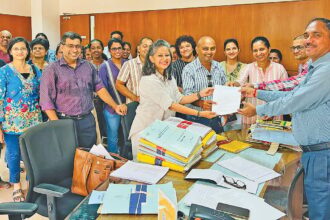
In April 2019, the State Authority of Karnataka, responsible for the behoof of irrigation projects in the state submitted the necessitated documents to the Ministry of Environmental Affairs for the purpose of clearance of the Kalasa Bhandura Dam. It was maintained that the project is “exclusively proposed for drinking water facilities to Hubli-Dharwad towns, Kundgol town, and en route villages as part of commitment to National Water Policy 2012”. The project received clearance on the 17th of October, a move that saw strong resentment amongst the Goan multitudes and statesmen. Subsequently, Chief Minister Pramod Sawant led an 11-member all-party delegation to New Delhi to demand that the clearance to the project be withdrawn. He also, ascertained that the interest of Goa would be prioritised and in case such decision has been taken without consultation of the State of Goa, it would be challenged in the NGT.
The argument established in Goa’s favour is that saline-sweet water equilibrium maintained is essential for the ecological quotient in the river for the fisheries sector and plays an instrumental role in the livelihood of one of cardinal professions in the state, the diversion of such water may affect the flora and fauna of littoral and maritime zones to an unprecedented extent. The project itself also lies in an ecologically sensitive zone identified earlier by Karnataka Forests Department and the Western Ghats Ecology Expert Panel headed by Dr Madhav Gadgil in their report in 2011 and subsequently by the Kasturirangan Report of 2013.This lays emphasis on the fact that the project may have adverse and unfavourable effects on the ecosystem and may prove catastrophic to the Mhadei Wildlife Sanctuary. The primary cash crop of the state, rice paddy which is farmed in the Khazan system would be in a state of detriment since its continuance of this 3000 year old agrarian practice depends on a synchronized system of the channelization of water from a river. Goa’s argument involves the continuance of several of Goa’s conventional and autochthonous professions into the modern era and may have myriads of deteriorating consequences for Goa’s anthropology and indigenous culture in the future.
But at the same time it is arbitrary, to be unsympathetic to Karnataka’s panoramic defence. Karnataka too has been facing acute water shortage and it has several consequences on the life and property of its individuals. After all it is immoral of the Goan multitude to shy away from the hard truth, that this decision may well impact the lives of lakhs of rural civilians, as water and sustainability is a basic right any human would naturally want to content. Secondly its actions can’t be seen as complicit as they are well within the bounds of the ruling of the Mhadei Tribunal. Karnataka has the licet right to approach the competent central authorities, to seek the clearance of its projects.
As one can perceive, these are two strong sides of the argument, with several impediments and no mutual solution in hand. Personally, I believe that the Environment Ministry was fallacious in issuing such clearance when, the issue still persists for further scrutiny and deliberation in the Supreme Court. One can also apprehend that timing of the clearance had a lot to do with the ensuing by polls in the State of Karnataka, that determine the future of the BJP Government in the state, which could have been a vindication for the issuance of such clearance in celerity and without entailed appraisal. And this decision may seem to have worked in favour of the BJP, owing to the astounding victory of 12out of the15 seats in the by polls held earlier this week. The hypocrisy and political motive of the BJP is evident in the fact, that following the results of the bypolls, the ministry has now issued a letter to keep the decision in abeyance until the disputes is deemed settled by the Supreme Court, proving that the past clearance may have well been an election gimmick of sorts.
This also nullifies the probable solution presented by several Goan lawmakers stating that the issue would be resolved by the Union Ministry in New Delhi in Goa’s favour. The Union Ministry’s opinion would be heavily ascended by Karnataka’s political weightage. Karnataka consists of 28 parliamentary constituencies and Goa consists of two. Goa consists of 18 lakh people, while Karnataka of 6.5 crores. It is but predictable, that the Ministry’s decision would be influenced by its political primacy. The only solution to this cataclysm would be approaching the Supreme Court and seeking a more judicious or acceptable decision for both parties.
However, this dispute and several others of this nature divulge a much catastrophic scenario that needs to see some resolute restructuring in India’s judicial and arbitration system pertaining to water disputes. My solution?: The creation of a permanent national level Water Tribunal by act of parliament. It is essential to constitute a body of constitutional repute, to arbitrate and adjudicate on dissensions in the context of water. It is essential that a legal forum consisting, legal luminaries, environmentalists, researchers and other individuals with immense erudition in such matters, whose judgement would be most acceptable and equitable. Although binding on the parties, such a judgement would have to be corroborated by the Supreme Court. India needs to be two steps ahead to tackle issues concerning the quintessential element of human survival, without which the nation will succumb to the rising necessities of its population and inadequacy to consolidate these basic rights, and in the end cease to thrive or in a pessimistic outlook, cease from existence.
(The writer is a student with a keen interest in social and political issues)