Pankaj Mishra in his occasional essays in the last few years has been mourning the decline of public intellectuals in the world of the specialists, and he spikes his disappointment by using a sarcastic line from Alfred Kazim: “They are all such specialists, such knowers on a limited scale.”
He bemoans the fact that public intellectuals today are increasingly entrenched in sectarian loyalties and have assumed a variety of cheerleading positions in the ideological movements that have made our times extraordinarily violent.
Scanning around, he finds that “the most convincing and influential public intellectual today – Pope Francis – is not an agent of reason and progress, let alone a “specialist” … he is still the moral voice of the church that was the Enlightenment’s main adversary.”
At one point, Goa had a rich tradition of public intellectual life, which was epitomized by the Institute Menezes Braganca, former Instituto Vasco da Gama. The Catholic Church of Goa has a long history of luminaries who engaged the society on larger societal issues with biting but respectful polemical discourse. The demise of Rev Almir de Sousa closed out the influential triumvirate of public intellectuals that he formed with Rev Lucio da Veiga Coutinho and Rev Martinho Noronha, who influenced the life of the Church of Goa for the last 50 years.
Post-Vatican Council II days were heady, not only for the Church, but forthe larger society. The Church was no longer the enemy of the Enlightenment project, but seen as an instrument of integral human flourishing (Pope Paul VI). Talking with the society at large as the ‘People of God’ was the call of the hour. Lucio, Martinho and Almir, the renaissance men, had the language and intellectual wherewithal to introduce the Church to the society not as an enemy of the Enlightenment, but as People of God.
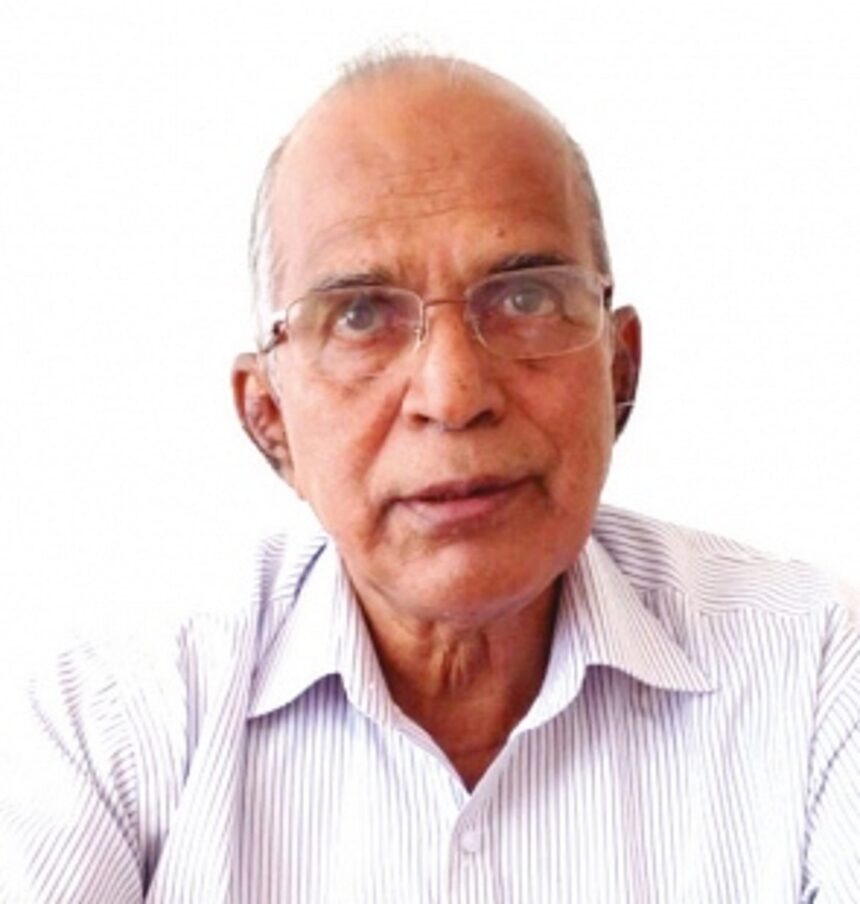
Fr Almir de Sousa was the junior member of this public intellectual triumvirate, grounded in theological anthropology and steeped into the ecclesiology of communion, wherethe People of God, and not the ecclesiastical hierarchy, are at the centre of the life of the Church, who act not as a counter-culture, but as a leaven.
One of the challenges this triumvirate of public intellectuals undertook was to recognize that secularization of the society is the outcome of the Enlightenment project and that it is irreversible; they sought to engage themselves in a dialogue with religion and society to make the Goan society a better place.
Fr. Almir focused on how to develop pathways as how to be genuinely, integrally, actively and effectively Christian in our own day, and how to enunciate God’s ineffable mystery in the language of our times.
Sometime in September 1977, Fr. Almir, in an informal setting at the Pastoral Institute Pius X, Old Goa, asked a small group of young priests: “How do we engage the society in an inter-religious dialogue?”
That was a question that preoccupied him as a public intellectual. He understood the socio-anthropological value of this societal dialogic engagement to advance Goan society’s wellbeing and authentic progress. For him public intellectual engagement was not an elitist exercise, but engaging the ‘hoi polloi’ of the society; that is the reason most of his public writings and public engagements were deliberately in Konkani vernacular. As someone grounded in theological anthropology, he focused on the life of the village to seek signs to explore the intersection of society at large and the life of the People of God. For him intellectual discourse was not an abstract and dense colloquium with a few, but a mundane and provocative conversation with all. He was always invigorated by discussions on the theology of the sign, which he taught to his young priests-students; in fact, he advised them to build their Sunday preaching around a ‘sign’, in order to draw in the congregation in faith-formation. He had a knack for keeping the audience thinking much after they had left their seats or the pews.
Public intellectual life is a necessary component of a vibrant and progressive society. Public intellectuals are not ideologues, but individuals driven by intellectual curiosity and by concern for the welfare of the society. Edward Said, a well-known public intellectual himself, said that the mission of the public intellectual is to advance human freedom, and to stand outside of society and its institutions and actively disturb the status quo.
Over 150 years ago, Ralph Waldo Emerson considered the meaning and function of the intellectual as the complete person, “who embodies all dimensions of human potential and actuality — the farmer, the professor, the engineer, the priest, the scholar, the statesman, the soldier, the artist. The intellectual is this whole person while thinking.” The public intellectual does all of these things not out of obligation to his society, but out of obligation to himself or herself.
The venerable triumvirate of Lucio, Martinho and Almir were public intellectuals for the sake of Goa and the Church of Goa. Their loss leaves a huge vacuum, and its ache is felt across the body-politic and ecclesial body of Goa.
In a prophetic way, Fr Almir, who shepherded the reformation of catechesis in Goa, was always concerned about the socio-political reality, which very recently Msgr. Octavio Ruiz Arenas, Secretary, Pontifical Council for the Promotion of the New Evangelization, articulated in the following words: “The Church no longer lives in a Christian regime, but in a secular society, in which the phenomenon of growing distant from the faith is exacerbated by the loss of the sense of the sacred as well as by Christian values being questioned.”
Thank you, Rev Almir de Sousa, for shaping our lives and preparing us for the emerging future.