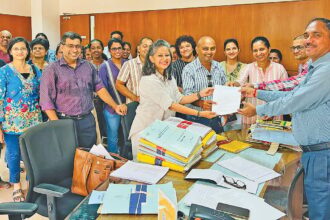
Vedanta Resources has recently appointed Mr Rajagopal Kishore Kumar, till recently heading its base metal business in Zambia as the Chief Executive Officer for the company’s entire Iron Ore business spanning India and Liberia. He was brought in to head the company’s flagship Sesa Goa, replacing Executive Director PK Mukherjee at a time when there is a glimmer of hope of mining operations resuming after a three year shut down. In a candid conversation with SUJAY GUPTA, he banks on hope and current optimism but is pragmatic that there are indeed impediments on the path of resumption and that the business will be downsized
Herald: The Chief Minister has said mining will begin by October. How realistic is this deadline or this announcement.
Rajagopal Kishore Kumar: This announcement is clearly a signal that the government and the mining companies have to step up their efforts towards the resumption of mining. It is welcome that there is a commitment from the highest office to support the restart. The issue that confronts us, both the government and the mining companies, are twofold. First, how quickly it can resolve the matter involving the issue of dumping ore outside the mining lease area. That the Supreme Court has given in its own decision post-conditions. The second one, a great impediment to the restart, will be liquidating the stocks which belong to the government and which lie with mining companies.
The state has the full right to auction these ores and make money. But mining cannot start till these stocks are liquidated
Herald: So you’re saying this process is also important.
Kumar: This process is critical. It has to happen before mining can resume because ultimately you are not allowing the mining companies to dump anything outside the lease area. There’s no space in our mining site. The mining site is a restricted site. Obviously we will have to use the existing warehouses and locations to produce the ore. Given the small acreage that we have for mining, we have no choice but to depend on liquidating the stocks lying on the ground
Herald: Sesa has suddenly announced a VRS scheme for its employees which has rattled the Chief Minister who has announced that mining will resume from October. Your VRS scheme is sending a signal that mining companies are downsizing
Kumar: All businesses across the globe in the iron ore industry have started looking at the possibility of managing costs. Given the fact that we have a limited EC limit now – we don’t have more than 20 million tonnes; a truncated volume of less than 50 percent of the current EC capacity – we have to produce the inventory, produce the iron ore and manage our short-term. This does mean that all our infrastructure investments, all our barges, trans-shippers, etc sized for the full volume are no longer in use. This, is in the short-term. In the long term, we hope we can restore the entire mining capacity. We have been considerate when we announced the monetary separation for our staff and workmen. It is one of the most generous schemes announced.
Herald: Is it also a reflection of the lack of confidence in mining resuming to the level to which it is expected at the present moment
Kumar: All the mining companies have contributed in terms of our best effort, knowledge of developing the infrastructure, which is very essential for the mining company. The Mines and Minerals Development Regulations (MMDR Bill) amendment also has come as a big help. I would say everything is looking up, looking . Each of the stakeholders has to play their role in bringing mining back. It’s not only the government; it has to be the barge owners, it has to be the transporters, it has to be the local community.
Herald: The other issue here is the legal challenges. There are two things. One is the legality of the renewals have been challenged in regards to the manner that was done. The other issue is the fact that IBM approvals have not been received from any of these renewals. Thirdly, these renewals were done under Section 8 (iii) of the MMDR act while the application for renewals were made under section 8 (ii). These may be technical issues, but a lot of these renewals will get challenged. At the end of the day, you are functioning because of these renewals.
Kumar: The EC limit lifting and the renewal per se does not give me the license to restart until and unless the mining plan approvals through IBM and the State Pollution Control Board, clearance on the assets as well as the operations of the local transport have been lifted. All these three are co-concurrence. We have already submitted our lease mining plans to the IBM. I don’t see a threat from the IBM or the regulatory angle. They’re more collaborative. They may impose some conditions for restarting mining. There will be certain restrictions. We are waiting for those audit processes to be completed. At this stage, all I can say is we are co-operating with IBM, GSPCB, and government to make sure our leases are at least authorized to operate.
The intention of the MMDR Bill, which was passed subsequent to all these orders, is also to authorize and empower the state government to take more initiative. At this time, there is a certain conflict between the judgement and the Bill. Eventually it will be the bill that will prevail in terms of operative capacity. I would see the State government’s role in resuming mining will continue to be substantial. It will have a larger role to play. Now that the export duty has been reduced, the economics will dictate the resumption of mining.