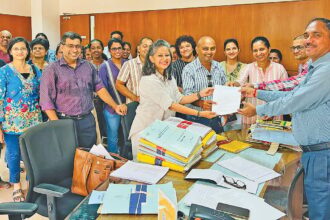
he seven-member Goa delegation was taken to different plants and facilities in Oslo, Stavanger (Norway) and Sweden to see the different facilities and technologies treating waste without any environmental degradation and foul smell.
While there still remains a question mark whether such plants would work in the State considering the waste generation and more importantly the weather.
Nonetheless, the technology seems to be the best so far considering the methodology adopted right from segregation, collection, transportation and then treatment.
Yes, the transportation is thorough and cautious with waste transported in containers and with leachate tanks.
Over and above, what is learnt from the trip was how the Europeans make energy out of waste.
Every bit of waste is saleable and with profits, they feel with recycling and treatment.
What is also important for us Indians and more particularly Goans is that the Europeans have a principle of ‘Producer Pays’.
Any person who produces the waste has to pay for disposal and treatment of that waste and nobody has any objection to that.
Be it chips packets, bottles or plastic, taxes are levied on the product so that it can be used for waste treatment, say the scientists. Hence the government does not have a burden for additional funds for treating waste.
Be it the production, company or the consumer, they have to pay for the waste.
While plastic and waste are used for producing fuel, power and heat (needed by European countries for water heating), the construction and demolition debris are recycled to produce aggregate, sand and pavers besides old asphalt is being used to produce new.
Another important aspect of the tour was that the companies like SINTEF, which now has an memorandum of understanding (MoU) with Goa on the Construction Waste, or IVL, which is handling Smart City for Sweden, or El Kresten, an e-waste handling company, or any other, are all non-profit organisations.
Whatever they earn from waste and research is spent back into research.
In case of e-waste El Kresten, it’s 50 per cent funded by the government but is released only if the industry contributes 50 per cent.
Similar is the case with IVL and SINTEF.
The important factor here is whether Goa can sustain such plants considering that the Refuse Derived Fuel (RDF) generated for incineration is much less.
The company Fortum – which converts waste to fuel, treats around 20 tonnes an hour, while the State’s collection of RDF is less than 50 tonnes a day.
On construction debris, there seems to be no answer as the current use of laying road is non-recommended.
“These kinds of roads will never last under the roads as the debris needs to be treated first before reusing. If used without treating, the roads would start sinking,” says SINTEF, Senior Scientist Dr Kristian Engelsen.
Krisitan also ruled out using plastic for roads stating plastic does not have binding capabilities.
Hence, with the High Court now directing the State government to find a solution for construction debris, the C&D plant has become a necessity.
Here is a short brief of the various facilities
visited by the delegation:
Waste-to-energy plant
-Fortum at Oslo
Statistics
Total cost of the project: 13.1 billion NOK
Tonness of CO2 to be captured annually by Fortum: 4,00,000
While we in India are still grappling to find a solution for waste, the Europeans seem to be in a totally different world in terms of waste management. They have been working on a full-scale carbon capture and storage (CCS) project initiated in Norway.
Carbon Capture and Storage (CCS) is one of the most important technologies for combating climate change. Fortum’s CCS project in Oslo can annually remove as much pollution from the atmosphere as that of 60,000 cars.
The Norwegian Government has initiated a full-scale carbon capture and storage (CCS) project. There are two capture projects that are part of the pre-engineering project: Heidelberg Norcem cement factory in Telemark and Fortum Oslo Varme waste-to-energy plant in Oslo.
The CO2 will be transported by ship from the capture plant to an onshore facility on Norway’s west coast for temporary storage. The CO2 will then be transported via a pipeline to a subsea reservoir in the North Sea for storage. Equinor, with its partners Shell and Total, are responsible for the planning of the storage facility. The storage concept study will be completed during the course of 2018, followed by an advanced planning study. Once these studies are completed for all stages of the CCS chain, the basis for an investment decision will be in place.
Fortum Oslo Varme’s waste-to-energy plant at Klemetsrud incinerates more than 4,00,000 tonnes of waste per year.
The waste heat from the incineration is used to produce electricity, district heating and cooling to the city of Oslo.
The emissions from the plant contain steam and CO2. The flue gas is currently cleaned out of dioxins, NOX and CO.
Electricity sales
Fortum has approximately 8,00,000 Norwegian electricity customers across six different brands: Fortum, Hafslund Strøm, NorgesEnergi, Fredrikstad EnergiSalg, Hallingkraft and Røyken Kraft. This makes them Norway’s largest electricity supplier. Norwegian electricity customers consist of both households and businesses.
Waste treatment and district heating
Fortum Oslo Varme is jointly owned by Fortum and the City of Oslo, and ensures the safe and environmentally friendly treatment of residual waste that cannot or should not be recycled. Company recovers energy from waste and other environmentally friendly resources to provide green district heating and electricity. Fortum Oslo Varme is the largest supplier of district heating in Norway and is responsible for 36 per cent of all district heating generated in Norway.
Construction & Demolition Debris Waste
Velde, Stavanger
The washing plant for construction and demolition waste was purchased by Velde Pukk in late 2014 and is the first of its kind in Norway.
“We opened discussions with CDE a number of years ago as we see the huge opportunity presented by the recycling of C&D waste to high quality, high value recycled sand and aggregates with a wide range of applications” says Managing Director of Velde Pukk, Egil Velde.
As well as processing C&D waste received at the Sandnes quarry, the new CDE plant is also processing overburden from the company’s hard rock quarry operations at the same site.
The CDE project was initially led by Eoin Heron, CDE Regional Director for Europe and Russia, and he says that the flexibility offered by the CDE equipment was an important factor in winning the project.
“We determined that we could design a plant that would allow them to not only recycle the C&D waste but also to recover material from the overburden which could subsequently be used in their integrated operations.”
The company, founded in 1984, has expanded significantly in the last decade, beginning with the introduction of an asphalt plant at Sandnes quarry in 2006. By 2007, they had built what they say is the largest, most modern and environmentally friendly production facilities for crushed rock processing and asphalt production in the world.
This was followed in 2008 by the establishment of a contracting business for road construction and in 2009, a ready mix concrete plant was introduced to the site.
The Process
Feed material is first delivered two R2500 primary screening units located side by side and with integrated apron feeders, which split the feed across two separate 150 t/h processing lines. From the feed hopper material is sent to the R2500 primary screening unit and the +90 mm material is removed via a double deck 5 x 1.5 m grizzly screen.
The remaining material is discharged to two horizontal feed conveyors. The 0-90 mm material then arrives at two AggMax 151 modular log washers where a pre-screen removes all the 0-4 mm material, which is delivered directly to the EvoWash 201 sand washing plant.
After aggressive scrubbing in the two AggMax units, the 4-90 mm recycled aggregate is sent to a ProGrade P2-108 sizing screen. The two AggMax machines also include a trash screen at the rear which removes any lightweight and organic contamination from the recycled aggregate product. Any sand liberated during the attrition phase is also sent to the EvoWash sand washing plant and ensures maximum product yield from the C&D waste feed.
The ProGrade P2-108 sizing screen is from the new Infinity screening range from CDE, which includes a patented side wall construction which removes unnecessary weight and reduces the power required to run the screen. The screen is set up to produce a 4-11 mm, 11-16 mm, 16-22 mm and 22-90 mm product all of which are stockpiled using static and radial stockpile conveyors. The EvoWash sand washing plant produces two grades of sand (Fig. 9): a 0-2 mm and a 2-4 mm. The 0-2 mm product is used in the asphalt production plant at Sandnes quarry while the 2-4 mm product is used in the concrete plant.
Given the space restrictions on site it was essential that full water recycling and sludge management was included on the new plant for Velde Pukk. “Not only does the plant require much less space with the full water and sludge management system but the fresh water requirement is 95% less than if we simply included settling ponds”, explains Harald Velde.
The wastewater from the plant is first delivered to an AquaCycle A1500 thickener (Fig. 10) where it is dosed with flocculant. This forces the very fine particles of silt and clay to bind together and sink to the bottom of the tank. Meanwhile, the recycled water overflows the peripheral weir and is stored in a concrete buffer tank before being re-circulated to the washing plant.
The sludge at the bottom of the AquaCycle thickener is discharged automatically at certain pressure and is sent to another concrete buffer tank, which is fitted with a set of agitators to ensure the a consistent sludge is delivered to the overhead beam filter press. The filter press model specified is one of the largest available and has 169 plates each measuring 2 x 2 m. These plates press the sludge to remove more water before the filter cake is discharged to a bay below.
“We are currently using the filter cake – which has dry solids content in excess of 80% – for the construction of embankments which means that we have eliminated waste from this stage of the process” explains Harald Velde. “Of the 300 t/h feed to the plant the only waste from the process is made up of the lightweight and organic contamination removed during the attrition phase.”
The future
The CDE plant at Sandnes quarry will divert approximately 600 000 t of C&D waste from landfill every year.
Velde Pukk aim to develop the market for recycled material in Norway in the months and years ahead through extensive testing and use of material in their own operations.
As well as operating the quarry, Velde specialize in the production of ready-mixed concrete and asphalt (and laying), while the business also runs it own transportation fleet around Sandnes and Stavanger.
The approach taken by Velde is refreshing and signals not only a change in attitude to C&D waste and the potential it offers but also that the industry is in good hands as it seeks to stay relevant, be viable and secure the future innovation that will lead to more waste materials being recycled.