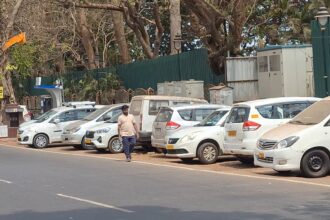
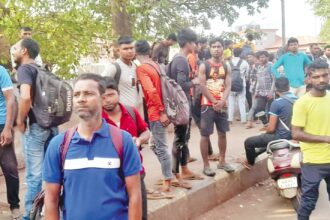
Time has been frozen from Quepem to Dharbandora. Circa 2012 September. The last loads of trucks left these mining belts as the death rattle was heard for Goa’s mining. It’s still silent. Deathly silent. A dusty truck, covered with a thin cloth to cover its modesty, a man sitting by his JCB machinery staring into nothingness, lads hanging by a tea stall figuring if a job on foreign shores, and the air hanging heavy with despair when the Chief Minister is offering hope.
From Sanguem to Dharbandora the only question that was asked by the people was ‘when will mines start?’ While some dared to curse the government openly some chose to remain shut citing repercussions from political leaders but majority of them complained that politicians had lost their trust. “A stage has come when the dam of this frustration will burst and this part of Goa would take to the streets if government does not stop bluffing and starts mining soon,” said Krishna Gaonkar, resident of Quepem.
Many jobless are still waiting in the hope that there will be a turnaround. But quite a large number of people have opted for alternative options like farming, but the worst-hit are truck owners who are still unable to repay bank loans are still struggling hard to overcome from increasing crises, said a resident of St Cruz in Curchorem.
Terance Fernades , who owns two trucks and looks after a family of five said, “I was a bus driver and with all my hard work I managed to purchase two trucks on loan, but to my bad luck before the truck could generate income, mining stopped and I am sitting on a loan liability of Rs 24 lakh to banks. There was a time I used to employ people now I have to hunt for jobs. Recently I got one job as driver.”
Those who had strength to look for alternative employment, grabbed jobs of any kind and the cases of the rich becoming poor are heard across the mining belt. These cases increased manifold after the state administration stopped financial assistance. “The moment Manohar Parrikar left, the state government stopped the scheme of giving us financial assistance and this has forced us to live a more miserable life. Each day starts with me cursing the government as my two trucks are getting corroded without any work.” said Herculano Pereira, a resident of Kakomody in Quepem taluka.
From a small tea stall to a heavy vehicle garage, the stoppage of mining operations has led to a situation where the flow of money has got curtailed. This has had a cascading effect on all trading activities, complained a Curchorem-based scrap dealer. “I am dealing in scrap, and mostly selling of second hand tippers. There was a time when we used to hunt for tippers which we used to repair and then sell. Few years back customers were ready to pay Rs 3 lakh for a 1992-93 model tipper but now the same has a value of less than Rs 1 lakh. Similarly mining machinery is losing its value drastically,” said Adam Syed.
People directly or indirectly dependent on mining, including truck owners, earthmoving machinery owners, mechanics, workshop operators, welders, shops dealing in spare parts, truck tyres, petrol pump dealers, car washing centres are still hoping that one day things would improve but as the promises are breaking the young are making moves abroad.
“My father has three trucks, my other family members are unemployed. Similar is situation all over and thus many youth from our ward are seeking jobs abroad as the State now feels that we are a burden and that is why they have even failed to create job opportunities as alternative livelihood to mining as part of relief,” said Lester Fernandes.
Even the prices of real estate that saw an unusual rise during mining operations, fell following the closure of the mines and the resultant crisis. Prices of apartments also reduced drastically. “People have either sold the properties or are looking out for buyers even for lesser price only to pay back loans. A 100 sq m 2BHK flat which cost Rs 34 lakh two years ago is now going for less than Rs 20 lakh. Analysts say reduced demand for housing has led to reduction in prices by at least 30%. Moreover, close to 200 flats are lying vacant in Curchorem alone, awaiting buyers,” said Vaman Chodankar, resident of Sanguem.
The effect of the mining closure has now forced panchayats to wait for government funds, otherwise development is out of question. The frustration is growing even at this level of politics as the panchayats are almost inactive in terms of providing infrastructure development. “We have 70 percent people who are mining dependent. As an alternative option people have started moving back to the fields to carry out farming and sustain but as panchayats we have no option but to wait for government funds to go for any development as from Rs 30 lakh reserve funds some years back we are left with empty pockets and that is hampering in all spheres of development including pre-monsoon works,” said Ugem panch Francisco Carvalho.
While the effect of mining closure still haunts the people at all panchayats in the mining belt with people facing severe hardships daily, the situation at Kale panchayat is different. Recently the state government allowed transportation of auctioned ore from dumps due to which life in the village has started returning on track.
But Kale, like the government’s promises is almost a mirage in the dessert of hopelessness.