50-year-old man from Sanguem is fighting for his life at the Cardiology department of the Goa Medical College (GMC). After months of struggling for life at a private hospital and finally the GMC, his family though still tense of his fragile condition say they have received a relatively good response from the staff and nurses in the hospital.
The Cardiology department is relatively new to the GMC and as such the patients and their relatives are highly impressed with the treatment.
However, they ask, why doesn’t the other wards and departments function the same way.
Experts say while there are problems galore at GMC, the government seriously needs to look at giving autonomy to the GMC on lines of the Goa University.
“There is no accountability in GMC right now. There is consistent political interference due to the huge budget it has,” said a doctor who did not want to be named.
Another doctor also questioned that when the GMC is affiliated to the Goa University, which is an autonomous body, why should the hospital not be considered for similar status?
Several doctors have opined similar sentiments but refrained from making official comment.
“There are a lot of scams in purchase of medicines, new equipment, exams, infrastructure development etc and for this there has to be accountability,” said a head of department.
Problems galore
On an average, over 175 people visit the hospital in a day but while some may say they have had a smooth visit to the hospital, there are several others who would say otherwise.
This is evident from the recent Goa Human Rights Commission (GHRC) case where a complaint was filed for making patients sleep on the floor of the Neurology ward. While the case may be limited to the Neurology ward,
there have even been instances where mothers who had recently given birth were made to sit on chairs in the waiting area.
One witness said, “The distress of the mother was clearly evident. But she was made to sit for some time before being given a bed to rest on.”
There is trouble brewing in the wards of the biggest government hospital in Goa. There are allegations of nurses and other staff having neglecting their basic duties towards the patients.
They have been putting the patients and their relatives through fear and trauma by forcing and bullying the relatives to administer complex tasks like administering insulin injections to diabetic patients without adequate training.
Space constraint
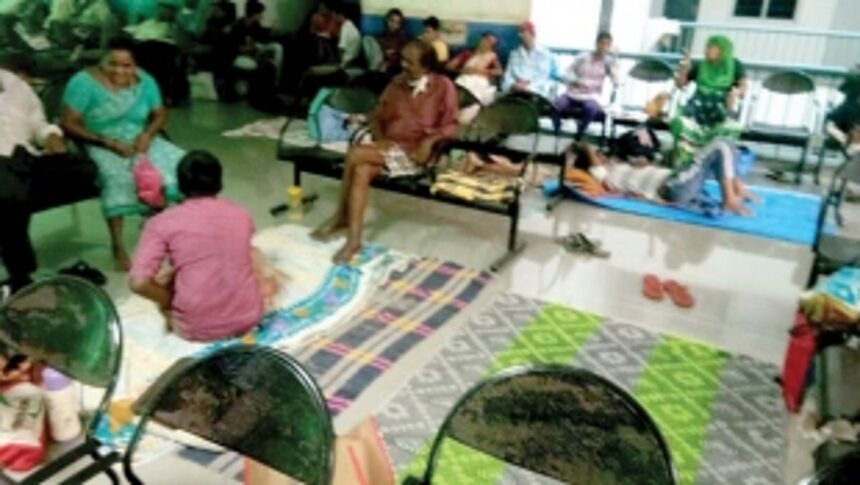
The space constraint is also clealry evident with family members and patients forced to sit on chairs outside the wards. People loaded with their blankets and bedspreads lie sprawled on the floor outside the ward as they wait for their loved ones to get recovered. Some have even taken to dry their clothes on railings at the nearby veranda.
Medicine shortage
When it comes to the medicines and the government pharmacy, though they claim to be open 24 hours a day, many patients are sometimes forced to buy costly medicines from the nearby private pharmacy. Other problem areas include the blood bank, canteens and the crumbling infrastructure.
A new morgue but still loaded with problems. The old morgue at the GMC clearly shows the signs of being an old dilapidated building but with a new state of the art building and facility, little seems to have changed from the past.
Though the new morgue may be state-of-the-art and fancy looking, it still lacks space as many students studying in the hospital have said they have themselves seen cases where cadavers were placed on top of each other.
“We have good infrastructure in the morgue but it is not completely functional. There are several times where we have witnessed bodies being dumped and heaps of bodies in a row,” said the student.
Doctors working in the department have said that while they try their best to see that the department functions smoothly, there are usually hiccups. One doctor went on the defensive when asked why despite having the infrastructure, the new morgue was not fully functional. Another doctor pointed to unclaimed bodies being one reason, the capacity is being tested.
“There are many bodies that are actually the property of the police as being part of unclaimed bodies they recovered as part of investigations and cases. Since we can’t simply incinerate bodies, we feel the pressure,” they said.
In the past, there have also been cases of rats feeding on dead bodies. Officials claim that problem has been dealt with.
Short staffed blood banks
GMC’s blood bank may be the only licensed bank in the state to prepare blood component packs including blood platelets and are visibly struggling with their staff crunch. Today, the department on an average supplies 75 bottles of blood a day but are functioning with two full time technicians nearing retirement and depend on contract technicians for smooth output.
Unhygenic conditions
The GMC has been under fire for mismanagement and poor functioning with many Goans giving preference to private hospitals instead. It is paradoxical that an institution dedicated to providing quality healthcare is so unhygienic and filthy. While dogs are found sleeping under the same roof as patients, the hospital has also become a shelter for hens.
The walls of the buildings are tainted with tobacco and gutka stains and believe it or not, mold, which can be detrimental to a person’s health.
A visit around the complex makes one aware that patients and visitors are distressed by the inefficiency of the management. “Patients are made to wait for hours before they are attended to,” says Lawrence Pinto, a concerned visitor.
The security at the hospital is lacking. With the increase in assault cases, doctors fear that relatives will respond in a violent way. They are hesitant to interfere in another doctor’s case even if the patient’s condition is serious.
The dramatic increase in road accidents has overloaded the hospital leading to a shortage of beds. In certain wards, patients are made to sleep on a mattress on the floor. In addition to this, the hospital lift often stops working, thus delaying treatment and putting the patients lives at risk. Quarrels between the technicians, nurses and doctors only add to the discomfort of the patient. Last year, the hospital had already started losing patients to private hospitals due to the government’s Deen Dayal Swasthya Seva Yojana (DDSSY) medical insurance scheme which covers 447 medical procedures in the private sector. Patients are now opting for private hospitals and the doctors at GMC are displeased.
On its mission to provide the best medical facilities to the public, it looks like the government has completely neglected GMC, one of Asia’s oldest medical colleges.