Without a doubt, salt constitutes a very important ingredient of our meals. Traditionally panned, the Goan sea salt was the only salt available in the State, before the advent of factory processed fortified salt. Now with the changing lifestyle, the consumption of sea salt has changed drastically and the salt pans are given up for development.
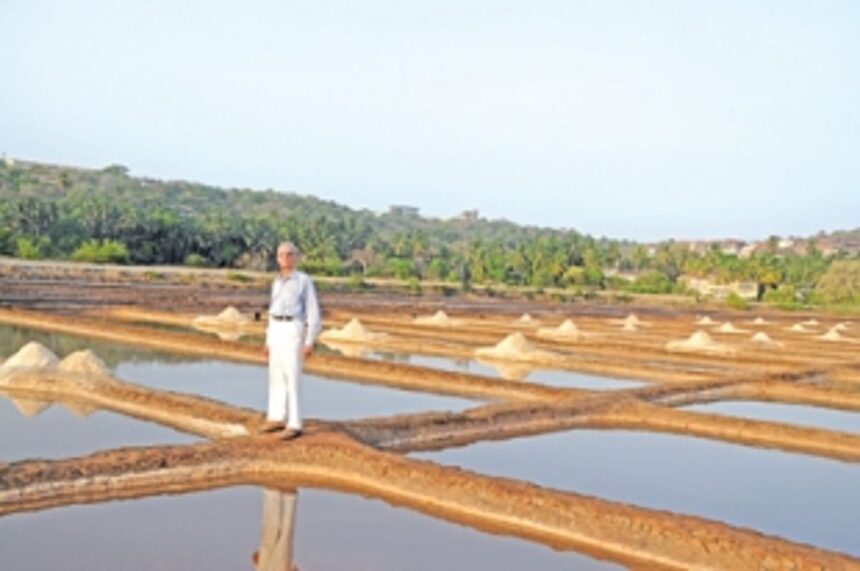
Against all odds, Advocate Govind Bhobe is determined to maintain his saltpans, his family’s traditional occupation and keeps him connected to his roots. “I want to continue with my ancestral occupation as I have been running the salt pans for more than 50 years even though it is not a lucrative job,” says Adv Bhobe. “Earlier, there were nearly 80 saltpans in Bardez of which twelve were in Nerul. Today, my salt pans are the only ones in Nerul. All others have been given up for development.”
Adv Bhobe is the son of Usno Shankar Bhobe, a landlord during the Portuguese era. As a youngster, he started working to study further. He studied law and was a professor of English in Rane Parvati Devi, College, Karnataka and a professor of Law at V M Salgaocar College of Law, Miramar right from its inception. A High Court advocate and notary, Adv Govind has been practicing for nearly 45 years. When not working, he is often spotted in his serene garden or under the harsh sun in his salt pans which covers one lakh acres of land. The salt pans are surrounded by paddy fields and coconuts trees. The fields are also used for fish farming in the months of November to December.
Before Adv Govind would take over the salt pans, the land was leased for many years. “After I took over, the production for the first year was 1000 bags of 75 kgs. Today, I am proud to say that the saltpans produce 5000 bags of salt per season. It has almost reached it optimal point of production but the salt pans are of excellent quality.” The sea salt is sold in tempos across villages in Goa as well as Maharashtra. A few bags are sold at the wholesale market in Margao.
It is not easy keeping this traditional occupation alive. Earlier, the salt pan workers were from the village itself. Now, skilled labour has to be brought in from Karnataka. “Local people have stopped working in the village salt pans because it is very difficult and so we are dependent on labourers (agris) from outside Goa. However, barring a few, most of the workers are hard drinkers. I currently have ten labourers from Gokarna in Karnataka. The season for extraction of salt begins in the month of February and continues till it starts raining. Every morning, I go to the saltpans to supervise and interact with the labourers which helps in maximum production of salt. I take good care of them and have built a good rapport with them,” says Adv Govind. He also provides them with houses with electricity and water.
Earlier, sea salt was used for drying fish and also using it as fertilizer for mango, coconut and cashew trees. It was bought in bulk to store for the monsoons. Now as packets of iodized salt have taken over the market and sea salt is not widely used, neither in cooking nor nourishing the soil for a better yield. “There is hardly fish to eat so drying it is a far away thought. However, sea salt is still used to mix fodder for cattle and by Goan bakers for bread,” says Adv Bhobe, the second of four brothers.
Though he is trying his best to keep up with the changing times, he finds no encouragement from the government. No incentives have been offered to salt pans as they come under the industrial sector and not agriculture. “I have spent lakhs and the salt pans are built with an embankment of two feet height and 20-25 meters width. Yet I have not received any benefit from the government.”
Adv Bhobe may still turn up for work in his lawyers robes and go to court to get favourable judgments for his clients. But the verdict is clear about his passion to preserve his family’s traditional occupation. It’s a unanimous judgment in his favour.