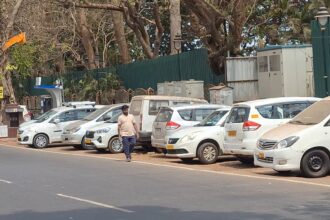
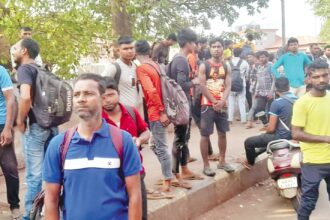
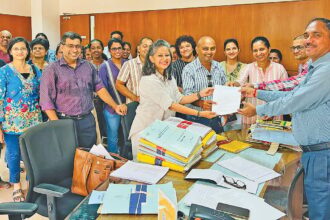
he queues outside the offices of the Portuguese Consulate General, on the way up to Altinho hill, begin before dawn and grow in length as the sun rises. Documents in hand, people from across Goa make their way to Panjim, with the hope that their carefully assembled documentation will be accepted by the Portuguese Consulate General and given time they will become citizens of Portugal. The tendency of Goans to adopt Portuguese nationality has led to the Election Commission of India seeking that candidates for the February 4, 2017 Assembly elections, swear that they hold no other citizenship. While this led to some contained outrage, there is no denying that the number of Goans opting for Portuguese nationality is not diminishing.
A Goan has the unique possibility of having never stepped out of the State yet, acquiring the citizenship of a foreign nation, in this case of Portugal which was once the coloniser. How does that augur for the fight to retain Goan identity?
“Portuguese citizenship has certainly diluted Goan identity since Goans perceive it as an upgradation of their lives. As long as jobs are not freely available here, people will migrate for greener pastures. Sadly, successive governments have milked the job placements, which has further led to this problem,” says Armando Gonsalves, Chairperson of Goa ForGiving, that has been taking up various causes in the promotion and preservation of Goan identity.
As a section of the people fight to retain the identity of Goa that is being severely eroded by migration, leading to a demand of special status for the State, thousands others dilute this identity through migration abroad, made a shade easier when opting for the Portuguese route.
There are many groups that look at safeguarding the identity of Goa, including a group that has been persistently fighting for Special Status. “Only through Special Status, under Article 371 of our Constitution can we save our mother Goa from outsiders. Our gains of the Opinion Poll are lost. First, MGP wanted to destroy the very identity and entity of Goa by merging her with Maharashtra. Then Congress and then BJP destroyed Mother Goa’s natural environmental heritage including our identity the coconut tree,” says Prajal Sakhardande, Convenor of Goa’s Movement for Special Status.
Yet, even as this group takes forward the fight for Special Status today, there are those who feel that Special Status would have been easier to obtain in the early years after Liberation, especially around the year 1967, when Goa voted in the Opinion Poll to remain as a Union Territory, rejecting merger with Maharashtra. The argument is that Special Status at that time would have preserved Goa better. “My personal view is that we should have asked for Special Status immediately following the Opinion Poll and this would have helped preserve ‘Goan identity’ and our land and resources from over-exploitation and degradation,” says Remy Dias, professor of history at Government College, Quepem.
In a poll that was like no other, Goa did not vote for a government but 50 years ago, on January 16, 1967, voted instead to retain its identity. It was on that day in the year 1967 that the residents of the land that was geographically known as Goa put an end to the question of who they were, as they stamped their preference on the two leaves symbol, rejecting the rose that meant merger.
Post liberation in 1961, Goa integrated and assimilated with India, but firmly stood the ground when it came to the question of retaining its identity despite attempts to merge it with neighbouring Maharashtra, expecting at that time to be able to preserve that identity forever.
But the survival of that identity hangs in balance 50 years later, with the gains of the Opinion Poll weather-beaten over the years as development and change set in, and Goa is today staring at a future far different from that which was conceived in 1967.
If one looks back to that period, perhaps the biggest challenge Goa faced after Liberation was ‘what to do with itself’. Merger was one option, union territory was another. The 1963 MGP election victory gave the pro-merger groups a massive impetus and the resolution adopted by the Assembly on January 27, 1965, seeking the merger of Goa with Maharashtra hastened the need to join forces and fight this, before the Union government could act on the resolution.
While the Union government didn’t do that, it instead allowed Goa to choose for itself what it wanted. Ironically, what would have happened had Goa voted the other way?
“If the result was the other-way round, one could very well have envisaged Goa as a district or a subdivision, with absolutely limited political stakes in State or national politics, a more personality driven politics (than it exists now), but perhaps less exposed to the so called ‘outsiders’ who are increasingly shaping the Goa of present,” says Dr Rahul Tripathi, Head of the Department of Political Science, Goa University.
While Goa rues the slow dilution of its identity over the years, there have been gains, if not in cementing the identity then in development and education. “One of the biggest gains of Opinion Poll has been advancement of education. The 1960s and ’70s witnessed a mushrooming of primary and secondary education institutiions. The ’80s saw higher education grow and develop with a number of engineering colleges coming up in the 1990s and thereafter,” says Dias, who is also Vice Principal, Government College of Quepem. He, however, asks whether one State University is sufficient to develop Goa’s valuable young human resources, and suggests that the State introduce a National Institute of Advanced Research (including Social Science) to carry our critical research in all fields.
But merely education does not play a role and this has to be supplemented with job creation to stop the brain drain from the State and retain its youth within the boundaries of the State. “Any new government will have to ensure that job creation will have to be done by encouraging investments in the industrial sector too. Goans love their land deep in their hearts and will always remain back home in case they have proper opportunities here,” Rodrigues said.
The threat of migration into Goa and of Goan out of Goa is very real. In 2013, the State government in the representation on Special Status made to Prime Minister Manmohan Singh and signed by then Chief Minister Manohar Parrikar had stated, “The apprehension is that by 2021 the migrant population will outnumber the local Goans.”
So, while a Goan will always remain a Goan, wherever in the world he or she may be, as was pointed out just last week by the Prime Minister of Portugal Antonio Costa of his father the writer Orlando da Costa, when he said “My father went to Lisbon but never left Goa, because Goa never left him,” the Goan in Goa is becoming scarce. Goa, therefore, needs to work on its identity and protection. Says Tripathi, “Goa very strongly needs to develop an internal consensus on what the essence of Goan identity is, which at present appears homogeneous only when faced with external threats. Diversity, plurality and inclusiveness have to be cherished if the political idea of Goa is to sustain.”
The Opinion Poll guaranteed that Goa retained its identity. The current demand for special status is to ensure that the identity, the Goenkarponn does not get diluted further. Somehow, the battle won in 1967, was of a war that has not yet ended, and will, perhaps, continue for years to come.