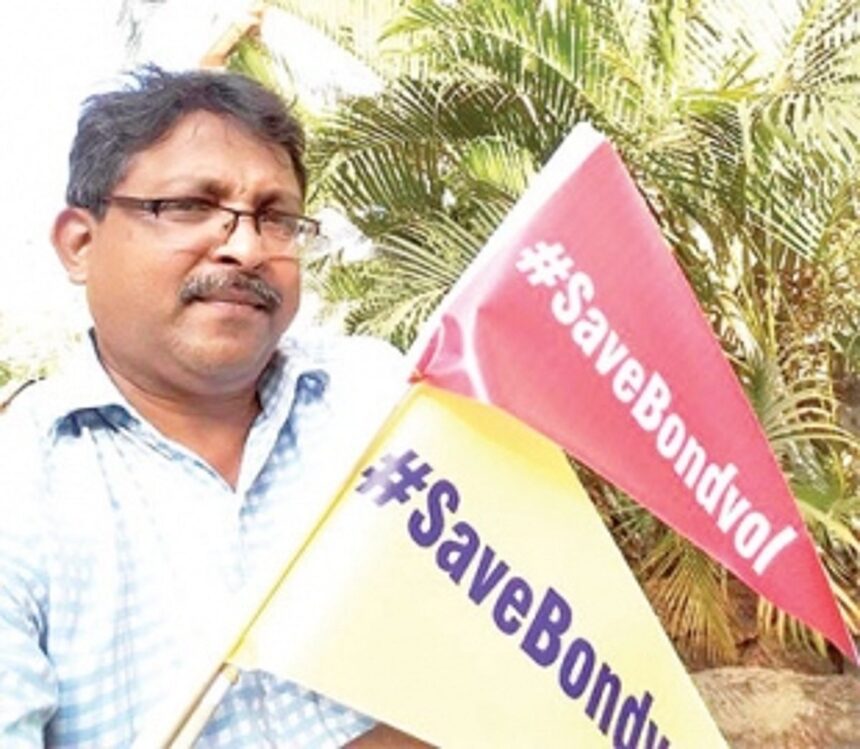
rowing up in Goa, as a child, I have never witnessed this kind of attack on our land, our heritage and the environment, as I see today,” sighs Arturo D’Souza and continues, “I grew up, waking up to the sounds of birds that resounded in my backyard and when these sounds slowly retreated, I wondered why.” A visit to the nearby Bondvol Lake – a basin of 8 hectares in a catchment area of 2 lakh sq mtrs, revealed a dry, arid spot.
On closer inspection, he realised that attempts had been made to take over the land, that many trees had been cut and burnt and that a road was actually built into the lake. “I was so shocked seeing this and it made me determined to do something about it,” he shares. He then approached the parish priest, Fr. Alexander Pereira and sought his support. Says Arturo, “Bondvol lake is officially owned by the local Calapor communidade. Under the Calapor banner of unity and service, we ran awareness campaigns and motorbike rallies to make people aware of the significance of this lake and its natural hydrology that served as a major water resource for the people here.” He emphatically adds, “Water is a precious resource and when we have it naturally, we must do everything we can to conserve it.”
In 2016, the ‘Save Bondvol Lake’ movement started gaining traction. Alert citizens noticed roads and construction firms making headway to construct apartments on the lake’s periphery. As the lake was drying up, they realised that community property was being usurped for private ownership and ‘lake view’ was being touted as the bait for real estate gains. In 2017, Arturo raised a Public Interest Litigation (PIL) in the High Court regarding the 110-year-old natural reservoir. “Justice Gautam Patel who heard the PIL immediately passed a directive that the periphery within 200 metres should be untouched disallowing any deforestation or construction and this diktat still stands,” explains Arturo.
The Calapor communidade moved the Bombay HC’s Goa bench to seek protection for Bondvol lake while the wives of these applicants moved the National Green Tribunal (NGT). These concerted efforts led to the HC ordering the Water Resources Department to repair the lake’s sluice valve, which saw immediate results with the lake being naturally rejuvenated. However, some tenants filed an injunction claiming that this wasn’t a lake but a paddy field and as rightful tenants they were being denied the right to cultivate. He explains, “I am not fighting against their rights but what was and supposed to be a public utility project has gone haywire with vested interests. My aim is to conserve this water body and make this a case study for others to follow.”
Not content with just this outcome, Arturo then worked towards getting the lake declared as a wetland ecosystem and is waiting for the official declaration to come through anytime soon. The conservation of Bondvol Lake was backed by the February 2018 Task Force constituted by Justice Gautam Patel that involved the Chief Conservation of Forests, the Water Resources Chief and the Secretary of the Goa State Biodiversity Authority. The voluminous report detailed the number and variety of trees, the GPS location, the hydrological aspect, contour maps etc, making it a detailed, scientific study.
Arturo points out, “This was ready made material for the Wetlands Authority. It is always important to back our claims with relevant information and data.” He shares, “After going through archives and records, I realised that the Portuguese government in 1908 had promulgated an order and had published a gazette or ‘portaria’, in OHeraldo declaring Bondvol lake as a public utility project.” He adds, “During the drought in 1830, the Portuguese had decided to safeguard these waterbodies and a sum of Rs. 30,000 was given by the then Governor to the Communidade to make the embankment.”
Despite naysayers, Arturo stayed determined to his course and now is witness to a revived Bondvol lake. “I feel so happy to see the lake full again. Earlier it was barricaded – now it is free for anyone to visit. The migratory birds and peacocks are back and the biodiversity is slowly returning.”
Sharing plans and ideas on the beautification of the lake once the new Wetland declaration comes through, Arturo says, “We will have registered volunteers called Bondvol MITR (friend of the lake) who will be responsible for its upkeep. We want to conserve the area as a biodiversity garden and perhaps even use the water through filtration process for drinking purposes, should a need arise.” It is interesting to note that Bondvol was selected for rejuvenation under the Prime Minister’s Niti Aayog programme that protects water bodies across India.
While myths and folklore of a ‘Rakonddar’ (a mythological creature who looks after a place) to a ‘Devchar’ (an evil spirit) claiming protection of Bondvol, no one can dispute the fact that Arturo and all those who supported this movement are the real life heros who make these myths seem irrelevant in changing the legendary narrative and being the true sentinels of their land.
Arturo now advises other villages and residents of Chimbel lake have approached him in a bid to follow his route to protect their reservoir.
Fearless, intelligent and outspoken, Arturo has set an example by demonstrating that with passion and determination, the status quo can be challenged. Lamenting and complaining, as most of us do is the easy cop out.