Joao Manoel Mascarenhas, popularly known as Joel Mascarenhas on the Konkani stage, hails from Mungul, Margao. Born on March 1, 1938, Joel took keen interest in tiatrs from a young age and would travel to places like Benaulim, Varca and Colva to watch them. “I love for watching tiatrs resulted in my interest in scripting them. But before I started actually writing tiatrs, I participated in them through acting and singing,” informs Joel.
At the age of 23, noted tiatrist C D’Silva took Joel to watch one of his tiatrs and he composed songs and rendered duets with him. “In 1960, C D’Silva staged my tiatr ‘Temp Ho Marekar’ and the opportunity dawned to render duets,” he recalls.
In 1962, Joel penned and staged his second tiatr, ‘Nagovnneachem Bhens’, followed by ‘Dotichem Kazar’ in 1963. In 1964, he scripted and staged two tiatrs, ‘Avoicho Ul’las’ and Mavoddechem Sukh, followed by tiatr ‘Kazari Irmao’ in 1965.
Thereafter, Joel joined the Navy band and served there as a drummer, trumpeter and violinist. “When a Navy Officer came to Goa to select Goans for the Navy band, there was an interview in Vasco, followed by another in Mumbai,” he recounts.
Joel passed both the interviews and was selected for INS Kunjali. While serving in the Navy band, he had the chance to learn a second instrument and he picked up the trumpet.
“My love for music developed as I went for musical shows with my father, late Anastacio Mascarenhas, who was a trumpeter,” informs Joel. “When dad purchased a drum set,” he adds, “Remedious from Maddel would come to tutor me for two months.”
Later, the tutor would take Joel along with him for several weddings and would give him a chance to perform for the events. That initiative helped him garner confidence and mastery over the instrument.
Seeking 60 days leave, when Joel would return home for vacation from the Navy, he would make it a point to stage at least one tiatr at Carmel chapel in Mungul and Maddant in Fatorda Rosary hall.
Joel’s tiatrs during these vacations included ‘Sotachem Ghor’ in 1966, followed by ‘Gharachem Nisontonn’ in 1967 and ‘Niz Mogacho Valor’ in 1968. He penned two more tiatrs, ‘Kortub Bomboikaranchem’ in 1967 and ‘Kortub Hoklechem’, which are yet to be presented on stage.
Some of the professional artistes in his tiatrs included Luciano Dias, Jepsis Hitler, C D’Silva and J X Miranda, while the remaining artistes would be from his village, Mungul.
After 20 years of service in the Navy band, Joel returned home in 1985 and joined the Goa Police band in 1986, where he served for almost 16 years, before seeking voluntarily retirement.
On retirement from the Goa Police band, at the advanced age of 64, Joel decided to learn the violin. He received tutorials from late mestro Camilo Xavier from Margao. “Many were under the impression that violin is the toughest instrument to learn when it comes to the nuances of playing it and I wanted to prove them wrong,” he reveals. “I did have the knowledge of playing the drums and trumpet so it wasn’t tough to learn the solfagio and the violin.”
Besides scripting and staging his own productions, Joel has also acted in tiatrs staged by J X Miranda, Frank de Santa Cruz, Jepsis Hitler, Luciano Dias and M Dod de Verna. He has mostly featured in female roles and aged characters.
Despite his fragile health, Joel continues composing songs at leisure, which are mostly decent, and on invitation, goes for weddings and other festive occasions for renditions. With the help of his son, Henry Mascarenhas, he has plans to release a CD of his favourite oldies in the near future, besides staging his pending two tiatrs.
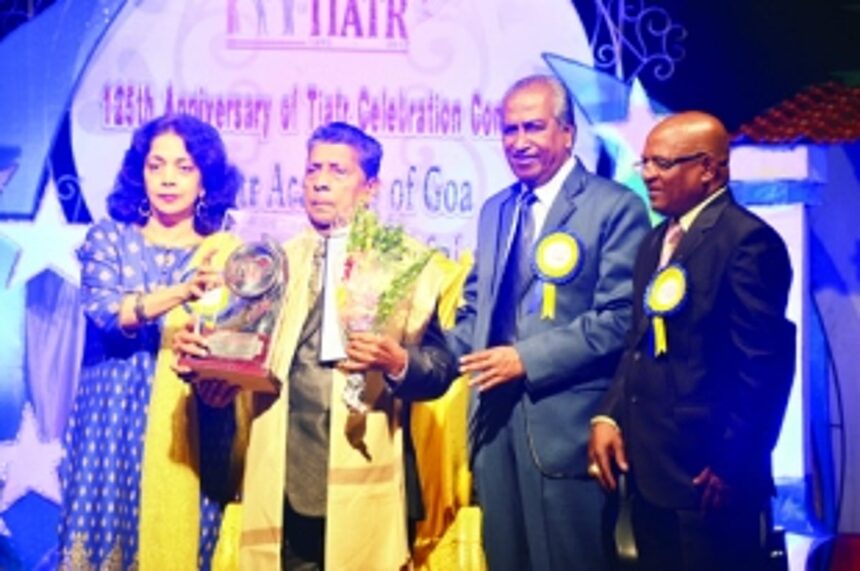
For his immense contribution in the field of tiatr, Joel was the recipient of the Kala Gaurav Puraskar for the year 2009-2010. The award was presented to him by the Directorate of Art and Culture and he received it at the hands of the former chief minister, Digambar Kamat and in the presence of the director of Art and Culture, Prasad Lolyenkar. As part of the 125 years of tiatr celebration, he was also felicitated by the 125th Anniversary of Tiatr Celebration Committee in Margao.