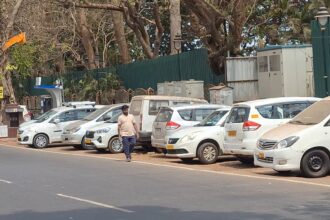
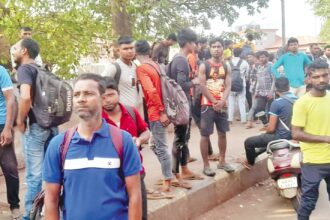
While the law is in place, nobody knows who will fine the tourists for creating nuisance and nobody seems to know who is supposed to implement these laws.
In order to protect and preserve the tourism potential of the tourist places in the State of Goa and to keep search places clean and free from nuisance, the Assembly amended the earlier Act of Goa Tourist Places (Protection and Maintenance) Act 2001.
The new Law is called the Goa Tourist Places (Protection and Maintenance) (Amendment) Act 2019.
As per the new law, the following activities are prohibited in the tourist places:
a. Consumption of liquor in open and cooking food in open
b. Littering waste including use material empty bottles at etc
c. Breaking of glass bottle
d. Such other activity as may be specified by the government by notification in the official gazette
e. Any person violating the provisions of section 1 shall be liable to pay a fine of rupees 2,000 to the competent authority or any other officer authorised by it in this behalf.
f. When such violation is committed by more than one person in a group, such a group shall be liable to pay fine of rupees 10,000.
Despite this law, there appears to be no implementation on the ground.
A tourist police official stationed on Calangute beach, on the condition of anonymity, shifted the blame, claiming that have not been told anything regarding penalising violators the errant tourists. There were similar replies from an Indian Reserve Battalion (IRB) official at the beach, who said that their job is security and surveillance of the tourists at the designated areas.
However, a senior police officer in the IRB said otherwise – which draws the oft-used analogy of the left hand not knowing what the right hand is doing. “The tourist police unit under IRB are authorised to check for any such nuisance on the beach. On finding any violator, the alleged accused is taken to the nearest police station to face legal action,” added the senior IRB officer.
The Travel and Tourism Association of Goa (TTAG) president Saviuo Messias said the law is good but that the failure to implement the law defeats the purpose.
“We were happy that this bill was passed, but the question is who will implement it. Failure to implement it will take us back to square one,” Messias said.
The TTAG has earlier voiced concern over the failure of the government to crack down on drunken behaviour mostly by male tourists, who they say create a ruckus and drive other ‘good tourists’ away.
“We need to control domestic tourism to manageable levels so as not to destroy our hospitable culture and environment. We need to keep the balance between the number of domestic tourists and international tourists. The challenge is to reinvent tourism and reposition Goa to appeal to the discerning traveller,” Messias had said.
Earlier this month, Deputy Speaker Michael Lobo had said that there was no point promoting Goa in international markets only to show the tourists, drunkenness and garbage in the State.
“Stop people from drinking on the footpath, on the promenades, on the beaches, breaking bottles. The minute you stop this you will see that this crowd will stop coming to Goa. They don’t want to drink in a shack or a restaurant, because they know it is expensive. They just want to buy and come on the beach and get drunk and look at women,” he said.
A local resident Nicole Fernandez complained about the how these male domestic tourists were just sitting on the beach with bottles and creating nuisance and often getting into fights even.
Locals added one could see the quality of tourists the morning of New Year’s Day after the celebrations that began on the New Year’s Eve had ended. A section of tourists were found sleeping on the beach, footpaths with garbage found strewn everywhere. Locals blamed this on the available of cheap alcohol and civic apathy.
“Alcohol is cheap compared to other States and this is the common factor that attracts such type of tourists to Goa, a local added.
“We have to get our excise laws changed and this issue has to come in notice of the Government. If liquor is available at cheap price at wholesale and retail shops, then why will people go and sit at a restaurant or shack for a drink?” said Messias of TTAG.
He gave the example of how the State government is strictly implementing wearing of helmets and seatbelts and its action against drugs. Similarly, he said the law has to be strictly enforced against drinking in public. He added that there is no requirement of technology even it just requires strict implementation, Messias reiterated.
“Until drinking is not banned in public and strict laws are not enforced, we won’t be able to stop this. Laws can be made but what about implementation and enforcement of these laws. The implementation and enforcement of laws is lacking. If the authorities concerned cannot enforce the laws of land, then these things are bound to happen,” Messias added further.
Stakeholders also questioned the amount of value these tourists bring to the State and how much they contribute by way of accommodation, meals and mode of transport. They lamented that such tourists are happy just to consume alcohol and stay in their own vehicles or on the beach itself instead of renting places, staying at hotels, visiting shacks and restaurants and traveling by taxis.
“Some of these people who came here to celebrate New Year’s cannot be called quality tourists. They had a bath on the beach, ate the stuff they had brought along with them, had drinks on the beach and went back,” said a shack owner, Shekhar Naik.
“The beach was crowded with tourists and there was no place to stand on New Year’s Eve,” quipped another shack owner Sudesh Salgaonkar.
Nitesh Chodankar, Vice President of Rent a Cab Association, also rued the fact that such tourists do not contribute much to the local business either, which he added has come down by almost 50 per cent.
Representative of Yellow and Black Taxi association from Pernem Raghu concurred and further pointed out that this year’s season is far worse compared to last year’s season.
While hotels have said that they have got bookings during Christmas the New Year’s Eve period and during the recent three-day-EDM festival, some of the local guest houses claimed that their customers who created a nuisance in the rooms.
Tourism Minister Manohar Ajgaonkar, who is also the Pernem MLA added, “We don’t want tourists who will create nuisance on the beaches and harass people after drinking. It is the duty of the police to arrest such people. We promote standard Tourists in Goa and not those who create nuisance after drinking and break bottle on the beaches. Police need to act strictly when they find such people.”
Danayand Sopte, Mandrem MLA and Goa Tourism Development Corporation (GTDC) Chairman added that EDMs and New Year’s celebrations had not attracted quality tourists. He was of the opinion that people who want to drink and create nuisance only come for such events. He also criticised the type of tourists who come to Goa who slept on the beaches instead of renting rooms or staying in hotels.
“During my last trip to America, we have worked very well on how we can attract more standard tourists from foreign countries. Necessary changes are also being made on the ground and I am working on that. Compared to last year, the percentages of foreign tourists will definitely increase during this year”, Sopte added.
(Inputs from Team Herald)