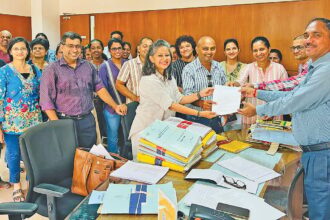
Text and Image’ at Goa University under its Visiting Research Professors Programme. With the focus on the rich tradition of storytelling in India through mediums of relief sculpture, water colours on plastered walls and paper manuscripts, Dehejia is guiding her students through the distinct modes of visual narration that artists in India have used over the ages. Storytelling is a universal practice crisscrossing national and cultural boundaries.
Dehejia’s first course looked at story-telling in sculpture with the focus on vibrant narrative reliefs where the literary sources used are a matter of conjecture. “Just as we can take a literary narrative and convey it as a poem or a drama, a novel or a short story, as a saga or in
flashback, so too with visual narratives. Different artists used different modes that ranged from monoscenic in which a single scene represents the whole story, to synoptic in which the artist places different episodes from a story in the same space, giving the viewer few clues as to where a story starts or ends. This creates a challenge for the viewer who must engage with the story fully to sort out the artist’s intentions,”
Dehejia explains. Her upcoming course will highlight the vibrant tradition of narrative in painted manuscripts where the actual text is on the reverse of each page and sometimes also carried on the painted page itself. The same artist would often use different modes of narrative to portray different episodes from the Ramayana, the Bhagvata Purana or other manuscripts, creating a challenging puzzle for the viewer to sort out. “Since the story is well known, the viewer is invited to engage with the artist’s portrayal. If you think of any Ramayana episode you
know well, wouldn’t it be more interesting to find it laid out on a page so that you have to engage with the characters to sort out the story? If laid out neatly, you might just turn the page as you already know the story.” Not enough is being done to preserve manuscripts in India and Dehejia says this is an immense problem that requires a determined infusion of funds which, of course, are in short supply. “Luckily digitization of manuscripts has started and hopefully will continue in full swing. That may not be quite the same as preserving the manuscripts themselves.
Our climate is not very friendly for paper preservation and extra measures like airconditioned premises for storage are needed if we are to preserve our manuscripts for future generations.”
History takes a low priority
in schools today and art history
is simply not taught.
Apart from being a professor
of Indian art, Dehejia is also
General Editor of MARG publications,
a Mumbai based not
for profit publisher and is
hoping to have an entire series
of units online in a few years
that will relate to the school
syllabi. She wants to ensure
that there will be free access
so that the school going student
will be introduced to
the riches of India’s heritage.
“I hope politics will stay away
from the accurate presentation
of history,” she says.
Dhejia has a background in classical
Sanskrit and Tamil and her work has
ranged from ancient Buddhist art to the
temples of North India, and from the
sacred bronzes of South India to art
under the British Raj. She has authored
more than 24 books and in 2012 was
awarded the Padmabhushan for her contribution
to art and education.
The course will be held from September
23 to 26 from 3 pm to 5 pm,
free of cost and open to students and
the general public.
Last month Doordarshan (DD) began
re-telecasting Purva Uttara: Past Forward,
a series of eight films that introduces
the viewer to eight spectacular sites
representative of the riches of Indian
artistic and cultural history. The series
focuses on the events and forces that
shaped Sanchi, Konarak, Mamallapuram,
Vijaynagara, Delhi, the Taj Mahal, Mewar
and Goa. Today these are icons of India’s
architectural and cultural heritage.
The series was conceptualized by
Vidya Dehejia and directed by Shyam
Benegal and Zafar Hai back in 1997 to
celebrate 50 years of India’s independence
and was aired on Discovery and
Star TV.
The film Rome of the Tropics: Goa
depicts Goa and its Roman influence.
The Portuguese came to India first as
traders and then as the ruling power of
Goa on the west coast. A large number
of churches began to be built. This film
will focus on Goa’s architecture which
represents a fusion of Indian and European
elements with influences from the
Renaissance, Gothic and Baroque styles.
French traveller Francois Pyrard de Laval
wrote of Goa around 1608 saying the
edifices of churches and palaces, both
public and private are very rich and
magnificent and were built by local
people. Dehejia says it was difficult to
choose the eight sites since there’s such
a wealth of material. “Goa was chosen
partly because it so often gets neglected
and it is an important part of India’s
cultural heritage,” she says.
Rome of the Tropics: Goa will be telecast
on DD on September 24 at 4 pm
with repeat telecasts the next day at 12
midnight and 8 am.