Fernando Monte da Silva
Earlier this month, the Uttar Pradesh tourism board invited select travel writers from across parts of the world to be a part of their Travel Writers’ Conclave 2015, wherein these writers were then taken through a series of short tours through the distinctive cities of Agra, Varanasi or Lucknow, which in turn offered them the opportunity to take back with them great experiences revolving around heritage tourism in the state. The event culminated in a major conclave that had industry experts formulate a road map to take forward tourism in Uttar Pradesh. However, what was highlighted, repeatedly, was the need to focus and emphasise on heritage as the mainstay of the concept. There can be no doubt that Uttar Pradesh is also looking at the expansion of the state’s tourism through the wildlife sector as well. However, their preservation of all things Mughal, Hindu and Buddhist is their main focal point. One could well ask how that is conceived. Simply put, through what is called The Uttar Pradesh Heritage Arc.
This initiative began through a series of endeavours that began in the year 2014. The Government of Uttar Pradesh undertook a number of initiatives to realise its vision for the Heritage Arc, which would in turn promote tourism. Statistics recorded for the 2014-15 winter tourist season highlighted the level of success that these endeavours achieved, with the state recording higher tourist footfall figures than Delhi or Rajasthan.
The Chief Minister of the state, Akhilesh Yadav who has endorsed the project, says “The Uttar Pradesh Heritage Arc stretches right from Agra to Lucknow and Varanasi, covering an area of approximately 700 kilometres in the process. It is a chain of survey triangulations that has served as an important step to boost tourism in the state of Uttar Pradesh and effortlessly links together great epochs of Indian history, art, culture and tradition – Agra, Lucknow, and Varanasi.”
Agra alone is a huge site of importance for the Heritage Arc, and has three UNESCO-endorsed heritage sites nestled within its boundaries: the Taj Mahal, Agra Fort and Fatehpur Sikri. As of now, two more are in the pipeline; namely the tomb of Akbar situated in Sikandra as well as the tomb of I’timad-Ud-Daulah, also known as the Baby Taj. This brings us to the comparison between Agra and a site of immense heritage value in our own state, namely Old Goa.
While Agra has three monuments of historical importance, Old Goa is by itself a site endorsed as a world heritage monument in its own right. Seven sites within its geographical boundaries have been declared as places of heritage value; the Basilica de Bom Jesus, the Se Cathedral, the Church and Convent of Saint Francis De Assisi, the Chapel of St Catherine, the Church of St Cajetan, the Church of Our Lady of the Rosary and the ruins of the Tower of St Augustine. That being said, while both states have the watchful eye of the ASI on them, the approaches being adopted appear to be drastically different. A look at the pictures above will indicate that while one of the minarets of the Taj Mahal is being maintained, it has carefully structured scaffolding that surrounds it, ensuring that no damage comes to its elemental structure. However, in similar vein, while maintenance work was being undertaken by the ASI at the Se Cathedral in Old Goa (the largest and first cathedral in Asia), slabs of stone were roughly hauled up using pickaxes, and were then left unattended to as work involving cabled ensued.
“The project involving wiring and cabling on the side altar was one that was required and had to be undertaken. However, whenever we undertake such projects, we ensure that the sites in questions are returned to the condition in which they were found when said work began,” says Abhijeet Ambekar, the Assistant Archaeologist working with the Archaeological Survey of India (ASI) in Old Goa. Yet, many people remain sceptical that such projects, when completed, return these sites to a state of authenticity.
Furthermore, this could devalue the historical value placed on such sites by UNESCO and the ASI themselves. When asked why no other sites in Goa had been added to already list of seven existent monuments on the list, Gangadhar Korgaonkar, the Deputy Superintendent Engineer with the ASI, stated “When structures undergo any modifications, their value decreases, leading to us questioning whether they should be added to such a list.” This then questions the viability of endorsing such a ‘cabling requirement’ at the Se Cathedral and the devaluation involved in the process, given that adding something that wasn’t existent prior would count as a modification.
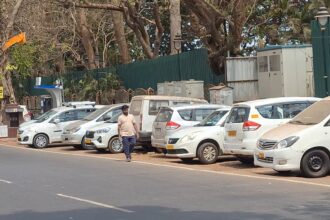
Another matter which potentially needs addressing is the traffic and parking issues in the locality as well as the cluster of hawkers that have set up permanent residence. This causes an unsightly mess, and results in disarray around the heritage structures. Which brings to mind the exposition of the relics of Saint Francis Xavier. If there can be a demarcated parking lot with rerouted traffic then, why can this not be observed throughout the course of the entire year? There will be much chatter as to how people will be expected to commute in such heat (and many other reasons). Agra’s solution for this is to set up a peripheral boundary with a parking lot, beyond which vehicles are not allowed to proceed. From that point on, electric shuttles are used, carrying everyone from the physically fit, to the disabled, in comfort.
Father Alfred Vaz, the Parish Priest at the Se Cathedral shares information on this front, saying “The civic-minded response of the people is paramount to having such factors come into play, to be honest. Very often, we set up barricades for certain reasons. Tourist vehicles push them aside and make their way into areas that have been cordoned off. At times, we have volunteers that can help us with our endeavours, but on a day to day basis, it is not really viable. We can certainly provide the space for parking for such an endeavour, but the other logistics that are involved certainly need to be worked out.”
But there are other issues that also need to be addressed. Issues which tend to affect the common man and regular visitors. One church-goer, Isabel Pereira, a resident of nearby Corlim took time out from her weekend morning prayer to voice her chagrin at the constant flow of visitors through the religious edifices of the area, stating “I find that the sanctity of the religious structures is simply not respected. Many domestic tourists come through in attire that simply does not befit the visiting on a site that is religious in nature. If they wouldn’t dress in this fashion to go their own places of worship, how is it fair that they do so here? Furthermore, there is constant chatter when they go through the Basilica or the Se Cathedral. This is a nuisance to those that come here for reasons such as prayer or reflection. I think that the tour operations need to be limited to certain hours. After all, it should still be regarded as a church first and a tourist attraction second.”
Which raises a valid point, of why certain decorum cannot be enforced, at least in terms of attire. This once again raises the comparison between Goa and Uttar Pradesh’s individual approaches. For instance, a site such as Fatehpur Sikri does not allow visitors to enter with shorts. Or with heads that are exposed. Men, irrespective of their faith when they pass through the mighty Buland Darwaza, wear a topi, while women cover their heads with a shawl. Does this then not beg the question of how there can be such a vast difference between that and the singlet and boxer shorts-clad brigade of tourists that make their way to Old Goa?
Father Alfred shares his views on this, saying “We have implemented signage in and around the churches, which is indicative of the fact that people who are scantily clad will not be permitted. However, do we have sufficient manpower to implement policies to the extent that we would like to? No; absolutely not. We would require at least a six-member security team, in order to keep tourists of that nature at bay. We have had many issues where altercations have broken out on this front, and we are simply overwhelmed, as the costs involved with having such a team in place is also prohibitive.”
The government has been flagged in the past for junkets involving a brotherhood of globe-trotting politicians that hop from destination to destination in the name of promoting tourism. However, perhaps the solutions are sometimes far closer to home and we can learn something from our next door neighbour before reaching for the dark side of the moon.