Alvarinho Luis
Goa is on a fast (or slow?) track to modern development in terms of infrastructure and road network for the last few years. A good road network is the backbone of the tourism industry (and also coal?).
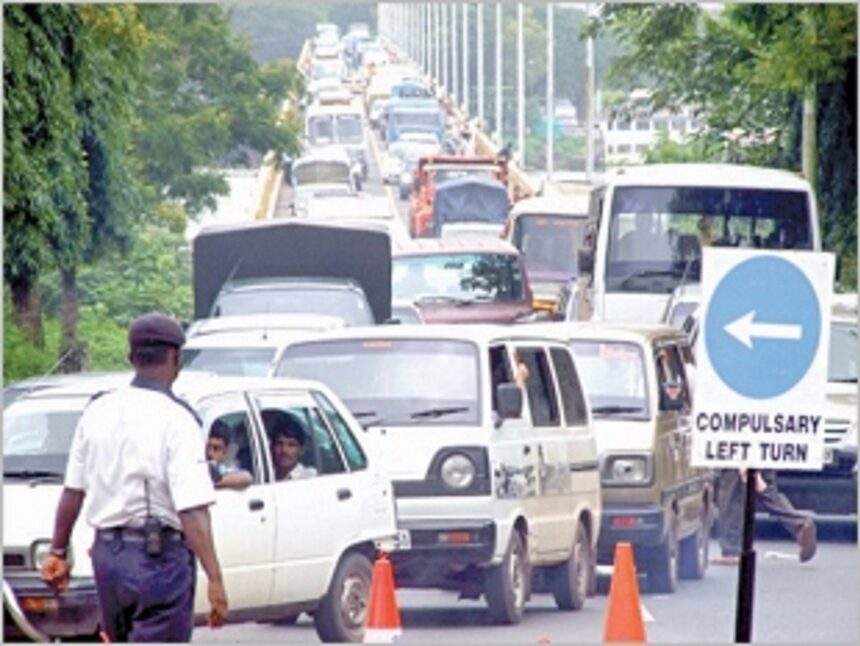
The government has taken a slew of initiatives to add a cable-stayed bridge (albeit much higher!) to the existing two over the once-beautiful Mandovi river (or Casino river?) and an ultramodern one over the picturesque Zuari river, with a mindset to regulate traffic and minimize ‘jams’. Unfortunately, poor traffic management, on the part of the road construction companies with no proper planning from those in authority, is becoming a nightmare to the road users, in particular the commuters. If you are driving a four wheeler between Panjim-south Goa or Panjim-north Goa, it is unpredictable when you will reach your destination. So set the mobile tone message to “I am trying my level best to come out of the ‘jam’, please bear with me as all possible lifelines on this route are busy, please try after sometime.”
If you are the bride/ bridegroom travelling on any of above routes on your wedding day make sure that you inform the priest to go ahead with the nuptials and that you would join in later. The potholes and invisible speed breakers (yes, they have been painted white in Aquem-Margao!) are becoming nightmare for the same tax payers who pay road taxes (also add GST) to the government coffers, in return for good roads.
And mind you, you are not the only one to ‘suffer’ from the traffic chaos, the VIPs cutting across political lines are also missing flights, not just one or two but three, due to these ‘jams’. So don’t worry be happy because is there will be ‘bright’ light at the end of the tunnel or every dark loud has a silver lining. Just as the holy book commands you to honor your parents, kindly honour the words of wisdom of our respected CM published in Herald: “Some problems are inevitable. If you want a new bridge, then one will have to suffer some pain as the outcome of it is going to be sweet.”
I am not an Engineer by profession, but let me spell out an evitable solution to the make this jam sweeter. I am familiar with the ground reality between Bambolim and Cortalim junction as I commute on this section every day, but I am naive to the Panjim-Porvorim section. I believe that the barricaded islands, whose perimeter is sometimes triangular or circular, as one of the reason why the traffic moves at snail pace on this highway. The geometry of the barricade reminds of trigonometry which I learnt in 12th class. As you descend the Siridao hill, all you have to do is move along the periphery of a protractor till you reach the zenith (90°) which is the Siridao junction. Then you need to steer a little to the right carefully and slowly negotiating the oncoming traffic and the protecting, at any cost, the kings and queens (also add bovines- they are to be treated holy!) of the Siridao kingdom. Pedestrian/ vehicle crossing is a major bottleneck at Siridao junction. To tide over this problem, a foundation stone for an underpass road, connecting Siridao market and Palem, was laid many years back by the local MLA Shri Francis Silveira, which has never seen the light of the day. Many lives have been lost on this section due to overtaking and crisscrossing with the wisdom that ‘I am the king …I will go first.’ With the barricading the sloppy section of the highway, the situation has become precarious which invites immediate attention of the authorities for a solution. Will the authorities take up the underpass road on priority basis?
All is not well at the Agassaim bypass road either, where 2-wheelers suddenly enter the main road creating a jittery situation for the main traffic. The DBL company trucks emerge from behind the barricaded wall onto the highway further compounding the chaos. The worst traffic congestion which is the order of the day during peak hours (9-10 am and 6-7.30 pm), and more so at the year-end, which takes place on the approach road to the Zuari bridge on the either side. The two-lane system on this section chokes the traffic, which becomes unmanageable if there is a serious accident on the bridge. The police or ambulance personnel are helpless to make it to the accident site on time. So hopefully the ongoing work for a six-lane bridge would alleviate the congestion sometime in 2022 (dreamingly!).
Another reason that leads to chaos is crowding of vehicles at the bottleneck by jumping the lanes. Adhering to the lane system and speed limit are hardly practiced in Goa, unlike in north India. The two-wheelers, with or without helmets, have no patience to wait, so the zig-zagging criteria help them to ‘get out of the mess.’
The traffic chaos has reached a serious proportion with the barricading of the highway at critical points. The public transport is not very efficient and breakdown is unpredictable. So commuters prefer their own vehicles preferably four-wheelers which have increased sharply disproportionate to the road taking capacity. The driving discipline is slowly fading away, and the principle “I have to somehow reach the destination” is practiced today. The use of electronic devices and drunken driving cause serious accidents on the highways. Rules are in place but do the Goa police have enough personnel and vehicles to man the traffic? Realizing the ground reality, the government has woken up from the slumber; they are going to setup a special cell and procure 46 new 4-wheelers to control the traffic and to make your travel to north and south Goa from smart Panjim ‘a shorter one.’ Let’s wait and watch!