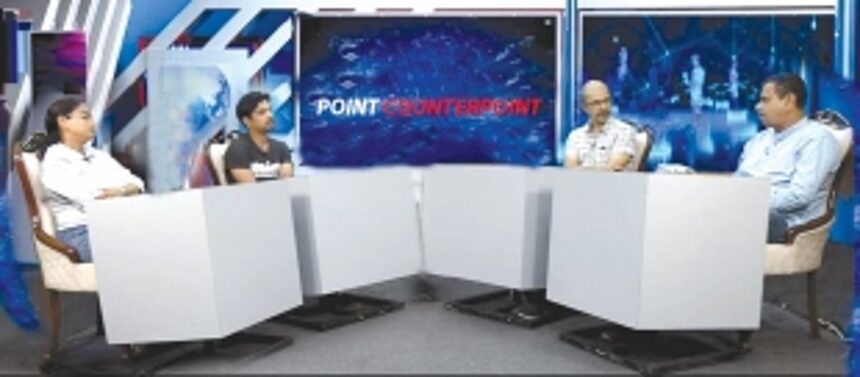
ince ages, print media ruled the news scape. For a long time, it had no completion on the horizon. In India especially, there was no threat from even television for a long time as there used to be one national channel Doordarshan, which encompassed everything – entertainment and news.
Then came the 1990s, the era of post-liberalisation. We saw for the first time, the emergence of private television channels giving us more variety than Doordarshan. Gradually news media channels started cropping up and by mid-2,000, we had news channels mushrooming. Despite the stiff competition from electronic media, print although started to struggle a bit for advertisement revenue pie, it still managed to pull on.
Then post 2010, we have seen a boom in digital media and post pandemic, social media has engulfed us completely.
The growing boom of social media and decline of conventional news media has thrown up an unwanted paradox. On one hand, the unsolicited content posted on social media platforms like WhatsApp is being consumed blindly by people, sometimes leading to social unrest; on the other hand, the relevance of conventional print media has become a point of concern.
The question therefore is whether print media is really under threat and is the future of print media over? If yes, then why? If not, then why is it still relevant and how does it still have the chance to get back in creating and consuming news in the manner we used to do in the earlier days.
Vailarose Fernandes, Faculty (Mass Communications), St Xavier College, said that it is a relevant issue to be discussed, more keeping in mind that traditional media and social media are totally opposite from each other.
“Traditional media was perhaps more regulated to a certain extent in terms of news we were getting through gatekeepers over a period of time. What has happened now is with the advent of social media, information dissemination has become unregulated. I think that’s the area of concern for a democratic society like ours,” Fernandes said.
“Apart from that, I don’t think print media will die out because every time we see a medium being born; it is not the only thing regarding how the content is reaching the masses. It is also very important that the media may also become an important player. But the question is who is controlling the media? I think that plays a key role. At the end of the day, the audience or news consumers decide which medium will be part and parcel of their lives,” she said.
According to her, right now social media seems to be the “new baby in town”, every one mushing over it considering its reach and flexibility.
“But I think, the good old print media journalism will be there for the next 100 years. It’s not going to get just wiped out,” the St Xavier’s College Mass Communication Faculty said.
Nolan Mascarenhas, a Culinary Alchemist said that one of the driving factors of social media’s consumption is a very simple phenomenon called FOMO of Fear of Missing Out.
“It leads to the rapid pace at which information is being consumed. We look at our phone and we wind innumerable amounts of communication going on. That is invasive enough to understand that it is part of our life’s ecosystem. This is not something we can run away from, unless we decide to become a hermit and snap all communication with the outside world,” Mascarenhas said.
“Having said that, I come from the old school of journalism where we would fact-check, cross check information and the sources before disseminating the information in public domain,” he said.
He added that the format is not changing anytime soon, perhaps because of the geographic location in terms of getting the paper delivered because it is easier to get it to one point of a place compared to another. But are people reading the same information in a concise format? Yes they are, if the message is still the same.
“It is very important to understand this. I was reading in a study that in a world of cacophony, it is actually meditative to read a piece of writing in a piece of paper. 87 per cent of the focus group basically said that it is peaceful to read versus scroll. As one grows older, he or she tends to slow down in terms of cognitive recipients. At the end of the day, keeping it written and keeping it concise and articulate is something which is there to stay,” he said.
Since the consumption of news generated through social media is very high, how much of it would survive the test of authenticity?
Derek Almeida, former Editor of The Goa Everyday, said that social media is a very large platform having a variety of information. News information is just one component in the social media space.
“I see print media has also entered social media. That’s the change social media has imposed on traditional media houses. The only problem is the revenue stream hasn’t caught up. Content is being created and posted on social media platforms, but somebody else is getting the revenue. That to a great extent has only been fixed in Australia, where Google and Facebook are made to pay for the content. Last year they paid nearly 200 million Australian dollars to media houses. Revenue has caught up in Australia, elsewhere it hasn’t. That is the big problem,” Almeida said.
As far as the genuineness is concerned, for long there have been two professions one could put on the card, without being qualified for them – social worker and freelance journalist. Anyone could do them.
“Today we have trained journalists in media houses. Lot of them undergo long years of constant checking on what’s getting in, if the information brought in is correct. In social media, there is absolutely no control. Anyone can start a page, launch a news channel,” the former editor said.
He added that to launch a newspaper, one has to go through a lot of process. In social media there is no process and therefore there is no control. Nobody wants to control.
“In case of a newspaper, there is a trust factor. In the case of social media that is not there. One doesn’t know the content creator or the authenticity of the information. Finally you have to go back to the journalist and his or her credibility for trusting the content,” he said.
Vailarose Fernandes added, “When we say credibility is more with formal news media organisations and a journalist, everyone now is claiming to be a journalist because now we have a concept called citizen journalism, where people generate news related content using the smartphone. Since there is so much of this kind of space where anyone can generate content, there is also a need to educate the rest about how you can verify the news sources.”
According to her, this is a shared responsibility between the people and news organisations. “We can’t blame alone the journalists for not doing their homework well and putting out unsolicited information or the gullible audience which believes in everything that is shared on social media. So, it’s a shared responsibility in terms of how you conduct fact checks. Already Google has taken this kind of initiative by conducting workshops,” she said.
A lot of media organisations, globally and in India have a high credibility like the Asian School of Journalism. Should the journalism and media schools also focus on fact checking?
“Yes. Fact checking should be part of courses run by journalism schools in the country. The training can’t be complete without these skills,” she said.
Almeida said while he takes efforts to tell people about fake information, it is very difficult to fact-check everything.
“If you take the Ukraine war as an example, you will find the media from western countries are giving a particular side of the story. The Russian media is saying something totally opposite. Once you put up both the versions together, you get to see the real story. Only then you can draw a definite conclusion,” the veteran journalist said.
According to the Editor, Dainik Herald, Avit Bagle said that he entered the journalism profession in 1990. From that time till today, there has been this common speculation that print media would diminish.
“But actually my experience is completely opposite. If you see the Marathi print media segment, the Bhaskar Group of Madhya Pradesh entered into Maharashtra with its Marathi daily (Divya Bhaskar), the Lokmat Group has grown from Nagpur to Goa. Even the Sakal Group has expanded from Pune to Nagpur,” he said.
Bagle said that in the Goa market, there were only a couple of newspapers once upon a time. Today there are 11 vernacular newspapers. It shows that print media is growing. Earlier, on average 20,000 copies used to be sold, which has grown up to 60,000 everyday.
“There was a time when radio dominated the news media market. Then television came. Radio evolved and brought in FM channels with greater entertainment quotient. When the private television news channel boom happened, it was said that the market of newspapers would shrink. But that has not happened,” he said.
This is because Indian psychology still believes that whatever is in print has to be true. So, even if you see any news on a digital platform like a website or YouTube video earlier, one is prompted to read the same news in the print the next day. Same goes for social media platforms like WhatsApp for confirmation.
Consumption of news by news organisations has also changed. Earlier media entities used to rely a lot on news agencies like the Press Trust of India (PTI), the United News of India or the Reuters. Now they rely on news apps like InShorts and social media to gather news from various sources, which act as news aggregators.
“These news aggregators might die because websites have started to erect payment walls. Gradually you have to pay subscription fees to read the content. Once that happens, the aggregators are going to have a problem, unless they take out a chunk of their money and pay. That is going to happen eventually. Tomorrow the situation will arrive where just like we pay for a newspaper, we will have to pay for a website and then the choice becomes important because one can’t pay for 20 websites,” Derek Almeida said.
Newspapers became a very much part of the family in yesteryears. Papers would be read, and shared. In villages, people used to sit under a tree and wiseman would read the news and discuss it. So, news consumption was a very community oriented activity.
A lot has changed today with the boom of digital media platforms, which has brought in change in the way youth consume news. Is there a shift in the whole regarding people not used to having a physical newspaper in their households and therefore a lot of habits they have inculcated is different? Maybe they are not as linked to their culture as it was earlier because the newspapers played that part.
Vailarose Fernandes said that one thing that has happened because of social media and the way youngsters consume news, they of course want to consume more of which is entertainment-driven. The moment you tell them news, they tend grow hesitant as there is more political content in it.
A lot of youngsters who are interested in sports go on to read the sports section first. Newspaper reading is a habit that has to be inculcated by the seniors of the family. You don’t have that space anymore.
“Post-Covid, a large number of traditional newspaper readers have moved on to viewing the same on e-papers and websites. But even if they are consuming news on digital platforms of an established newspaper instead of a news aggregator, it is a good sign. Because then they are aware of the developments happening around them. Otherwise you ask them what app you have on your mobile for news, they will say InShorts,” she said.
The problem with news aggregators is they will give only what is trending. It is also customized according to your profile and news reading trends. Youngsters are not aware of it. They need to be told that even if they are reading news on these aggregators, at some point of time, they must go back to the newspapers for the full story.
“That’s a habit I am trying to inculcate in the students, because if you just rely on social media, you are going to consume what is trending and what’s popular. I don’t think news can be a form of popular culture. Cinema is, but not news. So, it is very important to educate the youngsters right now because they are inclined towards social media and it is difficult to bring them back to traditional newspaper reading habits. We need to balance and make them aware. They need to make the decisions ultimately,” she said.
Social media has given a new meaning to the term followers. In earlier days, followers meant that you were a disciple of a sage or owed allegiance to a political leader or a celebrity. But now the system of followers on social media indicates the community that follows your content. Even politicians and political parties have caught on to it as social media gives a database of who’s watching you, who’s listening to you.
Quite unlike readership, where you don’t know who’s reading your newspaper, how many pages are being consumed, what type of news is being most read in the family whereas in social media you know who’s reading it, their profile and through analytics you know exactly from which region and at what time band people are consuming your content. So, doesn’t this become very attractive for people creating content but also the advertising lobby?
“For advertising industry, this is a very important database,” said Derek Almeida. “Even in the case of print media, it is very important to know how many copies are being sold, to whom and where it is being sold. These numbers are very important for advertising,” he said.
According to the former editor, the advertiser first places the advertisement and then knows the response by the number of calls.
“Social media is far more advanced. It is digital and audio visual format. Here you get the profile of the followers very quickly, likes and dislikes. It becomes much easier to target advertisements. Google are the ones who actually started it. It is very important to know who the followers are and where they are located. It becomes easier to pitch the product or the service. At the end of the day, revenue is very important,” Almeida said.
Advertisement has been subsidising the cost of newspapers for a century now. But revenue is the key. To know who are your followers and social media is a big help in knowing it. There is a limitation though for smaller newspapers. You can have readership abroad also, but that might be enough to generate revenue. The media house has to focus on the local market more, like Goa.
Nolan Mascarenhas cited the example of Apple, the multinational technologies company. Facebook has lost out three to four per cent of its entire revenue only because of Apple’s privacy policy not to mine data from people who own an IPod. Now you have an option of an advertiser tracking you versus not tracking you every single point of time. Perspective – Facebook loses close to 3 billion US dollars in advertising revenue, just because of this.
Android is completely different as a platform. Google played another game by pumping in USD 1 billion every month so that it could be a preferred choice apart from a Safari browser to have a Chrome browser. At least they still have all the Bots working for them in that front to get all the data mining coming in to disseminate across non-Apple device users because they have their own ecosystem as well.
“This is what technology does. This is scary because all of us are data BOTs where life is completely open out there, for people to consume our thought process and manipulate it as the need may be. Now we are in a watchdog status. Who is watching this entire process? When you are looking at someone with psychological hats of credibility, what is the agenda, no one has any idea about it,” Mascarenhas said.
But if you have a set up and communicate to an audience which sees it through a device, which is a mobile phone or an IPad or a Tab, you are basically the king or messiah to the one who is following you out there. That is the first word which is coming out but is it credible or not we don’t know. But it is the first mover advantage that is hitting.
“So your browsing habits and other online stats are known, which acts as an insight for potential advertisers to go after you. So when you show preference for a particular car sitting in your home, very quickly you will find numerous such car deals coming up on your screen,” he said.
Let’s get to the field of politics as it plays a huge role in the field of journalism. The thing is, how does print media handle the changed situation, where a politician thinks that he no longer needs the traditional journalism platform to spread his message to people? He or she can have his or her own social media page or a YouTube channel to convey his message directly to the followers in the particular constituency.
The consuming public when it gets the messages directly from the particular politician – be it election candidate, incumbent MLA or a minister, they are getting filtered information without getting the full picture. They are not getting nuanced views on a subject. What are the after-effects of this situation? How long will this work? Will there be a time when the politicians would have to come back to the traditional journalist because ultimately people need perspective. But if people know only the politician’s views, they are the winners.
Responding to this, Avit Bagle cited an example from his news reporting days 25 years ago.
“There used to be press room in the Old Secretariat. Those days, the minister used to come down to the press room in the evening and would brief the journalists about the decisions he had taken in the day. Now, these politicians are hiding behind these social media platforms,” Bagle said.
The editor of Dainik Herald said that they only give a four-line tweet or a sound bite in front of the television camera and their work is finished. There is no cross questioning, they don’t consider themselves answerable to questions by journalists. They don’t even answer phone calls by journalists because they can reach the masses directly through social media.
“My point of view is that the newspaper should go beyond these statements and report on issues that really matter so that they are forced to follow the journalists and forced to come back to them for giving clarifications and further inputs,” Bagle said.
Vailarose Fernandes said that when one talks about how to change the situation in terms of journalists and politicians, she said while it is necessary to give politicians their due importance, beyond that the journalists have to go the field and get strong content in terms of stories and photos.
“If you look at it critically, I think journalism also got into an armchair way of gathering news where you send emails, you see what’s trending. I have observed news organisations in Goa which ask you to send a photograph, send a report, which would be carried. If the journalists again want to get back followers, readers and subscribers, there is a need to understand that even a normal person is also looking out for content that is closer to their heart, something that is relevant to them,” Fernandes said.
It is not essential to always report on what’s trending on social media or what is important politically. Media has to go back to good old journalism, whether it is investigative journalism or human interest stories, which we saw during the pandemic.
“There were journalists who went to the field and gathered such news content and people started appreciating it. It made people understand how Covid was taking over a country like us. But if we sit back in our office rooms and then start building up stories then the blame for decline in news followers should lay on journalists too, not just social media,” she said.
She added that the trend of armchair journalism is growing even more now with Artificial Intelligence coming in. They are now going to go through the sources and news, just aggregate the information and put it out. This is going to diminish the manpower even faster than one can imagine.
According to Almeida, exactly the opposite is happening in Australia. Ever since Google has been made to pay, more people are getting into journalism, more people from journalism schools are getting employed in small newspapers. Money is changing all that.
“So, there will always be a need for such journalists. When you talk about politicians getting across their messages directly, as a voter I would like to listen to those candidates in my constituency. I don’t need the traditional media for that. But I will need it to give me the larger picture of the situation and provide a fact-check of what he or she is saying. Fact-checking is something journalists should do,” he said.
When asked about how traditional media can continue to thrive and new media could be a repository of good quality journalism, Fernandes said that journalism is here to stay. Perhaps everyone is a little sceptical about how it will turn out in the next couple of years.
“But when we are talking about the transition that is taking place by old school journalism with the advent of new media, the main onus also lies on readers and people who are consuming this content. It is more important to think of ways and means of informing the audience and making them a little more critical about what they are consuming,” the Mass Communication faculty at Xavier’s College said.
She said that they should also understand that when they prefer a particular content in any medium, why they are vouching for it. So, I think critical thinking is very important in a country which is the largest democracy in the world. This is lacking in society today.
“When it comes to print journalism, because of the strong cross-checking process, the credibility is much higher than social media. If traditional journalism has to migrate to new media platforms, the only way of boosting that credibility would be to understand who your audience is and what they are looking for. Create avenues where you can have a dialogue with the avid readers or people who come back to you either on your YouTube channel or Twitter handle and share their feedback,” she said.