Dodge feels that the coaches should develop themselves so that they inculcate their internal passion and drive upon the players for success
Herald:How long have you been coaching for the Foundation?
Slaughter: I have been associated with the foundation since 2006. I started my career teaching at grassroots before joining the foundation. I am into coaching for around 14 years.
Dodge: I have been with the foundation for the last two years but involved in football and coaching since 2008. Earlier, I was working for English Football Association and Charlton Athletic Football Club. My history of coaching includes communication sessions in schools, colleges, universities, etc. and also grassroots.
Herald: What made you to take up coaching?
Slaughter: I would probably say it was because of my brother that I joined coaching. I was a rugby player but at the age of 18 I stopped playing and set up a football team for my brother, who was suffering from intellectual disability, so that he had some way to express himself and enjoy football. After two years of grassroots for non-disable children I joined the foundation and that’s where my coaching career started to develop. I was doing more courses and coached more teams.
Dodge: I like teaching and so I decided to make my career in coaching. I enjoy teaching more than playing so that’s when I took my career in that way. As my career progressed I was into educating coaches. My job in the foundation is to work for improvement and staff training.
Herald: What is the important part of being a coach?
Dodge: An open mind. Not being scared to express yourself and try new things and also to understand what you are trying to coach. You have to first understand yourself how to coach, the different styles of learning and different ways to deliver the options available to you as a coach.
Herald: What values do you set as a coach for the foundation?
Slaughter: Number one value is to see that everyone is enjoying, having fun and learning on and off the field. Enjoy yourself as well because if you are not enjoying the football than what is the point in doing it. Second, is to develop myself. Because developing myself will inspire my players, my staff and coaching to compare themselves with me.
Herald: How is India improving in terms of football?
Slaughter: When I came in India in 2014 the Indian Super League (ISL) was just in formation. What I have noticed from the different States, I have been to over the time, is that Goa is the most popular when it comes to football. However, with the ISL, I think there has been so much of interest in football all over the country. It has been just growing. In terms of technical ability I don’t know, but in terms of passion for the game I see it really flourishing. Hopefully, like grassroots and participation has been growing, the technical level should start to grow as well which will help in developing stronger player for the national team.
Herald: What is the success behind Tottenham Hotspur?
Dodge: It is philosophy that has taken the Tottenham team to such heights. The whole philosophy is designed to create intelligent footballers and that comes from the stuff that we are doing here (in Goa). We design our sessions and see how the problems can be solved by giving them a chance to make a decision. We gradually increase the level of difficulty so we can try out some new things around.
Herald: What does the coaches and players need to reach the top level?
Slaughter: The coaches need to continue to develop themselves by doing more courses, seek more experience and practice. One can only be good at something only if you practise it. They need to take ideas wherein they can think how can, I change this, make this work for my environment and the people that I am working with. On the football field, a coach needs to create the carnival feeling by making players feel comfortable.
In terms of players, I feel there is need of change in attitude across the country. India is lovely place, however it is too formal. It needs to become more informal. When you think about the players warming up, the message across India, not just in Goa, is very static, formal. In India, there is a traditional way of creating the players in a technical and physical development, which needs to be changed. There is a need to make dynamic movements and challenge our bodies the way we are moving, the way we are using our brain to think.
Herald: Do you think there is need of foreign coaches for India?
Dodge: Not exactly. In India, the coaches need to develop what can be boosted by learning from foreign coaches, but every individual coach will have his own way of learning. Some may choose to watch others, some may learn from the book while some may use internet. Whatever it may be, the final conclusion is that the coaches need to develop themselves so that they will have that internal passion and drive for the players to develop. It is not just going for a course or attending it, you have to understand and practice.
Herald: Which was the highest peak for Tottenham?
Slaughter: The team finishing in the second position at the English Premier League 2015-16 season is our highest peak. It is a progressive team and a strong team.
Herald:What is your job at the Tottenham Hotspur Foundation (THF)?
Slaughter: The foundation is endorsed by Tottenham Hotspur Football Club and its aim is to create opportunities that change lives. Our responsibility is to work for charity. Our focus is the grassroots wherein we have exercise programmes for the schools and universities to develop skills in football. The foundation is similar to Goa Football Development Council (GFDC).
Herald: What Goa needs to develop football?
Slaughter: Empower young players to keep a carnival feeling around football and embrace the same. The passion for football needs to be generated. Young players need to be encouraged to be curious with football for many years like it had happened with cricket. If you walk around in Mumbai or Delhi you see kids playing cricket while in Goa children prefer football on the beach or on any other field which is beautiful thing to see. ‘Passion for football’ should be the motto.
Herald: How was your four-day programme in Goa with the Special Olympics coaches and other players?
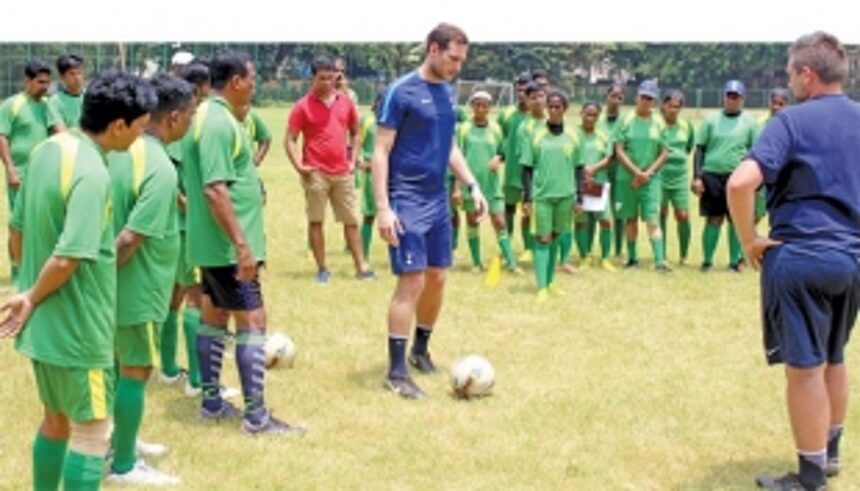
Slaughter: Fifty coaches participated wherein they were they were taught methods in the Tottenham Spurs way. The players were given one ball each for most of the sessions, having the ball rolling for 70 per cent of the time so that all the athletes are involved for the maximum time.
Herald: What about the one-day session with the GFDC players?
Slaughter: Our focus was changed from people of special intellectuality to older age groups 13 to 15 age group. Our sessions are much more technical and tactical based, so we thought them how to break the game down, so that even a 4 or 5 year-old Puyol Gayle would be out to understand how to play.
Herald: What is the difference between yours and Indian style of play?
Dodge: Our style is near the same but we go little bit in detail. We keep attention to lot of things outside the sessions, the structure, the planning, etc. The basics of our session is how can a player be included in the team and we make sure that we get our outcome. We are thinking two or three stages ahead as we have a bigger plan to the sessions. We are here to teach them the tricks and the tools we use which will help them improve.
Herald: Is this your first visit to Goa?
Slaughter: I had come to Goa in 2014 wherein I had sessions with the GFDC coaches. We gave an introduction to a lot of staff which we are talking about today. In 2014 and today, I have seen a lot of change in these coaches. The techniques that were shown in 2014 have been developed by the coaching staff and there is a lot of improvement in them. GDFC coaches showed us an example of their own session today which was similar to what we had expected. They have the foundation already and we are happy with what we have seen. The coaches have done well and developed their ideas so now we can go to next step in coaching techniques. May be in two or three years if we happen to come back we’ll see another improvement.