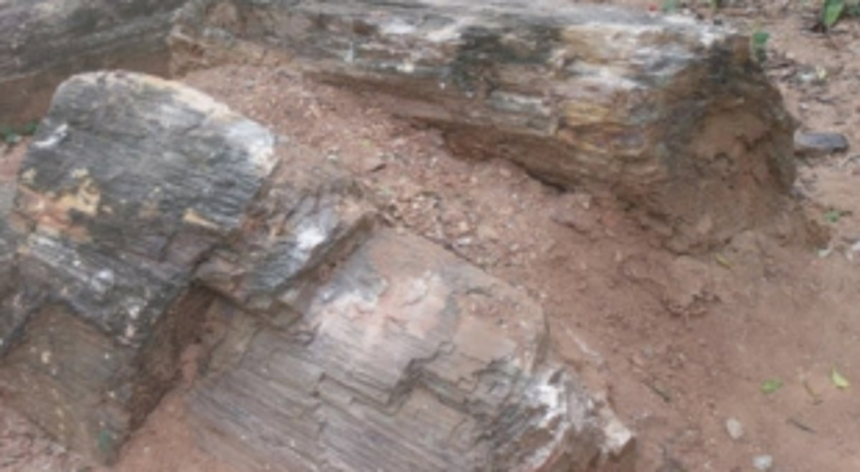
The story begins back in 1875-76 when a British surveyor described the local rock exposures along a stream bed as ‘petrified fossil wood’! This has been considered as a gospel truth by the pundits donning the hats of ‘scientific thinkers’ of today who have taken it at face value to propagate the idea of Goa hosting a ‘petrified fossil forest’ in the village of Khotode of the Sattari Taluka. Some even have claimed it to be 6.5 crore years old. This idea is not only bogus, but also misleading to citizens, and falls flat when investigated by a geologist. Therefore, the term ‘petrified’, instead of its technical usage, appears to be more of a metaphor as the mind appears to be “petrified” and blinded to the facts pointing otherwise.
Busting the myth is inconvenient as it tries to challenge the person/s who profess about it and break the conviction of their followers. This idea of Goan Petrified Forest is likened to the Akal Wood Fossil Park in Rajasthan. The latter is indeed a fossil forest, but in Goa it is not, due to the following reasons:

First things first: What is petrified fossil wood? It is a molecule-to-molecule replacement of dead wood/plant tissue by a mineral (commonly quartz) via high-temperature circulating fluids in geological environments. Characteristics of a fossil tree? Perfect preservation leading to the formation of a replica of the bark of a tree, now transformed into a rock. Occurrences in Goa? Anecdotal shreds of evidence exist in the form of some peat (type of coal) occurrences in the clay layers within iron ore mines of Goa. Rocks in Khotode? The area consists of meta-igneous and meta-sedimentary rocks (Gokul et al. 1985) which are more than 250 crore years old. These geological facts are unequivocal in their charm to hard-hit on those trying to cozen the people of Goa.
I was a part of the team of geologists from the Geological Society of Goa that visited the above mentioned site to investigate the tall claim. The observations were straightforward! The purported ‘fossil wood’ was screaming and pleading to us to reveal its true identity. It was in fact a Banded Iron Formation (iron ore bearing sedimentary rock), testified by the truthful magnet that got attracted to it.
This ground truth was cross-checked with the geological map of the area prepared by geologists from the Geological Survey of India in 1985 that reposed our faith in the field observation. For a layman, the rocks, in certain sections, showcased grooves and growth rings resembling the bark of a tree, but in fact, for a learned geologist, they were truly geological folds formed due to forces of nature. The first ‘Trees’ appeared on Earth 42 crore years ago, and the oldest fossil wood found is approximately 39 crore years old. As mentioned earlier, rocks from Khotode are 250 crore years old. Only people with math phobia would not grasp the number game. It is evident why the self-proclaimed ‘scientific thinkers’ get fooled. Such characters try to search for comforting evidence that suits their readymade results.
Scientific curiosity and inquisitiveness use the mind as a playground to chalk out various causalities for the myriad of observations and processes. An informed mind should always be careful about stitching the possibilities because the process does not always weave out a scientifically sound story, but the one that may convince the audience, the public.