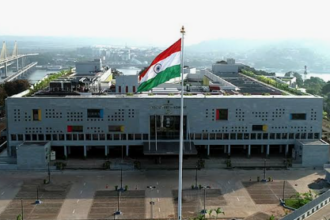
PANJIM: December 16, 2016 has finally come around, and with it, so has the beginning of the Serendipity Arts Festival. Much has been said about the festival, including how it will be an eight day-long immersive art-related experience across eight venues in Panjim, with a total of 14 curators facilitating dialogues on a total of 40 commissioned projects. However, in the process of selecting a host of venues such as the Mandovi Promenade, Bandodkar Ground, Kala Academy, Old GMC Complex and Courtyard, Jardim Garcia d’Orta, SAG Ground, DAG Modern, one must most importantly highlight Adil Shah’s Palace.
The reason the palace deserves special mention is primarily because of its significance to Goa, over the myriad shapes the State’s history has taken. According to most records, it is Panjim’s oldest surviving building, originally built by former ruler, Yusuf Adil Shah of Bijapur, in around 1500. Led by Afonso de Albuquerque, the Portuguese took over the building in 1510, and shortly thereafter it was converted into a rest house, and then the official residence for Portuguese Viceroys. Since the year 1961, the building served as the official building for the Goa Legislative Assembly and Secretariat.
It is quite evident that this edifice (for want of a better term) has been an integral part of Goa’s history. Rumour has it that there was even an underground passage (which eventually caved in) that led from the Palace to an adjacent building at Bairro Alto dos Pilotos, one of Panjim’s scattered Latin Quarters across the road. However, it has been left unattended to, for the most part, with it having been locked away from the eyes of the general public. However, with the onset of the Serendipity Arts Festival, it could well have been given a new lease on life.
Ensconced within the palace’s walls, are countless facets of art and culture, many of them Goan. The lensmanship of ‘Souza & Paul’, one of Goa’s oldest and finest photography studios is one such example, wherein the subjects of early 20th century Goa, are showcased so that modern generations may see their ancestors, the way they intended to be remembered. Yet another wall showcases an installation labelled ‘Terra Cognita?’. This is based on the foundation of the principle that the triangulation of the residence of the Mhamai Kamat family; Adil Shah’s Palace; and the statue that pays homage to Goa’s Candolim-born, legendary hypnotist, Abbe Faria are all of vital importance to the state’s psychogeography.
Touching on still more of Goa’s past, is another wall that traces Goan migrations through the photo albums of the Ribeiro de Santana family. The photographs, that have been painstakingly preserved, have been sourced from the personal archives of Dr Sebastião Paulo, his son Dr Arminio and his grandson Mario Ribeiro de Santana; and trace how the family spread from Goa, to various parts of the world, such as Mumbai, Karachi, Kolkata, Myanmar, Shanghai, Luanda, Lisbon and Brazil. In similar fashion, many other tributes have been paid to Goa’s past, along with artistic tributes to artists from other places as well.
The palace is a structure that emanates history, and being within its confines is awe-inspiring. In much smaller (but just as important) fashion, it could be to Goa, what the Louvre is to Paris. Let us hope that Adil Shah’s Palace serves in such fashion, and is allowed to preserve its importance in modern times, just the way it did historically; and that it is not treated with ‘white elephant’ status, like many a stadium that serves more as a venue for household exhibitions, rather than the purposes that they are truly meant to serve.