This is breathtaking country. Not quite what you would imagine in
some of Goa’s most scenic places and there are many. For its sheer expanse of
rolling and undulating land, with imaginary or real mist floating over rivulets
and hillocks, the expanse of green unbroken by any construction, the skyline
clear. And the rain.
From Aldona to Bicholim, through the interiors, quite as pretty
as the expanse of Windermere, Ambelside and Patterdale in England, quite one of
the most riveting line of countryside in the world, there’s a beauty which is
almost surreal. Most do not take these narrow paths, running alongside fields
and rivers, bursting with effervescence and life that only the monsoons can
bring.

William Wordsworth wrote about a wishing gate in these parts and
called the whole experience of soaking in this English countryside, and making
a wish, standing on the cliffs as “time out of mind”. In the fields of Aldona,
QuitlaCorjuem and beyond, towards Bicholim, through the village roads, it is no
different.
On one such journey last week, through the rains, the words of
Wordsworth, “time out of mind” rang so true.
Many of the spots, in this sleepy interior in Goa are
Wordsworthian “spots in time”. Untouched by tourism or tourists, basking in its
splendour and thankful for the lack of unnecessary attention, the land is
content. Draped with greenery, washed by the rain, fed by the rivers and
untainted by “development” of the kind seen in the tourist belt, Corjuem,
Aldona, Quitla are islands floating in a landscape which years ago, was what
Goa was, everywhere from North to South, East to west.
Now, these are hidden and beautiful because these are un-trodden
paths.
This journey was on the first day of the Ganesh festival and
images on the road were each a fragment of a colourful postcard from a magnetic
country side. Here are some snippets:
– A father and his- ten something- daughter carrying a small
idol of Ganesh into their village home near Corjuem.
– Two men- could be brothers, on a scooter carrying vegetables
and sweets, driving through the fields the expanse of green contrasting with
their spotless white clothes.
– The mini buzz at Pranay café on the QuitlaAldona road, with
folks drinking tea, some dipping their pao deep into the obviously sugary tea
glass and animatedly but smilingly making a point.
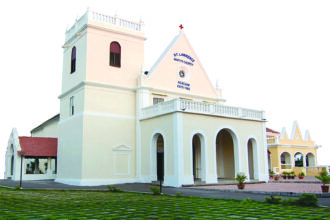
– The always spotless white and magnificent Aldona Church
standing tall and proud like a mantelpiece on a divine countryside.
– The view from the Corjuem bridge overlooking the river and the
fields and farms in the distance
– The sound of the train breaking the stillness of the
countryside at a railway crossing
– A temple bell ringing, cymbals clashing as the spirit of the
land meets the spirituality of its people.
These are not special vignettes but almost everyday ones. The
place may not have inspired poets, writers and singers to get inspiration from
the land and weave the landscape into their work, but there may have been.
After all, that was a different time and age. Even in England, after the
lakeside poets and writers, this generation hasn’t quite produced an encore.
Which is why, there is a great movement of revival, of looking at spots and
places mentioned by Wordsworth in his writings and using them to revive
literary tourism, so linked to the past, because the present falls short.
But because there was no Wordsworth, Coleridge or Robert Southey
to serenade mists rolling down the countryside in their verses or imbibe the
virgin wilderness in their works, our Aldona, Uccassaim, Corjuem and Bicholim
are no less gorgeous or less of a treat to mankind.
For 15 years now Business with Pleasure has been about such
journeys, each a need and an attempt to cocoon a slice of Goa, before it
decays. But this was one meandering through a countryside which is rejuvenating
by the day, bucking the trend of degeneration. And that is because we have left
it alone, allowing the land and the locals living around it, to live
organically and in harmony.
And in
this expanse, no one wanders “lonely as a cloud”, (phrase from Wordworth’s
Daffodils) but linked to the cosmos of man and nature, in perfect symphony.