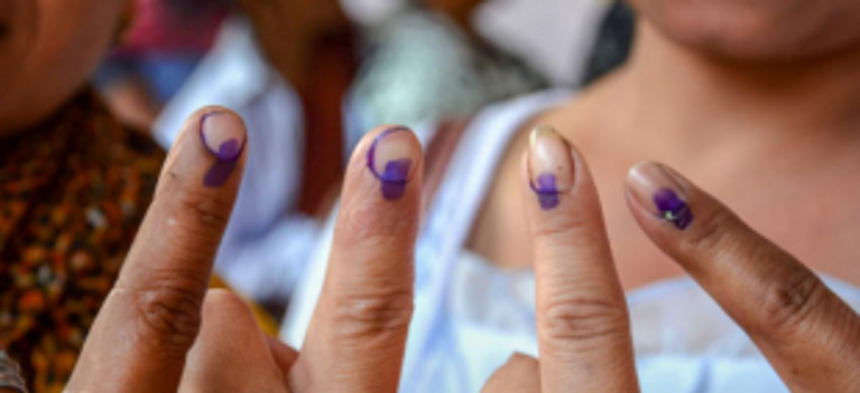
Political parties, the Congress in particular, have been complaining to the Election Commission of India regarding intimidation of government servants who were on election duty and who are yet to send in their postal ballots. The allegation made was that the government servants were being forced to vote for a particular party. In response the office of the chief electoral officer issued a public notice stating that it has come to their notice that public functionaries are approaching voters on election duty and attempting to exert undue influence on them to vote in their favour. The notice then highlights the secrecy of voting and that the postal ballot is foolproof and the voters’ identity cannot be revealed from them.
The fact that the office of the chief electoral officer thought it fit to issue such a public notice very clearly indicates that there is coercion being exerted on those who have opted for postal ballots to vote in a certain manner. The swift response by the same office to the complaints also illustrates the independence of the office that in the election process is very important. The election commission and the election office can show no leanings towards any party or candidate and have to act solely by the rule book. Any partiality displayed can cast a shadow over the election process, which is not acceptable to the people. It is appreciable that they acted quickly.

Goa expects not just a free and fair election, but that after the votes are counted and the results declared, that the mandate of the people be also accepted and respected by the political parties and the authorities. There is every possibility of a fractured mandate on March 10 when the votes are counted. It does not matter which way the verdict goes, whichever party gets a majority or is the single largest party should be given the opportunity to have a stab at government formation and set a brief period within which to prove its majority so that the possibility of horse trading is diminished. This didn’t happen in 2017, as though Congress was the single largest party, the first attempt was given to the Bharatiya Janata Party that had cobbled up a post-election coalition with regional parties and independents, while Congress waited for a call from the Governor. This should not be preferred as a precedent.
In recent years, Goa’s neighbouring States have had elections and both times, with a hung Assembly, the single largest party was given preference. In 2019, Maharashtra had a hung Assembly, where the Bharatiya Janata Party was the single largest party. After a short spell of President’s Rule as no formation could show a majority and much drama, the Bharatiya Janata Party’s Devendra Fadnavis was sworn in as Chief Minister, but when directed by the Supreme Court to prove his majority, he resigned. A coalition of the Shiv Sena, Nationalist Congress Party and Congress then formed the government. Similarly in Karnataka in 2018, the State returned a hung Assembly, with the BJP as the single largest party. BJP’s Yeddyurappa formed the government but resigned just minutes before the vote of confidence. These are precedents of the Governor giving the party that emerged as the single largest the first opportunity of forming a government.
There are more such examples, but these should suffice to establish that the single largest party should be allowed to form a government before turning to look at other parties. The process of a free and fair election does not end with the counting of votes, but with the formation of a government that has been voted by the people. That, and only that, is what Goa desires to see after the votes have been counted.