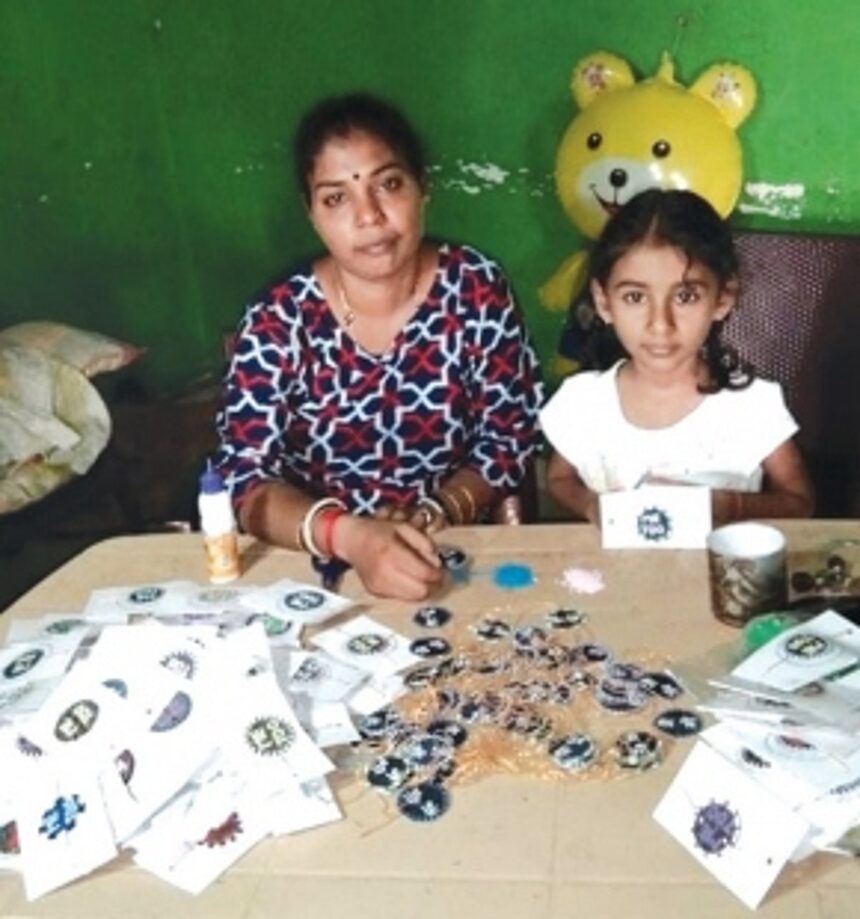
In the back of beyond of Anjuna, seven women have had a very different
rakhi this year. Over the last couple of months, Rangita Jenah, resident of
Grand Peddem vaddo in Anjuna, has spent most of her days with six other women –
Sarita Pathkar, Rajashree Mandrekar, Reshma Dhargarkar, Anita P, Rupa Redhkar
and Nili Jenah, repurposing used jeans and tetra packs into three thousand
pieces of colourful rakhis – each with the phrase ‘Me Too’ or ‘Main Bhi’
sequined or stitched on them.
#MeToo, a movement that began last year in India and quickly became the
collective language of empathy and acknowledgement among women, for the first
time questioned abuse and shifted the accountability to the abuser.

For Priyal Woodpecker, a poet and artist based out of North Goa for the
last six years, the subversive thought process that birthed these cheeky rakhis
was to create a certain tangibility to the movement and to question the very
idea of “protection” that this Hindu festival champions. “If we stop to think
about it, isn’t it strange that the very gender that we’re entrusting with our
protection is also the same gender that we’re seeking protection from? How can
we not question that our brothers at home become abusers on the street or at the
workplace.” Each rakhi thus came with a long 1600-word letter addressed to the
‘dear brother’, in which she urges each brother to value consideration of their
own actions – a virtue, she insists, outlives the (now toxic) idea of
‘protection’.
In India, when #MeToo began last year, women across the spectrum came
forward with stories of abuse by men in positions of power, much of which had
been suppressed and internalised for years. Many however raised a pertinent
question of how this movement could move beyond the urban circle and reach the
grassroots. The idea of regionalising the campaign struck Priyal as a possible
solution. “It came from the fact that it’s quite intimidating for a non-English
speaker to find enough courage and strength in her vulnerability and
acknowledge something as intimate as abuse, in a language that already excludes
her identity by making her feel ‘vernacular’.”
Over the next decade, Priyal and her team have decided to produce the
rakhis in regional tongues, adding one language to the campaign each year.
“Abuse, is not an urban concept,” Priyal sighs, “so why stop there?”
For Rangita and her team, these rakhis were their first touchpoints of
the movement. After they had niftily laid out one sequin after another to put
together the phrase ‘Me Too’ or ‘Main Bhi’ a few hundred times over, the phrase
and subsequent discussions and its iteration in various Indian languages
inevitably piqued their curiosity. “We knew that this was a movement to support
women, but as we got more and more involved we wanted to know what it meant and
how it helped.” For Priyal perhaps this was also the entry point, through which
urban, savarna feminism could transcend its caste and privilege boundaries and
reach the grassroots.
“In the days and weeks that followed, we had lengthy discussions about
abuse, safety, harassment and what we each could do to address them. This had
never happened before – we had never, in the presence of our families, children
and friends, openly acknowledge and talked about the realms of abuse and the
trauma that it carries,” Priyal reveals.
Rangita who had initially been shy to speak finally opens up as a broad,
proud smile takes over her usually placid face. Her daughter, Suhana, has by
now returned from school and joined the conversation. As Rangita pulls her
close, she has the satisfaction of a woman who has contributed to creating a
slightly safer and more aware world that she hopes, her daughter, now all of
six years old, will grow up in. “May she never have to utter the words MeToo,”
she says in Konkani.
Notably, her husband, Sanjay Jena, has also been an integral part of the
process right from the word go – from helping the team assimilate old tetra
packs that form the base of these rakhis, to washing and drying them out to cutting
perfect circles out of jeans, to talking to his peers about the work –
Sanjay, has been an ally, and quite proudly so – a definite pioneer in
his community. His message is to his fellow men – he wants men to be more aware
of their own actions and how they treat women. Since the start of the campaign
he has opened up the conversation with many of his peers and insisted that it
is the “bad gaze that needs to go. We have to do this together,” he maintains,
resonating exactly what Priyal also envisions for the campaign.
For Priyal, the rakhis are one of the ways to forging the conversation
forward – by the next year she hopes to have expanded to metoo bands, brooches
and pins. In India, while most women have faced abuse it is also inevitably
coloured by their socio-economic realities. The normalisation of this abuse is
perhaps what bothers her the most. “The first rakhis in mythology were powerful
protective threads that invoked safekeeping and nurture, without a subtext of
gender roles. In contemporary India, however, the festival has become yet
another vehicle of patriarchal constructs, reinforcing and re-iterating toxic
gender roles.”
As for Rangita, she has promised herself that they day she makes the
MeToo rakhis in Konkani, is also the day she will tie one on her brother’s
wrist.