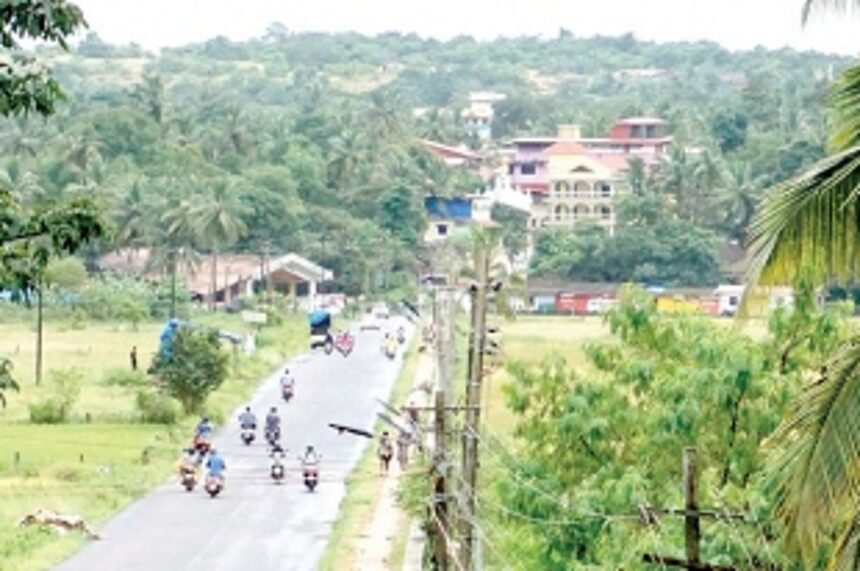
Bastora is a small scenic village that is situated close to Mapusa. One upon a time, it was known for its greenery and a number of ancestral houses with large fields stretched out in front of them. In the earlier days, when Bastora was ruled by the Kadamba and Vijaynagar dynasties it was known as ‘Bastodem’.
The village is home to a famous publishing and printing institution – ‘Tipografia Rangel’- and also the oldest ice factory and handloom mill.
Today, locals complain about the mushrooming of alleged illegal kiosks, land filling and structures in the village panchayat. Locals complain that the authorities concerned including the panchayat are turning a blind eye to the matter.
Another major grouse in the village is the rising garbage menace. Bastora village panchayat has tried to create awareness in schools and institutions on the proper disposal of garbage. However, locals concede that citizens of the village are also partly responsible, as people have been found dumping garbage along the road, in no-garbage-dumping-zones, in open areas and water bodies. “There is a need for citizens to be civilised and dispose their garbage efficiently,” added a local.
The open space near the Mapusa’s Tar River witnesses a huge amount of garbage being dumped there, even though there is a signboard warning against the same with punitive action. However, neither the panchayat nor the Mapusa Municipal Council is willing to clear it and the two civic bodies, keep blaming each other saying it is not their garbage.
Bastora Sarpanch, Savio Martins, told Herald that to tackle the garbage menace they have put up sign boards at areas where people were dumping garbage.
“Currently dry garbage is being picked up once a week from every ward. Since 90% of the houses in Bastora have a backyard, residents are expected to dig a pit and bury their household wastes or feed it to the animals. The panchayat has identified land for a MRF shed to install an incinerator plant to dispose pads and diapers, which are not collected by the panchayat. We are also working towards acquiring our own bailing machine and have identified land to set up the same. The only issue is with the people living in buildings and the tenants. Notices have been issued that complexes with more than 20 units, are supposed to have their own bio-digester and a compost pit,” said Savio.
The sarpanch further elaborated about pending works in the village and other issues. He said hot mixing of 50% of the roads in the village is yet to be carried out.
“By December hot mixing of the remaining three wards in Bastora will be completed. We are yet to undertake door-to-door tenant verification. At the same time we need a public cemetery for those who do not follow Hinduism or Christianity. We aim at carrying out water harvesting and conservation by reviving the ponds in the village. We have already restored one pond and there are another five, which need to be revived. A resolution has been taken to repair the bandh and sluice gates in Bastora,” said Savio.
The panchayat members have identified premises of 9,000 sq mts for a new panchayat ghar and community hall, opposite the existing one. They aim at making their panchayat a self-sustainable one by generating money from the community hall. They have moved a proposal to the government for land acquisition of the said property.
On another issue, the former Deputy Sarpanch, Andrew D’souza informed that the issue of kiosks operating illegally was taken up several times in the gram sabha but that the problem still persists. “These kiosks have the license to operate as mobile carts and are supposed to move from here at night. There is probably some motive behind the panchayat keeping quiet. The number of constructions in the fields is also on the rise with every passing day,” he lamented.
Locals are also concerned about the recent filling of mud into the Mapusa River at the Guirim bypass junction. According to the locals, this activity has diverted the river to a great extent and has led to the accumulation of water at that spot during the rains.A member of Revolutionary Goans, Chetan Bandodkar who exposed the dumping of mud into the Mapusa River last month told Herald that since they are narrowing the width of the river, there will be no place for rain water to collect and hence it could aggravate the flood-like situations witnessed in Bastora recently.
“The haphazard highway construction work along the Bastora stretch is the primary cause for the burial of half the river, which in turn is affecting the flow of water. If this is not rectified, there will be flooding in Bastora and surrounding villages every year. Due to accumulation of water in the fields some people have lost their crops and others were unable to cultivate. Sewage water is also being left into the nullah at places where illegal hutments have been built on the hills. The panchayat is not acting against the complaints made by us. There are several instances of land filling in the village. People living on rent and tenants are bringing and dumping garbage in Bastora,” Bandodkar alleged.
Another reason for water logging in Bastora is the 100-odd-trucks of mud cleared from the Mapusa –Tar River and dumped in a field by the WRD, after receiving an order from NGT. This accumulation of water is due to the filling of the low-lying area, which is a rice paddy field and an ecologically sensitive area.
Another local complained about a section of non-functioning LED lights, which have been fixed along the streets across the village.
“20% of the LED street lights in Bastora are not working. Several other places still have the old tube lights and CFL’s. The panchayat is also helpless and cannot get new LED lights fixed as the material is expensive. The department had assured that they will rectify the problem in 48 hours but it’s not being followed. Sometimes they come to check the lights after ten days and otherwise the people are left to struggle in the dark. Earlier if the tube lights were not working they would be fixed within 24 hours,” added the local.
Famous for: water polo era
There was a time, when water polo was played in Bastora and the sport, a unique feature of the village, used to draw in crowds from afar. It even caught the attention of Goa’s first Chief Minister, Dayanand Bandodkar, who was a fan of the sport and had attended a match in Bastora in the early seventies. Senior citizens of the village still recall fondly about how the water polo was played in the pond enthusiastically.
“An interesting fact of Bastora is that the villagers were known as ‘Chikal Chor’ mentioned by Ervell Menezes in one of his articles several years ago. It has come to light that the villagers used to take the sludge from the river and use it for their coconut trees and in the fields as it was very rich in nutrients,” added Andrew D’souza.
The village also has a famous temple and the historic St. Cajetan’s church. Further, the much sought after St Xavier’s College was founded in the year 1963 in Bastora, and it was initially run by the Jesuits, who deputed former the principal of St Xavier’s College, Bombay Fr Edward D’Cruz to take over as principal. Fr. Nicolau Pereira, who had a doctorate from the United States, oversaw the shifting of the college to Mapusa in 1968.