Does it pay to be nice?
The jury is out on whether ‘nice guys’ finish ‘first’ or ‘last’. There are several examples on both ends of the spectrum. Elon Musk, for example, is known for being a not-so-nice guy. His ‘rage firings’ are legendary. If you are one of those unlucky employees whom he notices when he’s angry about something, chances are he’ll take out his anger on you. Sometimes even terminating the employee’s services! Even if you have nothing to do with the issue. Steve Jobs was another leader known for not being nice. Unless he really wanted something. Both Musk and Jobs were successful business leaders. Yet, niceness didn’t seem to be the attribute which contributed to their success.
On the ‘nice’ side, Richard Branson is a good example. His approach to employees is well summed up in his famous quote – “Train people well enough so they can leave, treat them well enough so they don’t want to. If you look after your staff, they’ll look after your customers…” So, is it better to be loved, or feared? This article weighs the pros and cons of being nice and being nasty.
Niccolo Machiavelli seemed unsure saying “One should wish to be both, but, because it is difficult to unite them in one person, it is much safer to be feared than loved”. Considering Machiavelli believed that immoral behaviour, such as dishonesty and the killing of innocents was effective and normal in politics, his ambivalence on the matter is surprising. One might have expected him to be categorically in favour of being feared.
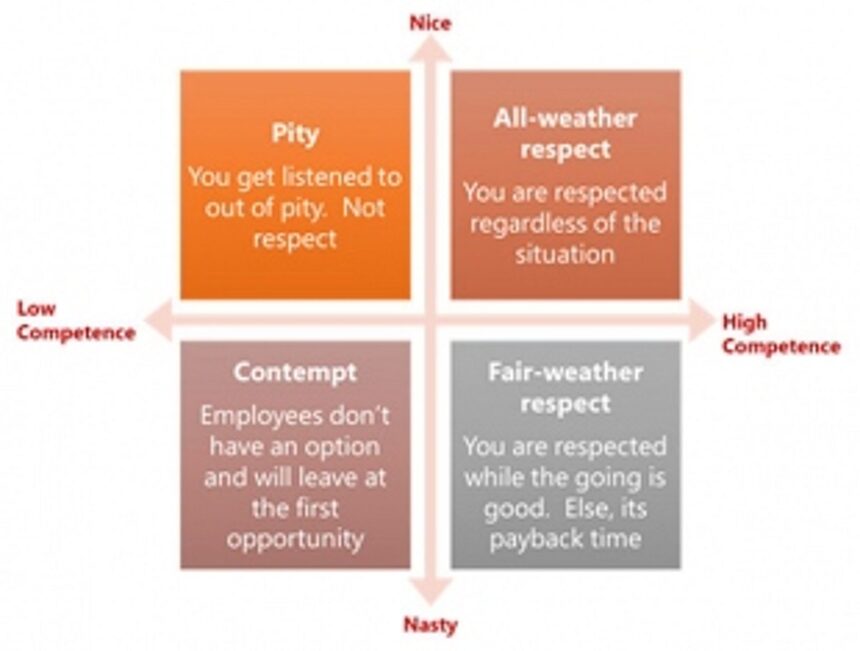
According tobehavioural scientists, when we are judged by others, there are two aspects they look at – how lovable weare (ourwarmth, or trustworthiness) and how fearsome we are (our strength, or competence). Put into what I’ll call a Machiavelli matrix, it plots niceness (or lack of it) and competence (or lack of it) on 2-axes. You need to aim for the top right quadrant of all-weather respect.
High competence alone mightget you respect. People inherently respect high achievers, people they can look up to. The problem is that the respect is fleeting if the high competence is accompanied by a nasty demeanour.Research also shows that people who are perceived as competent but lacking niceness, elicit the emotion of envy. Envying a person is funny- you both respect and resent the person at different times. When envious, people look past the challenges or sacrifices you might have made to get where you are and only see your success. That’s not helpful, either to them or to you.
With a history of being abrasive, given a chance people will get back at you. Steve Jobs was a prime example. A lot of the downturns he faced stemmed from him being not nice. Even his 12 years separation from Apple stemmed from him trying to engineer a coup to remove the then Apple CEO. Despite Jobs’ obvious brilliance, the Apple Board sided with the CEO. Jobs succeeded despite being nasty, not because he was nasty. Sure, some of his abrasiveness helped him succeed more. For example, for things he didn’t like in product iterations, his feedback used to be a terse “This is sh*t”. Sure, that’s not polite. Yet, that brutal feedback was often the reason for the perfection seen in Apple products. So yes, being nasty with your feedback might have a bright side. But try it at your own risk!
On the other hand, if you back up your competence with niceness, you can build yourself a nice fan club.Sundar Pichai, the CEO of Google is one of the busiest men on the planet. Yet, he took the time out to respond to a 7-year-old girls job application to Google. The internet went crazy discussing the matter and Pichai added a lot of fans.Events like this help define the Google culture and makes people look up to you as a leader and your company as a great place to work. Attracting the best talent in our current age of competition can give you the edge you need to survive in the market!
When an Uber investor was asked about its abrasive founder, Travis Kalanick, he said, “It’s hard to be a disrupter and not be an a*#hole.”Well, Travis didn’t last long. He was fired as the Uber CEO in 2017. While he retains a seat on the Uber board, he’s kind of disappeared from the public eye. And there doesn’t seem to be too much sympathy for him, judging by the lack of press on how he got a raw deal.
The most important thing to remember is that tough and nice don’t have to be incompatible. You only need to follow two rules when being ‘nice’. First, know the difference between being nice and not being assertive. Great leaders let people know when something’s wrong. They won’t hold their tongue on important things just because someone is going to feel bad about it. They know what they want, and they don’t hesitate to tell people about it. Two, being nice doesn’t mean saying yes to everything. Boundaries need to be set for everything- when people can approach you, how much time you give them and choosing how to help a person who asks for it.
Another important thing to remember is that being nice can be challenging. Every time someone takes advantage of your niceness, the temptation to move away is strong. You must make the decision to be nice every single day. Being consistently nice is not easy. It takes perseverance to stick to that path.Also, being nice isn’t about being nice only on the surface. It’s about being that way all the way down to your core. So, it’s much more than sweet talking your way into someone liking you!Being nice only on the surface is worse than being nasty.
Conclusion
Nice guys often finish last. But they also often finish first. Too nice, and you’re a slave to everyone else’s agenda. You won’t get time to focus on your own agendas. To do the things that you are truly passionate about. But if you are nice, high on competence and can set boundaries, chances are you’ll be first. Not-so-nice guys who finish first over the long-term are the exception rather than the rule.
And most importantly, being nice allows you a wealth of strong relationships. Relationships that you can count on to help you. Whether or not they make a difference to how much money you make. Or how much professional success you have. At the end of the day strong relationships are the true measure of our wealth!