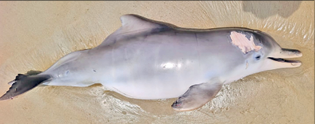
Eighteen Schedule I marine mammals washed up dead along Goa’s coastline in September 2025, all belonging to just two spe cies: the Indian Ocean Humpback Dolphin and the Finless Porpoise. These are residential popula tions, present in the state’s waters year-round. The deaths, recorded through the Ma rine Wildlife Stranding Response and Monitoring Network with first-re sponse support from Drish ti Marine lifeguards, have reignited calls from conservationists for a dedicated state-led action plan. Wildlife experts say the recurring mortalities high light a worrying gap in Goa’s marine conservation priorities. “Year after year, we read about dolphins and porpoises washing up dead on our beaches, but it remains just that – a news report of a carcass.
Where is the public inquiry into what’s kill ing these animals? Where is the awareness campaign so that boat operators, tourists, and coastal communities understand the severity of this crisis?” asks coastal environmentalist Arjun Naik. Despite repeated reports and recommenda tions, Goa has yet to announce a focused conser vation policy for these species. Conservationists note that while the state has a Sea Turtle Con servation Action Plan, no equivalent exists for marine mammals. Both dolphins and porpoises are listed as endangered by the IUCN Red List and protected under Schedule I of the Wildlife Protection Act, 1972 – the same status accorded to tigers. Unlike migratory species, these residential populations are restricted to shallow coastal wa ters and estuaries, making them especially vul nerable to local threats. “We wonder when the state government will announce a conservation action plan for these two species that are facing high mortalities due to a range of anthropogenic stressors,” says Puja Mitra, co-founder of Goa based marine conservation social enterprise Terra Conscious. The humpback dolphin holds significant eco nomic value beyond its ecological role. Goa’s growing dolphin-watching industry depends on sightings of these animals. Yet, dolphin-watching is classified as “watersports” rather than wildlife tourism, meaning operators are not required to obtain a No Objection Certificate from the Forest Department or undergo mandatory training on ethical viewing practices. Conservationists warn that without measures to protect the species, the livelihoods of boat operators and guides may be at risk. Since 2017, the Goa Forest Department has run a Marine Wildlife Stranding Response and Monitoring Network with voluntary support from Terra Conscious, Drishti Marine, and Reef Watch Marine Conservation. The network has intervened in over 1,386 stranding cases involv ing cetaceans, sea turtles, and seabirds between 2021 and 2024. ReefWatch provides marine vet erinary support through its Matsya Marine Tele medicine Helpline and Resource Centre. Prelimi nary examinations of recent strandings revealed injuries consistent with bycatch from trawl or purse-seine fishing, suggesting fishing-related mortality is a significant threat. In a comment to the media on earlier strand ings, Goa’s Chief Wildlife Warden K Ramesh Ku mar had acknowledged the issue and ReefWatch findings. Wildlife conservationists emphasise that tai lored action plans are essential. For these coast al species, interventions would include tour ism regulation, tourist sensitisation, fisheries management, pollution control, and continuous population monitoring. “Without investigation, without transparency, and without a concerted plan to address the root causes, we’re essential ly watching a local extinction unfold in slow mo tion,” says Arjun Naik. Rising mortalities reflect mounting anthropo genic stressors, including plastic debris, ghost nets, vessel collisions, untreated sewage, in dustrial runoff, habitat loss, and climate-driven coastal erosion. Shallow-water, estuary-depend ent species are highly sensitive to changes in wa ter quality, prey availability, and human activity. Conservationists stress the urgent need to bring together fishing communities, tourism operators, coastal planners, and waste manage ment authorities. Clear regulations separating wildlife-based tourism from high-speed water sports, establishing viewing protocols, and cre ating coordinated licensing systems are vital. With eighteen deaths in a single month and no signs of declining threats, the time for a focused, state-led conservation strategy is running out.