Father José Váz was born on April 21, 1651, in India. A native Goan, he was born in Benaulim and spent his formative years in the villages of Benaulim and Sancoale. As he grew older, his father enrolled him in a school in Benaulim to study Latin, laying the foundation for his future priestly education. Joseph Váz displayed exceptional academic ability, progressing so rapidly that his father decided to send him to the Jesuit College of Saint Paul in the city of Goa. After completing his education with the Jesuits, Joseph Váz joined the Academy of Saint Thomas Aquinas, where he pursued studies in philosophy and theology. He was ordained a priest in 1676. Father José Váz passed away on January 16, 1711, at the age of 59.

Situated to the south of the magnificent Igreja de Deus Espírito Santo in Margão stands the distinctive Barreto house, easily recognized by its brown façade. This property came into the ownership of Manuel de Miranda of Pulvaddo, Benaulim, in the mid-17th century. Today, the house is shared by two branches of the Miranda family. The separated portion features an elevated plinth, necessitated by the sloping road, and is accessed by a side staircase. Manuel de Miranda was the brother of Maria de Miranda, who married Cristóvão Váz of Sancoale. Cristóvão and Maria were the parents of St José Váz. His father originally belonged to the Naik family, which embraced Catholicism during the early Portuguese period.
It is widely but incorrectly believed that he converted to Catholicism; in reality, he was a Catholic by birth and was raised and educated in the Catholic faith. His family descended from Konkani Brahmins who had embraced Christianity in the mid-16th century, well before the birth of Joseph Vaz in 1651. From a very young age, José Váz exhibited deep piety and devotion, devoting much of his time to prayer and spiritual reflection. Tradition holds that during his visits to his uncle’s house in Margão in the 17th century, the saint would cross the open area then known as Praça de São Pedro to pray before the Blessed Sacrament in the Holy Spirit Church.
St Joseph Váz left an enduring and far-reaching legacy, not only in Goa but also in what was once the most Catholic region of Karnataka, particularly Mangalore and the surrounding coastal belt known as Kanara. During this era, the Dutch began challenging Portuguese dominance over the spice trade, which the Portuguese had long controlled in India, Sri Lanka, and the Moluccas. The Dutch allied themselves with local Hindu rulers around Mangalore and Buddhist monarchs in Sri Lanka to expel the Portuguese, capture their ports, and enforce strict limitations on the practice of the Catholic faith. In Mangalore and the Kanara region, the Dutch systematically destroyed Catholic educational institutions, including numerous Jesuit-run schools and colleges along the coast. They also banned all European missionaries from entering or operating in these territories.
When Father Joseph Váz learned of the immense suffering of Catholics in Sri Lanka, who had been without pastoral care for forty years following the Dutch takeover in 1656, he felt a powerful calling to come to their aid. While in Sri Lanka, he was unable to openly practice or proclaim Catholicism. For nearly ten years, he worked without protection, frequently adopting disguises to evade detection. At various times, he posed as a beggar, baker, washerman, bangle seller, or fisherman. One of the garments he wore is preserved by the Bishop of Sri Lanka, another was brought to Goa and is now kept at the Sanctuary in Sancoale, and a third, worn during his four years of ministry in Mangalore, is preserved along with an official document from the Bishop of Sri Lanka, certifying its authenticity as an article of clothing used by the saint.
Located just a few metres from the Sanctuary in Sancoale, Goa, stands the ancestral home of Blessed Joseph Váz. Although the original structure could not withstand the forces of nature, the room where Blessed Váz and his family prayed together has survived. Nearby, the jackfruit tree from the saint’s time continues to stand and flourish. According to tradition, as a young boy, Blessed Váz would climb down from his window at night using this tree, walk to Cortalim, and it is believed that through divine intervention, the doors of the Igreja de São Filipe e São Tiago Apóstolos would miraculously open for him.
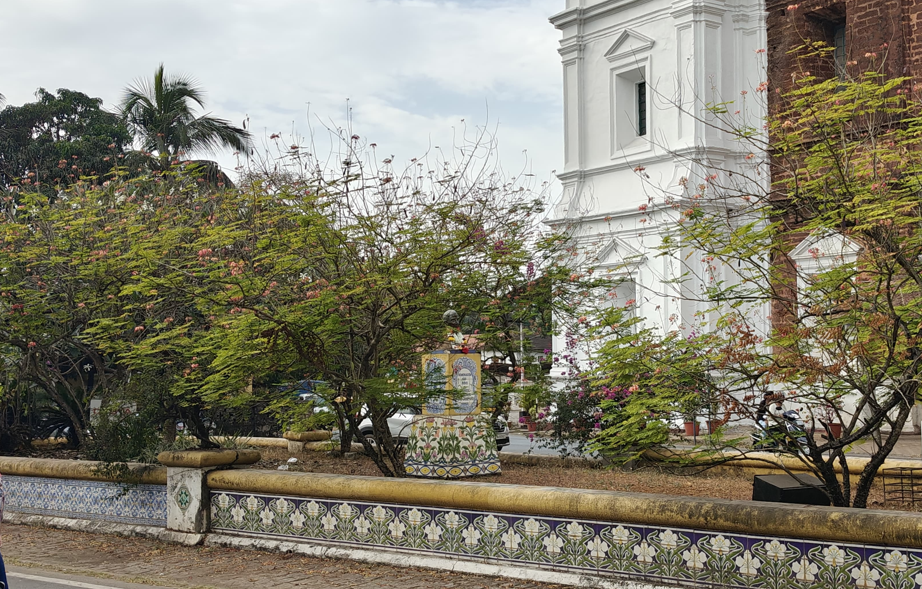
In Margão, anyone walking along the road south of the Church of the Holy Spirit cannot miss the green traffic island set amid the busy roadway. This space is now known as the Largo de Pe (São) José Vás. Historically, it was called Praça de São Pedro (Saint Peter’s Square) until April 21, 1938, when it was renamed to mark the 287th anniversary of St Joseph Váz’s birth. To commemorate the occasion, a bust of Pe José Vás was installed, crafted by one of Margão’s accomplished artisans, believed to be either Nanu Damodar Chari or Constancio Fernandes, both renowned for their artistic skill.
In the early 2000s, around 2003–2004, the bust of St Joseph Váz underwent restoration by the respected artist Agnelo Cornelio Cipriano Fernandes of Agali. The initiative began when the late Bebe Costa of Borda, who was overseeing the renovation of the island garden in Margão, requested Agnelo to repaint the bust, which had previously been painted but had faded over time.
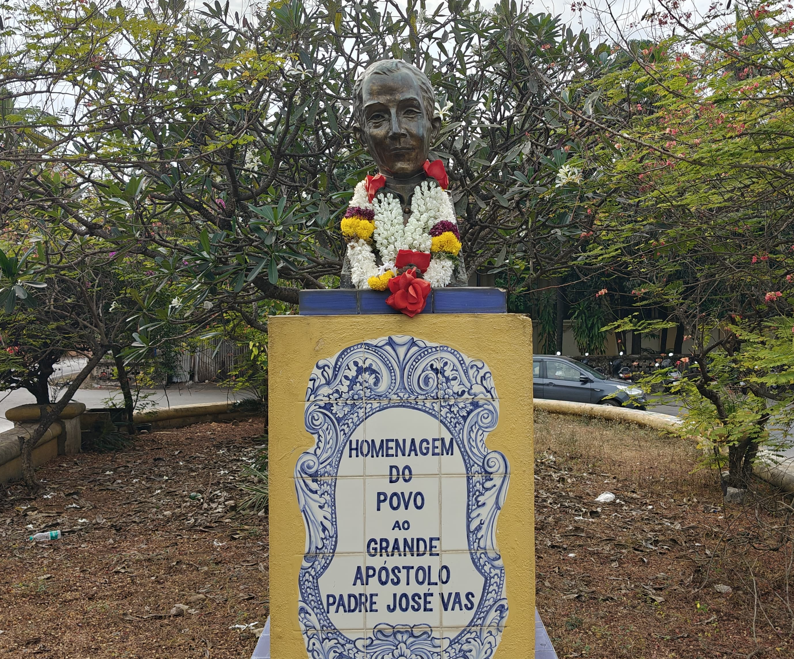
During the restoration, Agnelo was surprised to discover that the bust was made of a copper alloy, most likely brass or bronze. He carefully removed the old paint layers using a combination of chemical treatments and mechanical methods, carrying out the work on site. Agnelo recalled that the process was painstaking and slow, as extreme care was required to avoid damaging the metal surface beneath. He also mentioned that he could no longer remember the exact length of time the restoration took, as more than fifteen years have passed since the project was completed.