Giselle Regina Fernandes
SIOLIM: When Maria Jacinta Dias returned to Goa in the year 2000 after resigning from her government nursing post in Dubai, she believed she was closing a chapter of service. Family called her home, and with that decision, she thought her years of tending to the sick had come to a gentle end.

She could not have been more wrong.
What awaited her in Sangolda was not retirement, but a calling—one that would earn her the enduring title of “The Florence Nightingale of Sangolda.”
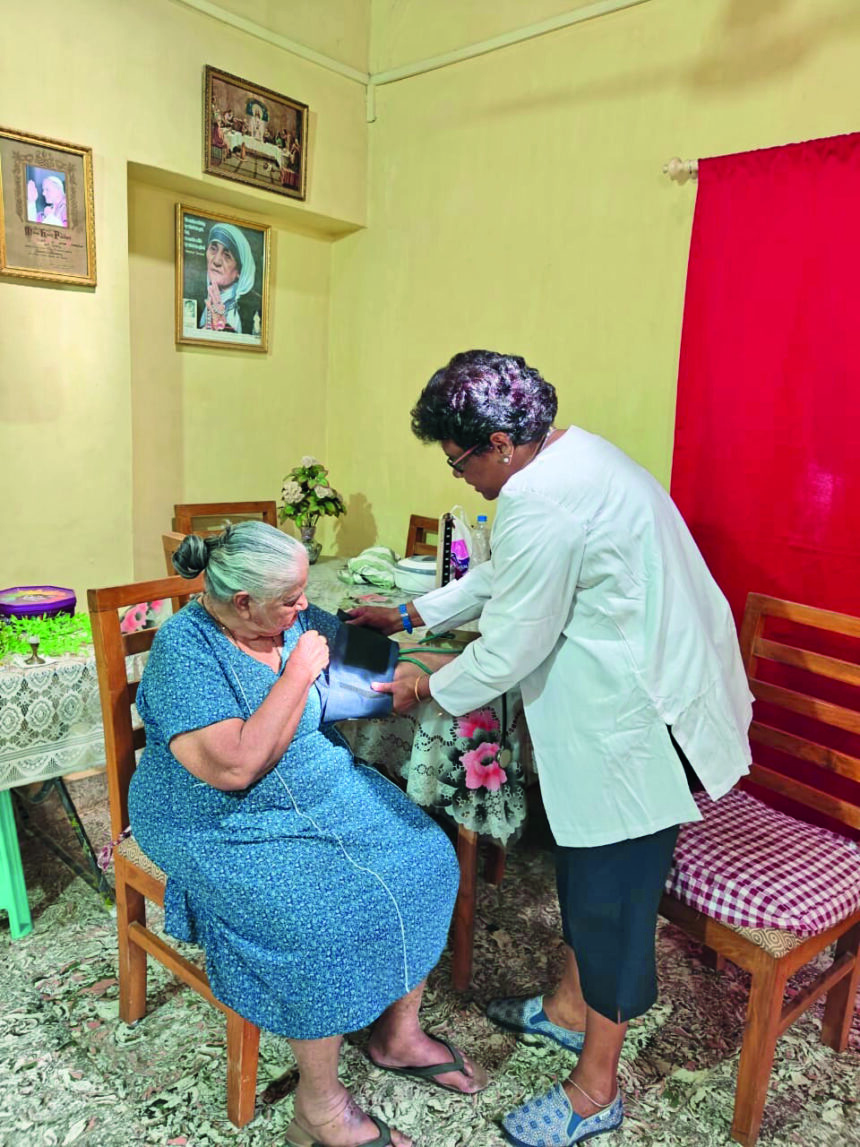
Come rain or shine, day or night, Jacinta has made herself available to anyone who seeks help. For nearly two decades now, she has rendered honorary medical service to all—without discrimination of caste, creed, or religion. Her modest home has quietly become a place of healing, reassurance, and hope.
The turning point came almost two decades ago.
A frantic cry pierced the quiet of the neighbourhood. Jacinta rushed out to find a man grievously injured, lying in a pool of blood as his family stood frozen in panic. Years of training took over instantly. She worked to stem the bleeding and, along with his relatives, rushed him to Goa Medical College (GMC).
That day, the casualty ward was overflowing. The hospital was short-staffed, every minute critical. The on-duty nurses struggled to locate a vein to administer an intravenous (IV) injection. A senior doctor was summoned—but time was slipping away.
“I had worked at GMC for many years before going abroad,” Jacinta recalls. “I knew some of the staff, and they allowed me to try.”
Her hands did not fail her. The IV went in successfully, stabilising the patient just long enough for senior doctors to take over and perform life-saving surgery. Twenty-six years later, that man is alive and well, forever grateful that Jacinta was there when it mattered most.
News of her quiet heroism spread swiftly through Sangolda.
Soon, neighbours began knocking on her door—at first hesitantly, then with complete trust. Emergencies like cardiac arrests, routine blood pressure checks, wound dressings, IV injections, catheterisation for the elderly, or simply advice for health concerns—Jacinta handled them all with patience and compassion.
No matter the hour, she responds. Many in the village fondly say she is a human version of the 108 ambulance service, always on call, always ready.
Her selflessness has forged bonds deeper than friendship.
When neighbour James suffered a heart attack, Jacinta rushed to his side and played a crucial role in saving his life. Since then, his wife Marta Fernandes has shared an unbreakable bond with her.
“My daughter Genevieve serves with the Missionaries of Charity,” Marta says, emotion filling her voice. “God has blessed me with another daughter—in Jacinta.”
Every evening, Marta insists on sharing tea with her. “Aunty Martha prepares tea and little godxem (Goan delicacy),” Jacinta smiles, “and she refuses to drink it unless I join her.”
Another friend, Shashikala, will not visit a doctor without Jacinta accompanying her. Even during hospital admissions, she insists Jacinta stay by her side. Such is the affection and trust she commands that neighbours often arrange transport to ensure she doesn’t have to struggle with commuting.
Her reputation has travelled far beyond Sangolda.
Like bees drawn to flowers, patients seek her out—from Guirim to Panjim, Caranzalem to Margao. She visits old age homes, helps friends in distant towns, and on occasions, even accompanies patients for out-of-state medical consultations. Those who prefer private hospitals often rely on her guidance, and she recommends trusted doctors without hesitation.
Ironically, the woman who heals others carries her own pain.
A national-level basketball player in her youth, Jacinta suffered a severe fall that led to surgery for spondylolisthesis. Two metal screws remain embedded in her spine to this day.
“Despite the pain,” she says quietly, “helping people gives me deep satisfaction. I am merely an instrument in God’s hands.”
Nursing, she insists, is not just her profession—it is her purpose.
“I will serve until my last breath,” she says with conviction.
Her journey began humbly. From a large family of eight siblings and limited means, life was far from easy. An elderly neighbour noticed her natural instinct for care when she was working as a stenographer and encouraged her to pursue nursing. With determination—and a father who made sacrifices despite financial hardship—Jacinta entered nursing school.
She went on to serve 14½ years at GMC, followed by eight years in the UAE, hoping to build a better life for her family.
In leaving formal employment, she lost her pension.
“But I gained far more,” Jacinta reflects. “Love, gratitude, and blessings.”
She never asks for payment. A simple thank you, she says, is more than enough. Though people often offer gifts out of affection, she accepts them only with humility, never expectation.
In Sangolda and beyond, Maria Jacinta Dias continues to live quietly among the people she serves—proof that true service does not need uniforms, titles, or recognition.
Sometimes, all it takes is one willing heart—and a pair of steady hands.