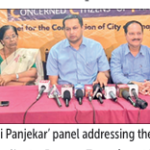
Former Chief Jus tice of the Allahabad High Court, Justice Ferdino Rebel lo (Retd) has extended his support to Panjim residents opposing the new 2,000-ca pacity casino vessel in the Mandovi River. Justice Rebel lo, who is also the convenor of the “Enough is Enough” movement, has questioned the legality of the proposed vessel and demanded trans parency from the govern ment regarding the licences and statutory approvals granted for its operation. In a letter responding to citizens’ concerns, Justice Rebello said the proposed 112-metre-long and 27-me tre-high vessel would re place an existing casino ship operated by the same com pany under the same licence, but with a much larger ca pacity of 2,000 persons com pared to the existing 300. If permitted, this single vessel would reportedly host more people than all six existing casino ships combined. Justice Rebello described the opposition by residents of Panjim and surrounding areas as “moral and just,” emphasising that protecting the environment is a funda mental duty of every citizen. He also highlighted the social consequences of gambling, noting that the government itself categorizes it as a “sin industry.” In law, gambling is considered “res extra com mercium,” meaning it is not a trade protected as a funda mental right and is entirely subject to government dis cretion, which can be with drawn at any time. He criticised successive governments for transform ing Goa’s capital into what he termed the “Casino Capital of India.” He argued that the continued mooring of six ca sino vessels in the Mandovi River has adversely affected the river’s ecology and the lives of residents along its banks. Raising statutory con cerns, he referred to the In dian Ports Act, 2025, stating that every port must have port-based reception and handling plans for waste. According to him, such plans have not yet been fi nalised. He also cited the Inland Vessels Act, 2021, under which vessels enter ing a port must discharge garbage at shore reception facilities and comply with the Inland Vessels (Preven tion, Containment of Pollu tion) Rules, 2022. He questioned whether the casino vessels are com plying with these provisions and whether the govern ment has appointed a Con servator as required under the Ports Act. Tracing the issue histori cally, Justice Rebello pointed out that the problem began in 1992 when Section 13A was introduced into the Goa Public Gambling Act, allow ing electronic amusement and slot machines in five-star hotels. In 1996, the Act was amended to permit “table games and gaming on board vessels offshore as may be notified.” He demanded that the government produce the relevant notifications spec ifying which games have been authorised, noting that “gaming” itself is not defined in Section 13B. He argued that under the Inland Vessels Act, 2021, an inland vessel must be used for transportation, storage, or accommodation while plying through inland waters. The casino vessels moored in the Mandovi River, he contended, do not serve these purposes and therefore do not fall within the statutory definition. Addressing the term “off shore” used in the Act and a 1995 notification, he said it ordinarily means away from the shore, typically in the sea. Since the ves sels are moored in a flow ing river and not at sea, he questioned how they can legally be classified as oper ating “offshore.” He stated that the government must explain to the people of Goa whether the moorings were installed by the gov ernment or the Captain of Ports and pointed out that no specific rules appear to have been framed govern ing such operations. He also raised concerns about replacing a licensed vessel with a much larger one. The Goa Gaming Act, he said, restricts the trans fer of licences and does not clearly provide for replac ing a vessel with a larger one under the same licence. Even if replacement is legal ly permissible, it must com ply with the original licence conditions and updated anti-pollution standards. He urged the government to immediately disclose the original licence granted to the operator. Justice Rebello criticised the State government, mu nicipal authorities and local MLAs for failing to safe guard citizens’ right to life and a clean environment. He called upon religious leaders across faiths to speak out against gambling, urging collective action against what he described as a morally and socially harmful industry.
LEGAL HEAVYWEIGHT JOINS BATTLE AGAINST PANJIM’S MEGA-CASINO SHIP