Govind S Poteker
The lips, cheeks and foreheads turn a uniform pink as vibrant hues of colour dominate smiling faces during the festive celebrations of Shigmo and Holi across the length and breadth of Goa. The sound of Dhol, Tashe and Shamele played by Romtamel played in the villages are unmistakably reverberating on the streets and in temple areas.

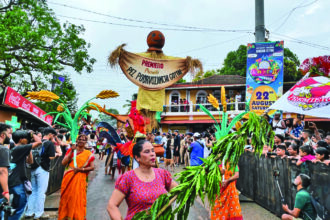
It is the beginning of spring season as the cool days recedes away bringing in all the excitements in villages and towns. Cities brush up for colourful float parades showcasing mythological tales of battles between gods and demons takes centre stage. The stories are wound round beautifully designed giant floats to the amusement of all, especially the kids who enjoy the colourful moments with awe. While the colourful floats are experiences of vibrancy of mythological stories, the villages are abuzz with greater exhilaration as many villages are known for their own identity. People celebrate Dhakto Shigmo, which is for five days before full moon and Vhodlo Shigmo, five days later. The glimpses of folk traditions are displayed during f loat parades, however the full spectacle of culture is best viewed in the villages where every festival is carried in a ritualistic solemn way. But catching up with Goan Shigmo is almost impossible in one festive season, for its sheer diversity across the state, which is unique. One has to be on the toes right from the day one of Shigmo and travel lengths and breadths of Goa. Karavlyo, Chorotsav and Ghode Modni in Sattari, Gade in Sal, Kudne and Pilgaon villages in Bicholim, Sheni Uzo at Molcornem, Tonya Mel, Talgadi and Goff dances in Canacona, Sanguem and Quepem. Gadyachi Zatra in Poinguinim, Shidiyo Utsav, Bali and Shishya Ranni in Gaondongrim, Canacona and Virbhadra at Shiroda and Ponda, Sotreo festival at Cuncolim and Zambaoli’s Gulalotsav are some of the long list of Shigmo customs rooted in Goan culture. Chorao and Britona are known for fire walking during Homkhand ritual. “To understand the diversity of these festivals, we have to go back in time when humans began their journey on Earth as hunter-gatherers killing animals and lived a nomadic life and later they started agriculture and settled in different places,” says Dr Pandurang Phaldesai, renowned folklorist having a in-depth study and research exploring the diverse cultural practices. “Once they had enough food for sustenance, people wanted to celebrate by singing, dancing and playing music and welcome new season. This gave rise to festivals in different seasons such as Shigmo, a change in season before rains and Dhalo, which is a fertility cult practiced by women. Some festivals are based on myths such as Chor Utsav, where the villagers celebrate in atonement of killings due to mistaken identity,” Dr Phaldesai stated. And, various dynasties that ruled Goa brought their own culture and traditions and the places got enriched, he adds.
SHIGMO CELEBRATIONS AT SURLA, BICHOLIM
When the world is in turmoil, it’s the colours that bring happy memories and joy, and there is no better way than to emulate people of Surla, Bicholim who celebrate Shigmo in a harmonious way. Hindu and Muslim villagers in a rare bonhomie here invoke the blessings and offer prayers together at the Dargah of Hazrat Pir Saheb at Surla Tar Masjid, that marks the end of Shigmo celebration on the fifth day of Shigmo, to be held on Friday, March 6. Pir was known to have created a bond between Hindus and Muslims, which is still strong till date.
GHODE MODNI AT THANE
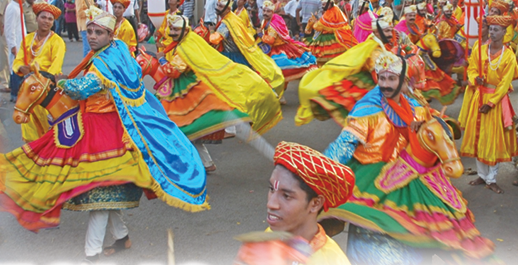
On the sixth day of Phalguna month, March 7, a vibrant and colourful festivity of age old Ghode Modni (Horse dance), the martial art folk dance is all set to be held at Thane, Valpoi. It is a long day celebration till the next morning. “The festival has roots in the past when there were no vehicles, and people would travel to Ghats from the village on horses,” says Pandurang Gaonkar, president of organising committee. The Thane village is made up of seven smaller wards, Thane, Pali, Charavane, Hivre, Golavli, Rive and Bokali. The villagers are protected by Shree Dev Mandalgiro Kolgiro, the Rakhandar of village. One the day of festival, Pooja is performed in the morning at Shree Navadurga Sateri temple, the Gram Devi of the village. Then, there is discussion (Baithak) of villagers and invoking blessings for the success of the festival. Gaonkar states, “In the evening the four performers dress in a classic Maratha style warrior costumes representing godessess, Sateri, Jogeshwari, Kelbai and Brahmani. After prayers they circumambulate the Shree Navadurga Sateri temple five times and proceed towards the shrine of Shree Dev Mandalgiro Kolgiro.” Here three horses from Pali who has the highest respect (Maan) are received and greeted by exchanging Shriphal (coconut), thereby forming a team of seven Ghodes. Two Ghode joins from Charavane, followed by three from Hivre and one each from Golavli and Rive. And, the festivity begins with 14 Ghodes (seven on each side) with lively battle on the field. Later, feet of Ghodes are washed. Pooja of Ghodes is performed, Gharane, invocations and wishes are carried and in the early morning at Shree Navdurga Sateri temple, the Ghodes are line up where all the flowers and decorations are taken-off. The festival ends with sumptuous food served to all, Gaonkar sums up all the show. In many villages, the festival last for seven days, culminating with Dhulwat or Dhulwod, the dancing and splashing of colours as the drums create some sort of trance atmosphere. Dhulwad is best experienced at rock shrine dedicated to Satiya Devi temple at Naibagh, Pernem. Sanjay Arondekar from Virnoda informed that devotees from 12 villagers in Pernem assemble at this shrine where the rhythm of Dhol and other percussion instruments rules in a very sensible way without creating any unhealthy atmosphere.
CHOR UTSAV AT CARANZOL
Chor Utsav at Zarme and Caranzol is very eye-catching and suspense enacted by the village folks. Villager Lavu Kalmiskar says, “Festivity begins at village’s sacred place, the Maand (Chavatho). After invocation a Chor (thief) is carried to the Shree Brahmani Sateri Kelbai Devi Devasthan, the place of grand celebration.” According to legends, nine Chors (thieves) were killed by villagers mistaken to be the robbers when they entered their village. As repentance and paying tribute to their memory eight Chors are buried with either head or only the torso above the ground visible. The dramatic scene is exposed only for few minutes as curtains falls or raised again as the crowd hamper for a glimpse. One Chor is raised on a spear and another laid on a raised platform. The grand Chor Utsav at Caranzol is schedule on Sunday, March 8, and there is nothing like witnessing it live in this remote village.