SHASHWAT GUPTA RAY
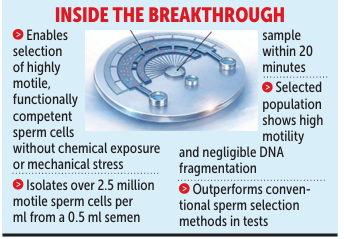
At a time when assisted reproductive technologies are becoming increasingly common — but also more demanding — re searchers at BITS Pilani K K Birla Goa Campus have developed a simple, low cost microfluidic device that could make fertility treat ment both more effective and less invasive. The innovation, de scribed in the study Mi crofluidic-assisted sperm sorter: a high-throughput sperm selection device published in Lab on a Chip, focuses on one of the most critical steps in assisted reproduction: selecting healthy sperm.

Developed under the guidance of Senior Professor Emeritus Gautam Biswas, along with Siddhartha Tripathi, Vadiraj Hemadri and PhD scholar Dhiraj B Puri, the device is designed to mimic how sperm are naturally selected within the female reproductive system. “This device isolates healthy, motile sperm cells by mimicking the natural selection process in the female re productive tract. The innovation can improve outcomes for couples undergoing assisted reproductive technolo gies like In Vitro Fertilization (IVF) and Intracytoplasmic Sperm Injection (ICSI),” Biswas told O Heraldo. The need for such an innovation stems from the lim itations of current laboratory-based sperm selection methods used in procedures like In Vitro Fertilization and Intracytoplasmic Sperm Injection. Techniques such as density gradient centrifugation and swim-up meth ods rely on multiple processing steps, including washing, spinning, and exposure to chemical media. “These steps reduce sperm quality and increase DNA damage, often lowering treatment success rates and forc ing couples to go through repeated, emotionally and fi nancially demanding cycles. We undertook this work to develop a gentler, more natural alternative that preserves sperm health and closely mimics how selection occurs in the human body. This allows the healthiest sperm to select themselves naturally, making the process simpler, gentler, and closer to physiological conditions,” the senior researcher said. By allowing sperm to self-select in conditions that closely resemble the human body, the device aims to re duce stress on the cells while improving the likelihood of successful fertilization — potentially easing both the physical and emotional burden on couples undergoing treatment. The researchers are now looking beyond the lab. Ac cording to Siddhartha Tripathi, ‘a patent has already been filed’, and the technology is moving towards real-world application. “Commercialisation is planned, and the device is cur rently undergoing further clinical testing on a larger num ber of samples to validate its performance before wider adoption,” he said. The project has been supported by the Science and Engineering Research Board under the Department of Science and Technology, Government of India, and aligns with national initiatives such as Make in India and Atman irbhar Bharat. As India pushes to build affordable, indigenous health care solutions, innovations like this could play a crucial role in making fertility treatments more accessible, effi cient, and closer to natural biological processes.