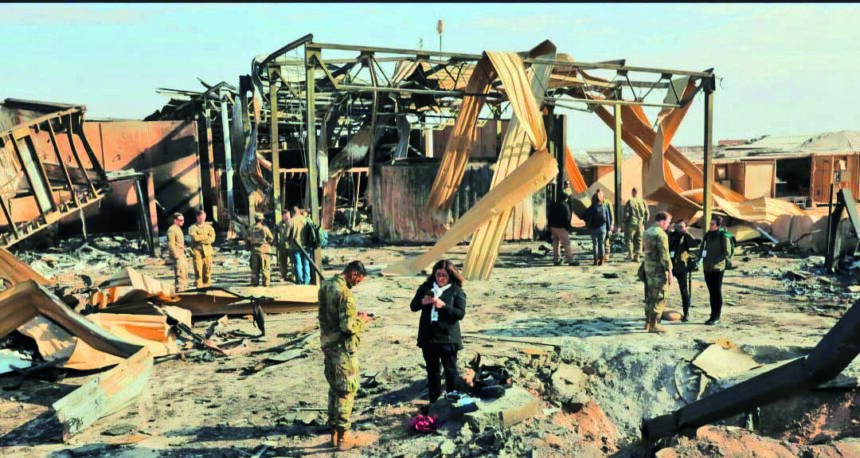
For the last 50 days, Iran has been navigating a severe military conflict with the United States and Israel. Despite significant damage to infrastructure, military capabilities, and the killing of its top political and military leadership, Iran has not collapsed and is holding out while attempting to use its regional leverage to pressure the US and Israel.
Iran continues to rely on its network of proxies, such as Hezbollah and the Houthis, to target Israeli and US interests, though many of these militias have been severely weakened by Israeli offensives. Its usage of asymmetric warfare, like the use of offensive drones and missiles to hit the military assets of the US and Israel has caused significant damage. In fact Iran’s decision to choke the passage of international oil vessels through the Strait of Hormuz has proved to be a masterstroke, forcing the US to seek negotiations with Iran. If tomorrow India faces a similar challenge, will India adapt any of Iran’s strategies?

“This conflict should be of great interest to our military and our political leadership. But the two situations are not the same. We shouldn’t blindly adopt any lessons from the scenarios in Iran. It is a theocratic and unitary State highly homogeneous whereas India is a democratic federal State. So, all the lessons from this conflict are not directly applicable to us,” former Chief of Naval Staff, Admiral Arun Prakash (Retd) said.
As far as asymmetric warfare is concerned, he said that one should not try to combat the enemy’s strength with our strength. We should try to combat against its weak points with our strengths.
When asked about the ongoing debate on the purpose of having expensive fighter jets and missiles versus cheap loitering munitions or suicide drones, he says, “Lessons should have emerged from Operation Sindoor itself, when air-to-air engagement took place at more than 120km distance and now in this case, the cost of a drone is about one-hundredth of the interceptors. I think the roles of manned platforms will have to undergo a drastic change.”
He added that one can’t say that they are out of date, but the role of manned platforms – whether airborne or seaborne- will have to undergo a drastic change.
“It will be a combination of manned and unmanned teams which is called as MUMT. So there will be a manned fighter plane, but under the man fighter’s control will be certain unmanned vehicles,” he said.
This conflict also exposed the weaknesses of US and Israel’s air-defence systems, like the latter’s much touted ‘Iron Dome’. What does that mean for our air-defence strategy?
“You see, these concepts like Iron Dome, Golden Dome, Sudarshan Chakra, or whatever, these are all unrealistic concepts. But you can install air defence systems at certain points, but you cannot protect a vast area like that of India. It is unrealistic to conceive of undertaking air defence of the whole country. The cost of drones is miniscule in comparison to the interceptors. One of the alternatives is to have your key military assets underground, like the Iranians have done,” he said.
Major General S H Mahajan (retd) says India needs to protect its vulnerable areas and vulnerable points which are basically major important military assets.
“We do not have the luxury of protecting our civil populated areas. However, important areas like BARC and other atomic energy institutions, ISRO’s installations, and major power stations should be protected because the enemy can play havoc. We should make our own systems which is basically a mix of anti-aircraft guns and missiles. It cannot be only missiles,” Maj Gen Mahajan says.
On the ability of Iran to fight a prolonged war, he said that India should bolster the existing ammunition production by the government-owned ordnance factories by involving the private sector. “Together with the private sector and our defence PSUs, we should have the capability to produce ammunition and that itself will take care of a two-front war,” he said.
Lt Col M K Gupta Ray (Retd) said that Iran stores its war stocks, including enriched uranium and munitions, in a vast network of deep underground, hardened tunnels and tunnel complexes designed to withstand bunker-buster bombs. They created the Isfahan Tunnel Complex, the Fordow Fuel Enrichment Plant (FFEP), Natanz underground sites and strategic tunnel networks.
“It gives us a lesson on how we need to stock our warheads and that too decentralised, based on strategic ground analysis,” he said.
On leveraging strategic geography, just as Iran used the Strait of Hormuz to control oil trade, the senior Bangladesh Liberation war veteran said that India is already planning to establish a second major airfield for fighters/surveillance planes and upgrading infrastructure for a larger permanent naval presence, particularly at Campbell Bay near the strategic Malacca Strait.
“This will expand its military footprint in the Andaman and Nicobar Islands, centered on a major project at Great Nicobar Island, to monitor and counter China’s activities in the Indian Ocean. This will, by virtue of its proximity, have reasonable control on the Malacca Strait,” the veteran officer added.
When asked about the decentralised military power structure adopted by Iran, Lt Col Gupta Ray said that its “Mosaic Doctrine” is designed to survive intense, centralised attacks by decentralising command into 31 provincial units and over 50 brigades. This allows local units to continue fighting even if the national leadership is disrupted.”
But should India emulate this strategy?
“India and Iran have two different strategic responsibilities. While Iran has limited geopolitical responsibility, India is and will remain a continental and inter-continental force, which would require inter-theatre movement of armies. Retaining flexibility of troop movements depending on threat perception is very essential to deploy the forces where it is most needed,” he added.
India is already working on two-front war, which will need massive inter theatre or inter-command movement of troops based on the war situation.
“Even way back in 1971 war, there were massive troop movements between Eastern and Western Command. One of the principles of war demands concentration of troops where it is needed the most. Iran is on defensive mode, whereas India ultimately needs to be on the offensive to win the war. Plus, we have a decentralised military command system, where all three of our services are distributed across the country into Commands. This ensures that even if the headquarters is hit, there are Command headquarters to take over,” he said.
Former army Brigade Commander, Brigadier Pradeep Sharma (retd) said that keeping in mind the globally turbulent times and India’s hostile neighbours, framing of a National Security Strategy and responses to various situations, including a two-front war addressing the worst case scenario, is a necessity.
“This strategy should be a pointer for all organisations to respond collectively to arising situations. Keeping in mind the strikes against leadership in Iran, where possible such a document could be purposeful under various circumstances,” he added.
However, Admiral Arun Prakash sounded a warning, saying that India has to preserve its strategic autonomy. But it is meaningless as long as we are dependent on Israel or France or US or Russia for our national security.
“We cannot be autonomous if we have to please everybody. We are taking a stand because we are dependent on others for defence equipment, oil, fertilizer and even rare earth materials. So, we have to find alternatives and should be self-reliant in every aspect. Otherwise we will forever be obliged to them and won’t be able to take an independent stand,” he said.