AUGUSTO RODRIGUES
VAGATOR /PANJIM/BAM BOLIM: Forty-nine lives lost in just 90 days. That is the grim toll of narcotics-related deaths re corded in Goa between Jan uary 1 and March 31, 2026, according to information furnished by the Depart ment of Forensic Medicine and Toxicology at Goa Medi cal College in response to an RTI application filed by this correspondent. The figures expose a deadly undercur rent beneath the State’s tourism-driven economy and raise fresh concerns about the increasingly toxic mix of narcotics, prescrip tion drugs and alcohol cir culating through Goa. The deaths, spread across multiple police jurisdic tions between January 1 and March 31, have alarmed medical professionals, an ti-narcotics investigators and local residents. While official records do not establish any direct connection between the fa talities and late-night party activity, a review of police data, emergency complaints and forensic findings re veals an eerie pattern that continues to raise uncom fortable questions.

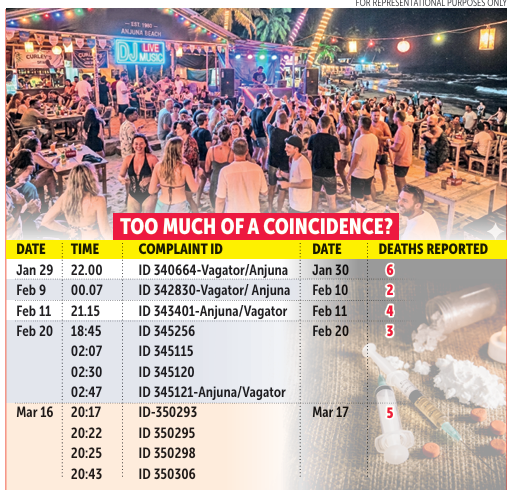
The RTI data shows that six narcotics-related deaths were reported across six police stations on January 30 alone, including two un der Anjuna police station limits. The previous night, at 10 pm, a complaint (ID No 340664) was lodged with emergency services re garding loud music alleged ly being played at multiple locations in Vagator. Similarly, two deaths were reported from Agacaim po lice station and one from Ponda police station on January 11. On January 10, emergency service 112 re ceived two complaints (ID Nos 336516 and 336527) regarding loud music at a location in Vagator. Again, on January 15, two deaths were reported from Mandrem police station. The following day, fatalities were recorded under Fatorda, Old Goa and Pernem police sta tions. Records show that on the night preceding these deaths, complaints regarding loud music were lodged with emergency services through calls bearing ID Nos. 337577 and 337440. Police officials caution against drawing simplistic con clusions from the geographical spread of the fatalities. “Youngsters and tourists staying all over Goa attend these parties and therefore deaths reported at different police stations are not surprising.
A fatality can occur any where after drugs are consumed,” stated a senior officer of Goa police whilst trying to explain deaths due to narcotics reported from police stations all over Goa. Medical experts point instead to an increasingly danger ous drug supply chain in which narcotics are allegedly be ing mixed with pharmaceutical substances. “The problem,” thinks Dr Fenton D’Souza, “is that a lot of spurious stuff is entering the market. Ecstasy, Cocaine, speed, even the so called blue pill is mixed with different pain killers bought over the counter and sold. Mixed with alcohol, the consequences are lethal.” That concern finds support in forensic evidence. According to officers familiar with investigations, sub stances such as Oxazepam, Tramadol and Pregabalin have surfaced repeatedly in toxicology reports. “There are cases reported where drugs like Oxazepam, Tramadol or Pregabalin have been detected through Ran dox reports. These drugs are mixed with narcotics and when taken with alcohol, give a quick high and many a times lead to death. Youngsters come to Goa because drugs are easily available,” said an officer from Hyderabad Nar cotics Enforcement Wing (H-NEW) on condition of ano nymity. A Randox toxicology report dated September 9, 2025, linked to a case registered at Anjuna police station, alleg edly found an 80 per cent concentration of Oxazepam in a victim’s system, far above the cut-off threshold of 10.
Five deaths were reported across five police stations on January 5. In four of those cases, forensic findings indicated the presence of Ethylglucuronide, a metabolite associated with alcohol consumption. In the fifth case, Tramadol was detected. “Ethylglucuronide is a broken down product of ethanol which get extricated in the urine for up to four days or eighty hours after alcohol is consumed. When mixed with pain killers, the highs vary and could lead to death,” stated a forensic doctor on condition of anonymity. “Excessive in take of alcohol is cause of death of many youth,” he added. The pattern continued into February. Four deaths were reported on February 11, followed by one on February 13 and another on February 14. Emergency service records show that on February 13, complaint ID No. 345115 was registered alleging loud music from several clubs in Vaga tor. “The police will want to hide the cause of deaths because they are answerable to their masters. One does not need to be a scientist to know that loud music that is played today can be enjoyed only after taking drugs,” alleges local resi dent Balbhim Malvankar. Malvankar also questioned what he described as incon sistent enforcement. “And fingers are not just against the police but other department too.
How come we have no lights at night but these places have electricity to play music till early morn ing when music is supposed to be stopped at 10 pm,” won ders Malvankar. For residents of Goa’s northern coastal belt, reports of overdoses have become disturbingly familiar. “Why is it that ambulances are kept near the scenes of most parties? Overdoses and collapses during parties are common. The lucky survive, the others find eternal rest,” explains activist Alex Noronha from Anjuna. The most startling cluster of deaths emerged during Car nival celebrations. Goa observed Carnival from March 14 to March 17, and RTI records show that nine narcotics-relat ed deaths were reported from nine different police stations on the final day of the festivities alone. Two of the deaths were due to overdose of ampheta mines; two were due to Fentanyl — O Heraldo report dated May 13, 2026, ‘Fentanyl linked deaths in Goa spark alarm’and other narcotics and four due to Ethylglucuronide.
Qualitative Randox findings also indicated elevated con centrations of methamphetamine, amphetamines and vari ous prescription painkillers. “When tourism was at its peak with foreigners around,” recollects Anna Fernandes from Anjuna, “there were par ties but few. They took drugs but the drugs they took, did not take lives. We are seeing a curse because the focus now is on money and not God.”