SHASHWAT GUPTA RAY
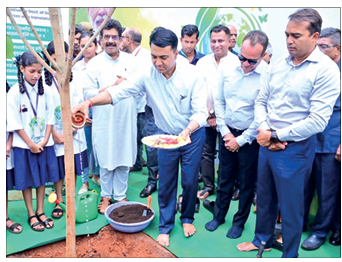
While Chief Minis ter Pramod Sawant marked World Environment Day by launching the Green NH66 Mission, involving large scale plantation activities along highway medians and roadside avenues from Patradevi to Galgibag, en vironmentalists criticised the initiative, labelling it a ‘greenwash’, citing low survival rates for roadside plantations and the ongoing felling of thousands of trees for state-approved mega infrastructure and develop mental projects. Rajendra Kerkar, environ mentalist said that while the government frequently undertakes these initia tives, they often appear to be more of a formality than a meaningful environmental effort. “A primary issue is the lack of focus on survival rates and the selection of appropriate species.

For instance, during road expansion, many ancient trees that provide essential shade are cut down. Despite assurances that these would be replaced with mango trees or other indigenous species, the PWD has failed to do so. Instead, we see a preference for ornamental or exotic plants, such as Australian Acacia, which provide neither shade nor food for local wildlife,” Kerkar told O HeraldO. Furthermore, he expressed significant concerns regard ing the utilisation of CAMPA (Compensatory Afforestation Fund Management and Planning Authority) funds. “Despite substantial deposits over the last decade, these funds have often been misused for departmental administrative costs rather than actual reforestation.
The consequences of these policies are evident in the inten sification of human-animal conflict. As indigenous food sources disappear, animals like the Gaur are increas ingly entering human settlements in search of fodder,” he said. The veteran ecologist urged the government to adopt a model similar to those seen in successful local initiatives or historical precedents, where preference is given to indige nous, shade-giving, and fruit-bearing trees. “Engaging local communities, schools, and self-help groups in these drives would ensure better survival rates and genuine environmental restoration,” he said. Director Goa Foundation, Claude Alvares, said that while the initiative is presented as an environmental effort, the lack of adequate planning and infrastructure suggests this is more of a ‘greenwash’ or ‘tamasha’ than a sustainable project. “Mass planting without a month of prior preparation— including securing water sources, organizing community involvement, and installing tree guards—will inevitably lead to the loss of these saplings.
Previous projects by the PWD and other departments have failed because they do not account for road expansion or long-term maintenance. Without protection from animals and regular watering, we are essentially witnessing a mass slaughter of trees,” Alva res said. He said that in contrast, the Goa Foundation has seen success in Mapusa by shifting the strategy to planting four year-old trees rather than young saplings. “This programme includes iron guards, a dedicated wa tering schedule, and a replacement plan to ensure a 100 percent survival rate. This success is due to the direct in volvement of NGOs and self-help groups, and also govern ment agencies like the PWD,” he said. Alvares added that the Goa Foundation will be conduct ing a formal evaluation of this 15 lakh-tree drive in Decem ber to assess the survival rate, and we will share those re sults with the public.
We believe the state should focus on credible, localised programmes involving the Biodiversity Board and local communities rather than uncoordinated mass plantings. Environment activist Ramesh Gauns said that the pre vailing narrative that large-scale tree plantation drives can offset the destruction of ancient forests is a dangerous fal lacy. “Forests are complex ecosystems that cannot be replaced by planting saplings, which often have a survival rate as low as 30 percent. While these symbolic gestures are publicised, thousands of acres are simultaneously being diverted for mega projects. For example, in Maharashtra, big hydroelectric projects are coming up on the Sahayadri mountain ranges across the Western Ghats, which will dire consequences even for Goa,” Gauns said. He said that the consequences of these actions are al ready visible and irreversible.
Mega-projects and increased construction lead to massive land sealing, preventing rain water percolation and depleting groundwater levels. Goa is facing a drastic drinking water crisis as a direct result. “The Forest Department has already attributed recent fire outbreaks in Goa’s wildlife sanctuaries to climate change. We are seeing the effects of environmental deg radation in real-time. We must move beyond “bluffing” with roadside plantations and address the root causes of environmental loss. This requires an immediate halt to mega-projects that desertify our natural landscape and a serious study into the long-term effects of construction on groundwater recharging,” he said.