Despite a statuto ry mandate reserving four percent of government jobs for per sons with disabilities (PwDs), govern ment de partments in Goa have made little effort to ensure compliance, according to the Disability Rights Association of Goa (DRAG), which on Monday accused authorities of sys tematically failing one of the state’s most vulnerable communities. “We are deeply con cerned by the lack of data maintained by the Direc torate of Education and the Directorate of Em powerment of Persons with Disabilities regard ing employment figures,” DRAG president Avelino de Sa said. “With approximately 1,000 schools in Goa, the mandatory four percent reservation should account for 1,600 positions.
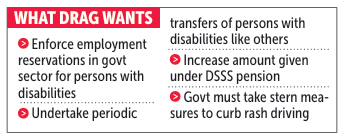
However, we estimate fewer than 200 persons with disabilities are currently em ployed in this sector.” The absence of official employment data, activists say, has made it nearly impossible to assess the scale of non-compliance or hold departments accountable for unfilled reserved posts. Calling for immediate corrective meas ures, de Sa urged the government to en force existing provisions requiring depart ments to disclose employment statistics and vacancy backlogs. “We request immediate enforcement of the law requiring all departments to file annual reports detailing their employment statistics and vacancy backlogs,” he said.

The association also questioned the government’s increasing reliance on contractual and outsourced recruitment mechanisms, alleging that such arrange ments are being used to sidestep statuto ry reservation requirements. Pointing to the Goa Human Resource Development Corporation (GHRDC), de Sa claimed that around 2,700 personnel are employed through the corporation with out reservation norms being implemented. “We question why the government utilises a Special Purpose Vehicle (SPV), rather than employing these individuals directly, which would ensure statutory res ervations are met,” he said. “Furthermore, recent contractual recruitments by the Goa Labour Welfare Society have also failed to include vacancies for persons with disabil ities.” The criticism comes amid growing concerns among disability rights groups that reservation policies are being under mined not through legislative changes but through administrative practices that keep large sections of public employment out side the ambit of regular recruitment.
Beyond employment, DRAG accused the government of neglecting several long-pending issues affecting the disabled community. De Sa pointed to the government’s fail ure to act on a 2024 directive issued by the State Disability Commissioner recom mending a threefold increase in the month ly pension provided under the Dayanand Social Security Scheme (DSSS). “The current monthly pension of Rs 2,000 is insufficient, given the rising cost of living, including increases in fuel and gas prices,” he said. “Despite a 2024 order from the State Disability Commissioner to increase this amount to Rs 6,000 for the 12,000 eligible PwDs, no action has been taken.” The association also raised concerns over what it described as inconsistent ad ministrative practices within disability-re lated institutions, seeking uniform transfer policies for employees with disabilities. “We request that the government apply the same mandatory transfer policies to PwDs as it does with other staff across all departments, to ensure transparency and administrative health,” De Sa said.
DRAG further linked disability welfare to broader public policy failures, highlighting the increasing number of road accidents resulting in death and permanent disabil ity. “We advocate for stricter enforcement against drunk and reckless driving, the in stallation of speed breakers on highways, and more rigorous checks on rental vehicle agencies,” De Sa said, while also calling for the revival of a voluntary Traffic Sentinel Scheme to enable citizens to report traffic violations.