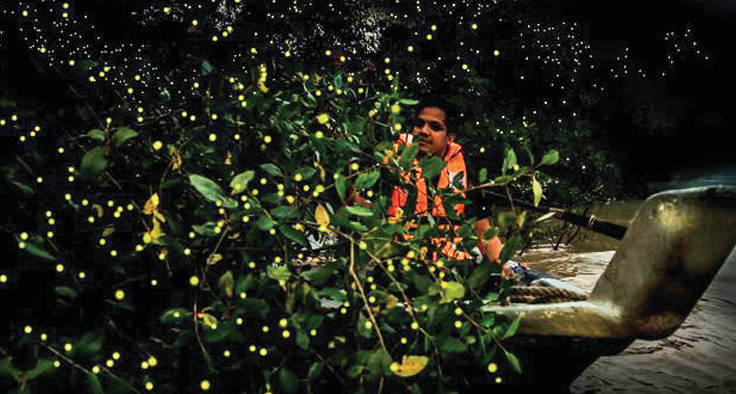
Fireflies also known as lightning bugs are actually beetles. Most fireflies have wings, which sets them apart from other light-producing insects in the same family, known as glow-worms. There are around 2,000 species of fireflies; the adult fireflies mainly feeding on pollen and nectar, whereas their larvae eat worms, snails and other insects. They use their light to communicate and find mates. The light usually comes from special organs under their abdomen that take in oxygen and, inside certain cells, combine it with a substance called luciferin to produce light with almost no heat. This bioluminescence lights up the tip of their abdomen. During late May to mid-June is when they breed, they put on elaborate courtship displays during this period. Each firefly species has its own unique flashing pattern, trying to attract potential mates.
IS THERE A DECLINE? Watching fireflies flickering with the subtle scent of petrichor in the evening air during the light rains foreshadowing the downpour season, has become a less common experience these days. “Firefly population have declined especially in the urban landscape. We used to see many fireflies in the cities and towns too especially during pre-monsoon. We no longer see them or they have become very rare, which says that their numbers have declined.” says Omkar Dharwadkar, a naturalist, wildlife photographer and a wildlife tour operator, based in Vasco. Rapid urbanisation, habitat loss and the biggest culprit to the decline of the lighting bugs is increased artificial night light, which masks their bioluminescent mating signals preventing them from reproducing. “Main reason for their decline is likely the bigger and brighter lights, also green spaces around cities have reduced considerably, overall habitat degradation. Expanding urban areas bring more light to otherwise darker areas which are not favourable to fireflies,” mentions Omkar.

VITAL ECOLOGICAL INDICATORS
“A decline in firefly populations can be a warning sign of broader environmental degradation, much like the decline of other charismatic species. Decline in the firefly population indicates loss of habitat quality such as hydrology, soil moisture and leaf litter. It also points to light pollution and chemical usage. They may be telling us that our landscapes are becoming brighter, drier, more fragmented, more chemically intensive, and less capable of supporting biodiversity as a whole” says Parag Rangnekar, a naturalist from
Vasco. “Firefly larvae are predators and help control populations of pests like snails, slugs, and other worms. In adult stage they are pollinators and pollinate several flowers. In larval and adult stage they serve as prey to a number of other creatures. They also serve as bio-indicators, their presence symbolising a healthy ecosystem.” explains Omkar. “Conserving fireflies also helps conserve an entire community of less visible nocturnal biodiversity,” adds Parag
COMING GENERATIONS MAY NEVER KNOW THIS GLOW
Watching swarms of fireflies at monsoon nights must be a deeply nostalgic memory for many older locals, chasing after them with mason jars or trying to catch them in cupped hands. The newer generation seems to be missing out on something so simple yet magical. “When we used to go to the village, my mother’s house used to be surrounded by the jungle, we used to see small fireflies and that time we didn’t have big, bright lights, so we could see them easily and we would try to catch them every-time we saw them,” recalls Nayana Shetty, a 58-year old resident from Panjim. Many kids today may never know what it feels like to stand in the dark, surrounded by hundreds of these glowing insects, or to cup one in their hands and watch its light pulse against their skin before letting it go.
HOW DO WE HELP?
There hasn’t been any active conservation conducted to save the lighting bugs. They exist in a blind spot, too small to be charismatic, too common to seem endangered, often poorly understood to trigger alarm. The research gap is real. There is no baseline population data for most Indian firefly species. Parag points out meaningful changes public can implement by general public. “The first thing that anyone can do is to get educated about fireflies and their role in the eco system since knowledge is the first step to conservation. The second simple step is to reduce excessive lighting around our homes, especially during the pre-monsoon season. Switch off outdoors lights in the night, use warm lights instead of bright LEDs, avoid decorative lights on trees, point lights downwards with a shade etc. Avoid use of chemicals in the gardens, practice responsible firefly watching without shining torches directly at the fireflies, keep on designated paths and avoid trampling.”