SHASHWAT GUPTA RAY
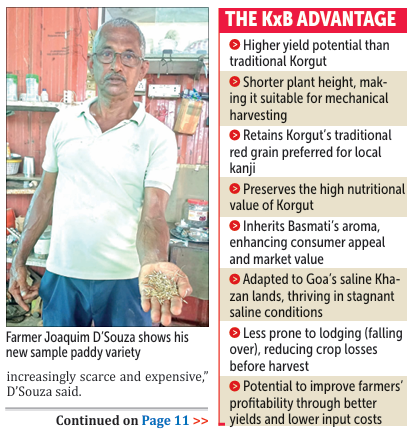
Faced with the twin chal lenges of low farm mechanisation due to the tall stature of traditional paddy varieties and relatively low yields, former Deputy Director of Agriculture-turned-farmer Joaquim D’Souza has cross-bred two locally grown paddy varieties — Korgut and Basmati — to develop a new experimental variety aimed at deliv ering higher yields, improved nutri tional value and compatibility with mechanical harvesting. “Drawing on my 33 years of experience with the Agriculture Department, my post-retirement goal is to support the farming community by addressing a major challenge associated with Korgut. While this variety is well-suited to our Khazan lands, its height causes the crop to lodge, making mechan ical harvesting impossible. This creates a heavy dependence on manual labour, which has become increasingly scarce and expensive,” D’Souza said.

To address this, he has undertaken a cross-breeding pro ject using Korgut as the female parent and Basmati as the male parent to develop a shorter, more resilient variety. “My primary objectives for this new generation are to en able mechanical harvesting and reduce labour costs, retain the traditional red colour and nutritional value preferred for local kanji, and incorporate the aromatic qualities of Basmati to enhance its market value. Additionally, I am focused on maintaining the high-yielding potential of the hybrid while ensuring the crop can thrive in the stagnant saline conditions of Khazan lands,” he said. The former Deputy Director of the Agriculture Depart ment said he has successfully grown the new-generation paddy in his initial trials. “Although it typically takes six to seven years to fully de velop and stabilise a new variety, these early results are very encouraging. I am currently stabilising the seeds and protecting the samples from adverse weather and pests in preparation for larger demonstration trials,” the senior farmer said. If successful, the new variety — currently referred to as KxB — could eventually replace existing varieties, offering Goa’s paddy farmers a more profitable, labour-efficient and mechanisation-friendly alternative. “I haven’t given this new variety a name yet.
At present, I am conducting more field trials. Since it is the result of crossing Korgut and Basmati, I am referring to it as ‘KxB’. It is not intended for commercial sale. Once the field trials are successfully completed, I will distribute it to farmers who are willing to adopt the new variety,” he said.