The fix is on. As always. But even the corrupt, craven and notoriously pliant FIFA cannot script everything that happens on the field in the open glare of the World Cup, so players and teams often find ways to tell their own wonderful stories. That infinite edge of possibility gives all sport its power to create unforgettable moments, which can erupt into paradigm shifts in the collective global consciousness. That happened at the 1936 Berlin Olympics, which Hitler and the Nazis explicitly intended to be their ultimate propaganda tool for asserting supposed “Aryan” supremacy. Instead, the heroic African-American track and field star Jesse Owens put the lie to their bigotry, by dominating the sprints and long jump and taking home four gold medals.
Just now, with huge historic significance, it seems like something similar is underway on US soil (although Canada and Mexico are also each hosting 13 World Cup matches) where President Trump and his viciously anti-Muslim, anti-Black and anti-immigrant MAGA cohort are seeing their racism and xenophobia repudiated in real time. Of course, inequality and unfairness aren’t going anywhere soon either, as we saw play out especially cruelly (and predictably) with Iran, the first country to play in the World Cup while being subjected to bombardment by the host. Their team was already under high duress by the time they got on to the field, after FIFA caved to US demands they couldn’t stay even one night after games, but had to fly back to base camp in Mexico.

Even after that, they played with such grit and grace it took an extremely controversial VAR decision (crooked might be the more appropriate word) to end their tournament. “What these young people, these players have done, it should be written in history because the host country treated us very unfairly,” said Amir Ghalenoi, the dignified coach, “despite all of these problems, we’ve been able to perform well and the world is proud of Iranians and our team. I urge FIFA, don’t let hosts treat players and teams the same way in future World Cups.”
Immediately afterwards, amply proving the Iranian’s point, the American official in charge of Homeland Security exulted that “I’m just glad they’re done, and they’re not coming back, I was so happy when we were able to pull their visas and said they could leave US soil, and I might have sung a song or two, or maybe danced a happy dance.” If he did, Markwayne Mullins danced alone, because the rest of us have been lit up with joy by the beautiful game being played by teams and players that represent the opposite of the Trumpist world view.
There are immigrants galore at this World Cup, more foreign-born players than previous editions, almost a quarter of 1248 total. Muslim excellence (and religious expression) has been ubiquitous, from Spain’s 18-year-old quicksilver genius Yamine Lamal’s sujood after his first Cup goal, to the regular grateful prostrations by the Egyptians while edging Australia out on Friday night.
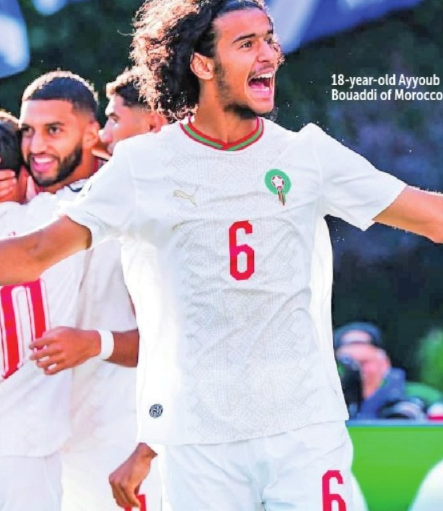
Above all, Africa and African talent has run rampant throughout, whether representing diasporic locations around the world or the “sh**hole countries” the American president continually derides. It is no secret that football is inextricably linked to colonialism, both in terms of the spread of the game as well as the host of players from colonised backgrounds representing the countries of their former colonisers. For just one obvious example, the dominant French team at this Cup – up to now there is no team that looks capable of beating them – has 21 players of African descent out of 26.
However, the really big difference in 2026 has come after FIFA grudgingly opened up direct slots for Africa to 9 (by contrast Europe gets 16) and after an additional team qualified, 9 out of those 10 advanced. Everyone can see the immediate improvement in the quality of play, along with style and drama aplenty, all good for the Cup, but even better for the world.
Everyone can see the immediate improvement in the quality of play, along with style and drama aplenty, all good for the Cup, but even better for the world.
Earlier this week, Gerard Akindes wrote a useful essay about the globalisation of African football on the excellent website africaisacountry.com. He writes that “today, the majority of players on Africa’s most successful national teams—except South Africa and Egypt—play outside the continent. Increasingly, they are dual citizens, European-born, raised and trained in Europe, highlighting an additional challenge.”
But then, “in a fascinating reversal, the 2010s saw a ‘reverse muscle drain.’ Second- and third-generation African immigrants born in France (Riyad Mahrez, Algeria), England (Victor Moses, Nigeria), or the Netherlands (Hakim Ziyech, Morocco) began representing their ancestral nations. Morocco’s 2022 World Cup semifinal run was powered by a team mostly born and trained in Europe.”
Akindes says “The story of African football is one of structural irony. Born in colonial resistance, sharpened through the anti-apartheid struggle and the fight for World Cup representation, and matured through World Cup heroics, it has finally achieved global recognition. Yet that recognition has come at a fundamental price. The commodity logic of global football has reduced many local leagues to ghost events and turned millions of African children’s dreams into speculative assets for agents and academies. The success of Morocco’s and Senegal’s academies and diaspora proves African talent is world class, but it also shows that players must leave Africa to make a good living and become stars. When European-born dual citizens choose to represent their ancestral nations, they bring joy to Africans everywhere—a genuine pan-African achievement. But it also exposes a complex and uncomfortable reality: The continent’s domestic football infrastructure and governance are decaying even as its exported stars shine weekly through the world sports media complex.”
His conclusion is important to remember as this World Cup illuminated by African brilliance heads to its crescendo: “If the game is to truly serve the continent, the goal cannot be merely to export talent, produce a commercial AFCON every two years—soon every four—or win prestigious matches at the World Cup. The goal must be to build the local ecosystem: to ensure a child in Kano or Kinshasa can grow up to be a professional in their own country, earn a dignified wage, play in a full stadium, and watch their league in prime time. Until then, the global visibility of African stars will remain just that—a reflection of individual brilliance extracted from a system that cannot yet sustain it. World Cup successes bring real continental pride. But can the achievements of a handful of stars and national teams truly speak to the lives of 1.5 billion Africans, let alone offer a path forward for the hundreds of millions of young players polishing their skills on any open patch of ground they can find?”
(Vivek Menezes is a writer and co-founder of the Goa Arts and Literature Festival)