ANIL KUMAR MISHRA
World Nature Conservation Day, ob served globally on July 28 every year, is meant to celebrate efforts to protect and restore the environment. In Goa, however, it raises an un comfortable question – where are the 10 lakh trees the government promised to plant? Fifty-three days into the Goa government’s 90 day tree-planting sprint, there is still no clarity on how many saplings have actually been planted. As the September 5 dead line for the State’s ‘Green Goa, Clean Goa’ campaign draws closer, the only official figure available remains 3,200 saplings planted on World Environ ment Day, June 5, when the campaign was launched — and silence ever since.

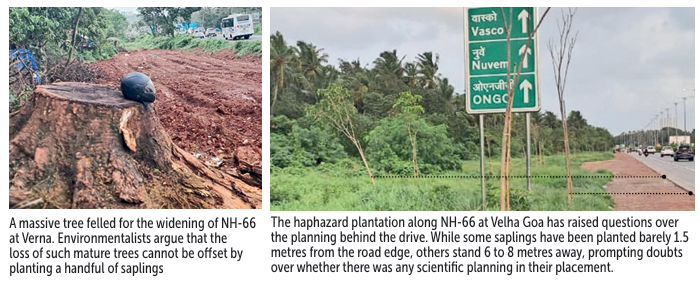
No update, no interim tally toward the 10 lakh trees Chief Minister Pramod Sawant promised, despite inquiries made with different departments and agencies, including the Public Works Department (PWD) and the Forest De partment. Just the assurance by a senior PWD official, that the system is being tracked. “Planting trees is easy, but sus taining and maintaining them is the real challenge. That is why every tree being planted will be geo-tagged so that we know exactly where it is and can monitor its condition after one year and beyond,” the official said. The plantation drive’s centrepiece is the Green NH-66 Mission, meant to turn the Patradevi-to-Canacona stretch into a green corridor. But the government’s own account of its progress reveals a campaign running into the two obsta cles it apparently didn’t plan for — land and trees. On land, the official claimed the State simply doesn’t have enough of it. “The biggest problem is finding land to plant trees. We are now planning to approach private land owners, requesting them to provide land. We will plant the trees for them, while they will be responsible for maintain ing them. If they are fruit-bearing trees, they can also enjoythe produce,” the official said. North Goa, where the land crunch bites hardest, is faring worse than the South, and even roadside plantations aren’t friction-free. “People sometimes object even when trees are planted close to the boundaries of their fields.
That is one reason why several trees have been planted along roadsides,” the official said. On trees, Goa, it turns out, cannot supply its own green ing. Saplings have been trucked in from Karnataka, and full grown trees hauled from Rajahmundry in Andhra Pradesh, “because such planting material is not readily available in Goa,” the official conceded. What’s actually being planted here hasn’t fared much better under scrutiny. Environmental experts flagged a recent plantation along the narrow median of the Old Goa Bypass, where Peepal saplings were packed close together on a high-speed highway divider — a species choice horti culturist Daniel D’Souza called a hazard by design. “First of all, the Peepal grows into a very large tree.
In the future, if such a tree falls, it could endanger lives. Secondly, its fruits are small figs, and when they fall on the road, they can make the surface extremely slippery,” D’Souza said. He didn’t stop at species selection. “My appeal to those who have undertaken this drive is to plant suitable tree species. These saplings have not been planted properly. I can say with certainty that nearly 50 per cent of these trees will either die or topple because they have not been plant ed deep enough. They are unlikely to survive to maturity,” he said — a coin-flip failure rate, baked in from the start, on a project whose entire selling point is long-term survival. Avertino Miranda, Convenor of the Goa Green Brigade, sees the same carelessness running through the whole campaign, and a more damning backstory behind it. Before it was planting ten lakh trees, the PWD was failing to plant far fewer. “The PWD has miserably failed over the last ap proximately 10 to 15 years in undertaking the mandato ry compensatory tree planting and the backlog is almost 40,000 trees yet to be planted. Earlier, the PWD had even made a ridiculous proposal to take up the compensatory tree planting in neighbouring States, whereas the trees were butchered in Goa,” Miranda said. On the current drive itself: “Targets have been set to plant a certain number of trees, but there seems to be no proper planning about where they should be planted.
This is a waste of public money.” Environmental activist Abhijit Prabhudesai goes fur ther, framing the entire campaign as cover for the felling it doesn’t advertise. “Our Government massacres, or allow builders, miners, etc to massacre, crores of trees every year, most being unaccounted. Our Government changed the very definition of a tree so that smaller ones can now be freely massacred,” Prabhudesai said, pointing to what he calls a redefinition designed to let smaller trees fall outside protection entirely. On the saplings themselves, he cites the State’s own re cord: “Forest department records reveal 80% and more mortality in 5 years for saplings grown like this,” Prabhu desai said. His prescription is the opposite of everything the campaign is built on. “The correct way is to allow natu ral regeneration of trees and forests. Leave a patch of land alone, and the natural regeneration will do a proper job,” he added. Zarina da Cunha, of the Nuvem Biodiversity Committee, questions whether the arithmetic behind the announce ment was ever real to begin with. “How did the Chief Min ister conclude that so many trees could be planted in just 90 days? Are we expected to believe this is some kind of magic?” she asked, before pointing at the same supply problem the government itself admitted to. “Does the For est Department even have that many saplings? Is this not an ambitious announcement without adequate prepara tion, foresight, or careful planning? Is it merely a statement designed to impress rather than deliver?” she questioned. Her sharpest question is the one the government has yet to answer, on record or otherwise. “The public also de serves to know how many trees have been cut down over the last ten years,” she asserted.
Ninety days was always the wrong yardstick. The real one is the 40,000-tree compensatory backlog the PWD has carried for over a decade, the 80% mortality rate on its own past plantings, and a fresh batch of Peepal saplings already given a coin-flip’s chance of surviving the highway median they were planted in. Geo-tagging a dying tree does not make it a living one. It only ensures the government will know exactly where to find the stump.