Dolcy D’Cruz
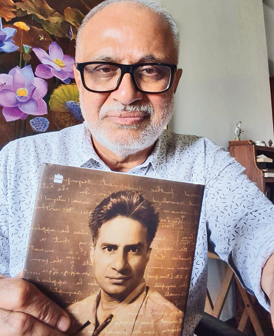
“The JNU library had purchased about 4,000 books from his estate. A few years after he died, his wife and daughters sold all his books, and those books formed the nucleus of the JNU Library.” Ram’s biography, which is around 300 pages long and has 16 chapters, draws extensively from family archives. It includes several photographs that have not previously been made public, including the photograph used on the cover, which comes from the family album. “I’ve tried to make it a book that will reach the average reader, so you don’t have to be either a historian or a mathematician. Anyone who is interested in his life can read it,” says Ram. The book also devotes three chapters to Kosambi’s father, Dharmanand Kosambi, because, according to Ram, understanding the father is essential to understanding the son. Ram’s research also explored questions surrounding Kosambi’s birthplace. “If you look at Wikipedia, it says that he was born in some town called Kosben. I have searched high and low, but I can’t find Kosben. However, I located his mother’s house. His mother came from a large family in Chicalim in Bardez. Kosambi was born in that house,” he says. The house still exists, and relatives have confirmed that all the children were born there. Dharmanand Kosambi, however, was born in Sancoale. Ram also met some of Dharmanand’s relatives in the region, though the family house in Sancoale has since been given to a spiritual organisation. Among the intriguing discoveries during his research was the story of 26 silver coins donated by Kosambi to the Fogg Museum at Harvard University during his senior year. The coins, which were Mughal coins, later disappeared after being stolen. “While doing this research, I suddenly came across a letter thanking him for the donation of 26 coins. I can only speculate because the information is very scant. All I know is that he had the coins and gave them to the museum,” says Ram. The origin of the coins remains unknown. He adds, “His family was not wealthy. If they had bought them, I don’t think Kosambi would have simply given them away like that. It remains a mystery how he got the coins, and then he donated them.” Kosambi was one of the earliest members of the Tata Institute of Fundamental Research (TIFR) in Bombay, where he joined the faculty in 1945 as the second person appointed after Homi Bhabha. Kosambi’s contributions to differential geometry and the study of random functions remain part of mathematical literature, although his mathematical reputation suffered considerably by the time he left TIFR in 1962. Kosambi’s mathematical career also contained controversy, particularly regarding his claim to have solved the famous Riemann Hypothesis, one of mathematics’ greatest unsolved problems. “The Riemann Hypothesis was proposed more than 150 years ago, but even today, no one has managed to prove it. He claimed that he had proved it. He wrote what he believed was the proof and sent it to other mathematicians. Every mathematician told him that it is wrong. But he simply refused to accept their criticism. Finally, he published it in a journal. Once you publish something in a journal, everyone can comment on it. The hypothesis remains unproven to this day. It is still one of the most famous problems in mathematics. Kosambi never apologized for his claim, and it was bringing disrepute to the Tata Institute,” he explains. The episode damaged his standing among mathematicians, and Ram believes it reflected the complexity of Kosambi’s personality. Kosambi’s decision to live in Poona and commute daily to Bombay while working at TIFR was another example of his unusual choices. The reason, Ram explains, “It sounds very nice to say that he lived in Poona and went to Bombay every day while working at the Tata Institute of Fundamental Research but it takes three hours each way. One can’t help feeling bad that a person of such great gifts wasted so much of his time. The simple reason was that he had built this house in Poona, which he had designed himself along with his father. He couldn’t find a similar place to live in Bombay. Everyone who saw that house told me it was beautiful. It has since been demolished, and apartment buildings have been constructed there instead.” What did Ram learn about Kosambi after years of research into his life? “He was an interesting person, and he still speaks to today’s generation because he addressed issues such as academic freedom. He believed in the importance of having the freedom to choose what you study and to pursue whatever intellectual interests you have. That kind of freedom, he felt, should exist. He also believed that you should be able to argue against authority, no matter how powerful that authority is. For example, when he advocated solar energy, he was implicitly criticizing Nehru’s policies. He was going against the Atomic Energy Commission and, therefore, against the Department of Atomic Energy, which Nehru had created. He was willing to challenge all of this. He would write about it openly in the newspapers. I think people should know about him. After all, how many scientists write in newspapers? And he didn’t always write about science in newspapers. He used them to engage with the public on a wide range of issues. There are so many aspects of him that remain very contemporary, and I think there is a lot to learn from him. He would have spoken out for freedom and peace,” says Ram. Kosambi’s unusual background also shaped his worldview. Unlike many people from the subcontinent, he received his schooling in America, not just his higher education. As a Goan under Portuguese rule, he travelled on Portuguese passports and did not see himself as a British colonial subject. “He had the privilege of saying, ‘I’m Portuguese.’ He was not a Portuguese subject. I think this shaped his way of thinking and his outlook on life,” says Ram. More than six decades after his death, Kosambi, whose 119th birth anniversary will be celebrated today, July 31, with the release of this book, remains a figure whose ideas continue to provoke discussion. The book will be discussed by a panel comprising Vivek Monteiro, vice president of the Centre of Indian Trade Unions (CITU), Maharashtra, who holds a doctorate in theoretical and mathematical physics from Stony Brook University; Parag Parobo, associate professor of history at the DD Kosambi School of Social Sciences and Behavioural Studies, Goa University; and Kaustubh Naik, doctoral candidate at the Department of South Asia Studies, University of Pennsylvania. The book will be available on sale at the book release as well as at The Dogears Bookshop, Margao and online on Amazon