Vivek Menezes
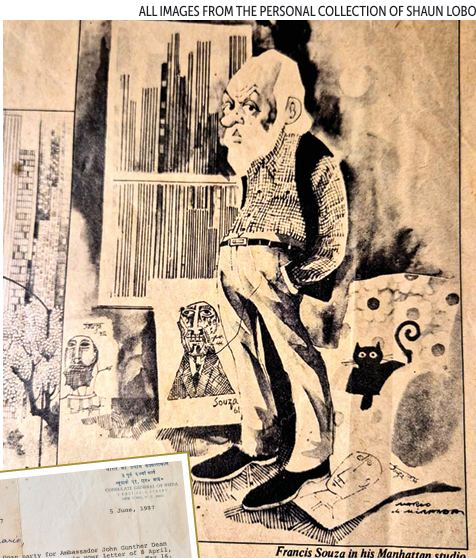
In the invaluable archive of Mario Miranda’s artworks being safeguarded and intermittently showcased by Shaun Lobo (whose late father Ronnie was a close friend of the artist) I was delighted to find a letter from the Consulate General of India in New York dated 5th June 1987. The old-fashioned air mail correspondence is addressed warmly to “my dear Mario” by Alan Nazareth, our consul at that time, and reports the great success of “a Goan party” for John Gunther Dean, the US Ambassador to India, hosted at the Taj Group’s pioneering Raga Restaurant at Rockefeller Centre. Nazareth tells Miranda the gathering ‘which you had proposed to me” had proved “a most enjoyable luncheon party” with “successful socializing” between luminaries like the great modernist painter Francis Newton Souza, the opera singers Richard Kness and Joan Grillo, “former Governor B.K. Nehru, Shri L. K. Jha, M.P., Ambassador Gharekhan, industrialists Rahul Bajaj and Shri. B.K. Thapar.” He said “we are now eagerly looking forward to your visit and exhibition here.

Please let us know your plans as early as possible.” This letter has several revealing and counter intuitive aspects, and it is also meaningful in a very personal way because I witnessed that party and its enduring socio-cultural ripples across the still-fledgling desi scene in New York at a time when India was still effectively unknown in the American imagination. Just like Ronnie Lobo (who passed away in 2017), my own father (who turned 85 earlier this week) was a Taj executive from the 1970s into the 21st century, as it mushroomed from a less than a handful of properties to sprawling multinational conglomerate. Nazareth wrote to Miranda “the party was organized by the joint efforts of Lenny Menezes and myself. As you undoubtedly know [he] represents the Taj Group of Hotels in New York and the Raga Restaurant is owned by them and had no difficulty in providing a full Goan menu, as a number of the cooks in the restaurant are Goans!” All this – everything Nazareth describes about the 1987 Goan gala in NY – was so outré for the moment, so far ahead of its times, that it needs to be contextualised properly. Back then there were less than 500,000 Indians scattered across the USA (by comparison there are at least 12 times as many today, with another 500000 likely illegals alone). Economic liberalisation back home was still years down the road, so every Indian in America was painfully aware there were several corporations with bigger budgets than the whole of India, with that of General Motors famously more than double in size. Almost no Americans knew anything about our food, and even fewer had ever heard about Goa, which is why the Raga party was an eye-opening landmark event.
The late, great Chef Floyd Cardoz told me posh Manhattan clients would keep describing what they had eaten there 20 years earlier, beseeching him to reproduce their memories, and I vividly recall Souza’s eyes shining when he recalled “the first real prawn curry” he tasted there after decades. Above all, the letter shows us the hidden colossus that was the real Mario, the hugely significant cultural icon whose formidable many-faceted legacy has been sadly diminished, distorted, ineptly pigeon-holed and woefully provincialized over the past 15 years. No contemporary Indian artist has ever been plagiarised more, with the worst culprits right here in his own state (and quite often by the government itself), while the deadly slur of “cartoonist” remains perpetually attached, so all the cash flow generated by the merchandise operations in his name has still done nothing for his artistic reputation. Meanwhile, utterly disgracefully, we keep on bleating Goa, Goa, Goa as though the old Aldeia was the sum total of his life experience, and there’s an equally wrong and ridiculous push to portray this explicitly modern Indian artist as some kind of antediluvian Portuguese. It’s sad and silly, he never even used the “de” in his name throughout his career!
This ongoing painful situation has made Mario’s birth centenary distinctly bittersweet – the heavily touted “people’s artist” has been thoroughly let down by his own people – but that is also why it is imperative to return to the original works, and revisit the actual facts. It has to be properly understood that you cannot even begin to get to grips with this great creative life without looking way beyond Goa. To his birthplace, because the experience of slow time in colonial Daman is key to understanding how his unique, archival and affectionate style came into being. Then to the breezy precincts of South Bombay, where he was embraced by lifelong friends like Behram “Busybee” Contractor, and his wonderful drawings and illustrations became beloved and ubiquitous, eventually becoming the defining body of visuals about self-consciously “modern” India.” After that, outwards, as he became an early Indian cultural ambassador to France, Germany, Portugal, the USA and Israel (plus many other countries) who came back home with densely packed sketchbooks to profoundly shape our ideas and attitudes to the world.
That globetrotting icon is the real Mario Miranda, fully capable of remote-controlling that brilliant party in New York in 1987, and not just some “cartoonist” but an eminent soft power strength of the country. In my opinion, it is quite merciful he is not around to witness the silly, fraudulent, nativist drivel being posthumously retrofitted into his legacy in Goa, because what was already happening in his lifetime was bad enough. I very well recall how Mario and Habiba were hurt by the situation, and particularly upset about the non-stop exploitation, while never getting his due as the Indian art world began to kick itself into gear to become the billion-dollar marketplace that it now is. Mario was too much the gentleman to complain in public, but we can and must feel every ounce of regret on his behalf, while noting the situation has still not improved, and we have to do better. To that end, I have requested Shaun for permission to print the two rarities you can see on this page.
One is an excellent line drawing of Francis Newton Souza, and old friend (actually the GenZ term “frenemy” would fit better) from the 1950s onwards, who is depicted with great verisimilitude exactly as he was in his later hermit like years in his apartment near Lincoln Centre in New York City. This is one great Goan artist portraying another, but also reminds us that Mario’s art was and still is unfairly excluded from the gallery system that churns millions of dollars for his peers. I do believe there is hope on that front, because we have seen Angelo da Fonseca leap from obscurity into the art historical canon posthumously over the past two decades, and it is quite likely to happen with Mario as well.
Also very interesting is the lovely little sketch – I guess it was done spontaneously “from life” – showing an Opinion Poll rally from 1963, when Goa rejected merger with Maharashtra to set our path in the direction of statehood. Here is politics, sharp editorialising, very modern aspirations, a much better way to understand our Mario.